
On this page
Your needs, this model
Does it fit your priorities?
Do you want the EDX 10x50’s combination of 10x magnification and 50 mm objectives?
The exact U.S. page identifies BU-BEN1050 as a fixed 10x50 configuration; matching is by model SKU and published geometry, not an independent optical test.
Explore this need in the finder →Does the EDX 10x50’s 340-foot scene and 5 mm exit pupil justify the larger body, or would the wider 8x42 field suit you better?
The manufacturer table gives both 10x42 and 10x50 340 ft at 1,000 yd, while the 8x42 lists 426 ft. The 10x50 has a larger geometric exit pupil than the 10x42, but that alone is not a brightness guarantee. Choose the exact 10x50 format or prefer 8x42 for the broader field.
Explore this need in the finder →Does the 10x50 meet strict eye-relief or close-focus limits when manufacturer values disagree?
The current page and shared model table conflict on one or more strict values. Unknown eye-relief, carry mass, or close-focus fields do not pass an essential numeric threshold; choose this profile only if the reconciled configuration supports the requested limit. Tripod compatibility is documented, but adapter-in-box is not.
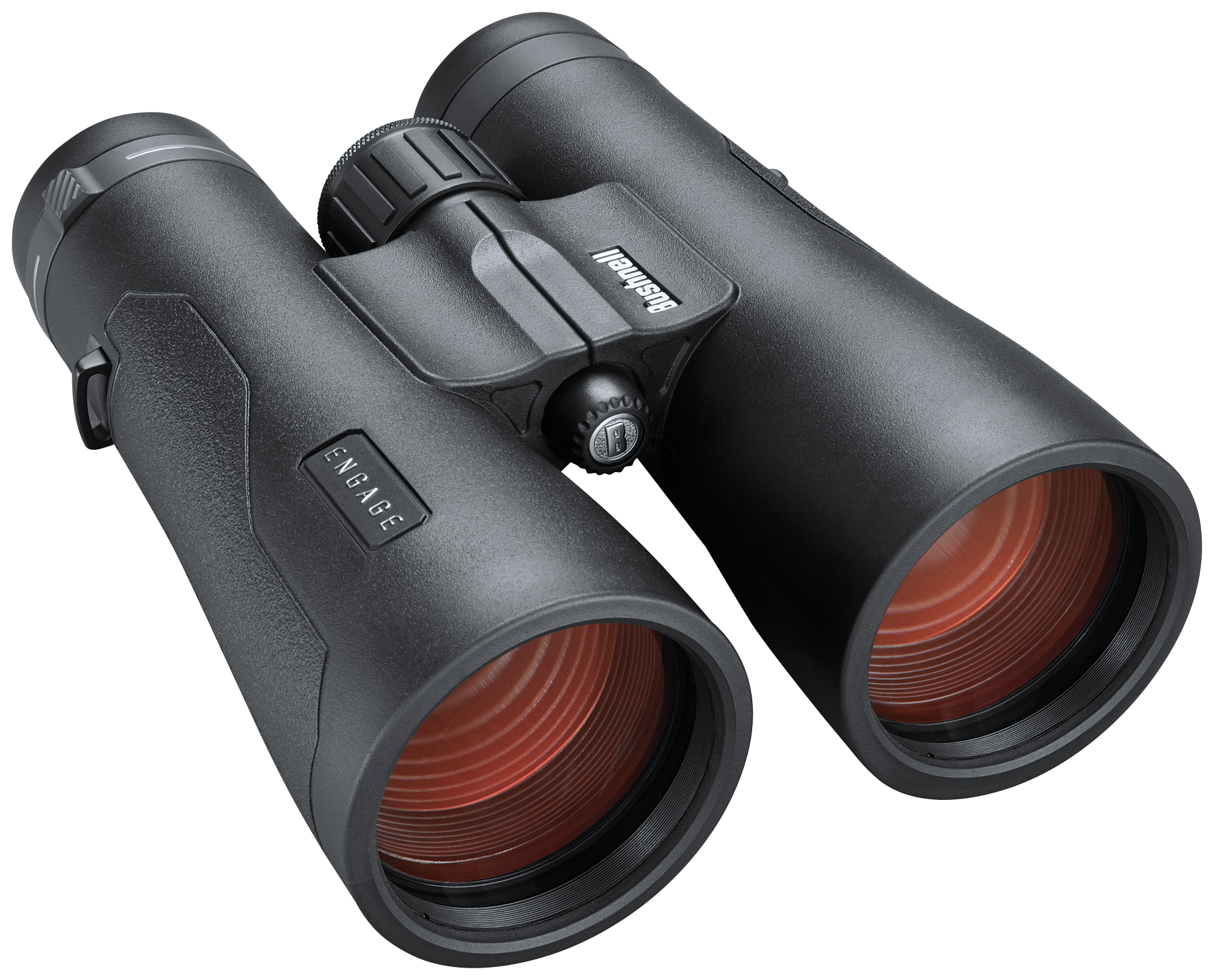
Explore this need in the finder →The Bushnell Engage EDX 10x50 combines ten-power magnification with 50 mm objectives. It keeps the 10x power of the smaller EDX 10x42 but adds objective diameter, yielding a listed 5 mm exit pupil; in exchange, the published body grows to 6.5 inches and 29.2 ounces. This is a source-based comparison of exact product ID BU-BEN1050, not a field test.
The middle ground between compact size and long reach
Among the four EDX choices, the 10x50 preserves a ten-power view while using the larger 50 mm objective format. Its manual-listed field is 340 feet at 1,000 yards, the same published width as the 10x42. The 10x50’s 5 mm exit pupil is larger than the 10x42’s 4.2 mm, a geometric consequence of the larger objective at equal magnification. That may be one consideration for dusk or open-sky observation, but it is not a measured brightness score and cannot promise an advantage for every viewer. The model is not a pocket binocular: it is listed at 29.2 ounces and 6.5 inches long.
The 12x50 is the other large-objective choice. It raises power, but its manual field narrows to 280 feet at 1,000 yards and its 4.1 mm exit pupil is smaller than the 10x50’s. If you want a wider scene or a more forgiving subject search, the 10x50 is the more sensible starting point in that pair. If your subjects are typically distant and you can hold or support the instrument steadily, compare the 12x50—but do not assume the largest magnification is automatically the most usable.
EDX coatings are stated features, not measured results
Bushnell’s exact product page lists a roof prism system, BaK-4 glass, ED Prime glass, PC3 phase correction, dielectric prism coatings, Ultra Wide Band coating, EXO Barrier, twist-up eyecups, a locking diopter, argon gas purging and IPX7 water resistance. Its EDX description also names a magnesium chassis. The shared Engage guide marks BEN1050 as one of the ED Prime and locking-diopter models, lists the same 10x50 geometry and describes setup, tripod use and cleaning. These are useful differentiators when comparing an EDX with a less expensive configuration; they do not prove a particular resolution, color fringe level, transmission figure in real use or durability outcome.
The page and manual agree on the 10x50’s listed field width (340 feet), 5 mm exit pupil, 15 mm manual eye relief, 10-foot close-focus table value, 6.5-inch length and 29.2-ounce weight. One notable exception is eye relief: the current page says 16.9 mm, while the 2020 guide’s exact BEN1050 row says 15 mm. Since glasses fit can depend on eyecup position and face shape as well as the published number, this mismatch should remain unresolved. The strict profile does not claim that either number alone meets an essential minimum. Generic page copy also repeats a 6.5-foot close-focus claim, while the model-specific page field and manual table say 10 feet; the conservative matcher leaves that field unknown rather than silently choosing the more convenient figure.
Make the support plan realistic
The manual shows a covered tripod socket and calls for a compatible 90-degree binocular adapter—Bushnell #161002CM is named as an example—to mount the binocular horizontally. A tripod can help with long, stationary viewing, especially when you are deliberately using higher magnification, but the manual does not make it part of the normal viewing setup. Tripod-adaptable does not mean a tripod or adapter has been confirmed in the box. The captured sources do not settle adapter package inclusion, so check the contents with the seller before relying on it.
For adjustment, set the hinge until the two image circles merge, then focus the left barrel and correct the right with the diopter ring. BEN-prefix rings lock after they are pulled up to unlock. With glasses, the guide says to lower the twist-up eyecups; test whether your frames still show the full circle. The page’s 16.9 mm and manual’s 15 mm values make a practical try-on preferable to an online threshold.
Weather protection needs the same measured reading. Bushnell lists IPX7 and argon purging; the guide describes water exposure up to the rating and fog protection. Neither claim is a reason to point the optics at the Sun or to assume underwater operation. Brush dust away before wiping the glass, and do not use paper towels or household window cleaner on coated surfaces.
Who should compare this model?
Choose the EDX 10x50 as a candidate if you want 10x magnification, a 50 mm objective and the wider of the two 50 mm EDX manual fields. It makes less sense if your top requirement is light carry; compare the EDX 10x42’s 5.5-inch form, but note its current page/manual weight conflict. The EDX 8x42 is the broad-scene option, while the EDX 12x50 is the higher-power option with a narrower field. For any decision that depends on eye relief, close-focus distance or included mounting hardware, confirm the exact product variation and package with Bushnell. At capture, this page showed an Add to Bag offer, but stock, current price and retailer terms can change. No independent optical testing was performed.
Sources: Bushnell’s exact EDX 10x50 product page, the Engage collection, and the manufacturer’s Engage owner guide (English pages 2–4; table includes BEN1050). The linked original image has a clean, transparent product presentation; Bushnell does not say whether it is a photograph or rendering or provide reuse terms.
Key specifications
Key details at a glance
| Magnification | 10× |
|---|---|
| Objective diameter | 50 mm |
| Real field of view | 6.49° |
| Field width at 1,000 m | 113 m |
| Exit pupil | 5 mm |
| Manufacturer-published weight | 29.2 oz |
More specifications and setup details
| ED glass confirmed for this exact model | Yes |
|---|---|
| Phase coatings confirmed | Yes |
| Locking diopter ring confirmed | Yes |
| Lens and prism coatings | Exact product page lists ED Prime, dielectric and PC3 phase coatings, Ultra Wide Band and EXO Barrier. Shared 12-20 guide defines FMC, dielectric, PC3 and Ultra Wide Band; these are maker statements, not independent performance measurements. |
| Water and fog protection | Current exact page lists IPX7 and argon purge; shared manual describes exposure up to IPX7, dry-gas fog protection and EXO Barrier. Do not infer underwater use or scratch-proof lenses. |
| Tripod use | Manual describes a covered 1/4-20 socket and a compatible separate 90-degree binocular adapter (Bushnell #161002CM is an example). Adapter and tripod package inclusion are not confirmed in captured sources. |
| Published weight note | Exact page and shared model table agree at this captured revision. |
| Manufacturer-rated waterproof | Yes |
| Built-in image stabilization confirmed | No |
| Integrated laser rangefinder | No |
| Onboard ballistic solution display | No |
| Direct 1/4-20 tripod thread confirmed | Yes |
Use the exact model’s instructions for operating limits, supplied equipment and version differences.
Sources for this review
Sources for this assessment
- Bushnell Outdoors Engage EDX 10x50; exact U.S. product ID BU-BEN1050; Add to Bag/available in capture
- Bushnell Engage Binocular Owner’s Guide, 12-20; shared manual names exact BEN842/BEN1042/BEN1050/BEN1250 SKUs
- Bushnell Outdoors Engage collection; exact EDX configuration card linked to U.S. product page
- Exact product-page-linked original image for BU BU-BEN1050; retrieved status 200

Choose your optical trade-off first.
Choose viewing purpose first, then magnification, objective size, scene width and any fit, weather or mounting constraint. A direct-Sun requirement is separate: only exact manufacturer-confirmed solar binoculars can pass it.