
On this page
Your needs, this model
Does it fit your priorities?
Is the EDX 10x42 power and 42 mm objective combination your preferred ordinary configuration?
The exact U.S. page identifies BU-BEN1042 as a fixed 10x42 configuration; matching is by model SKU and published geometry, not an independent optical test.
Explore this need in the finder →Does the EDX 10x42’s 340-foot scene and 10x reach suit you, or is the wider 8x42 scene more useful?
Bushnell lists 340 ft at 1,000 yd for this 10x42 and 426 ft for the 8x42; the angle figures are derived from manufacturer field widths. Choose the 10x42 power/objective configuration for its particular tradeoff, or select 8x42 when the broader scanning view matters more.
Explore this need in the finder →Can its page/manual conflicts on eye relief, mass and close focus satisfy your essential fit limits?
The current page and shared model table conflict on one or more strict values. Unknown eye-relief, carry mass, or close-focus fields do not pass an essential numeric threshold; choose this profile only if the reconciled configuration supports the requested limit. Tripod compatibility is documented, but adapter-in-box is not.
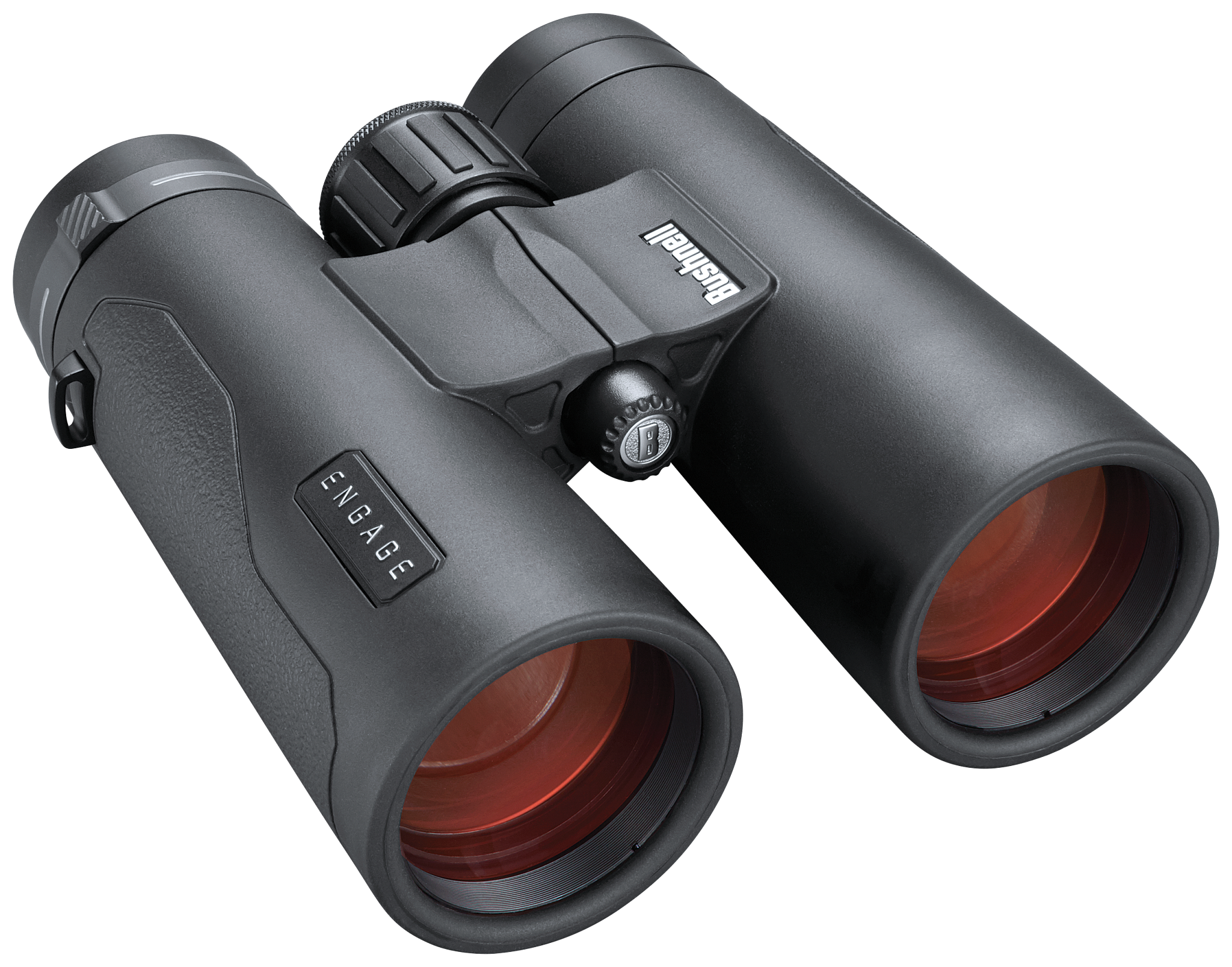
Explore this need in the finder →The Bushnell Engage EDX 10x42 is the compact full-size middle of this EDX group: ten-power magnification, 42 mm objectives, and a manufacturer-listed 340-foot field at 1,000 yards. Its useful distinction from the 8x42 is more apparent enlargement, not a wider scene. This assessment is limited to Bushnell’s current BU-BEN1042 page and the shared guide’s BEN1042 entry; it is not a hands-on test.
More reach in the same stated length
If a bird or animal is usually farther away than a backyard feeder, ten power can make its details occupy more of your view than the 8x42. That extra scale is the reason to choose this model over the EDX 8x42. It comes with the matching cost: Bushnell lists 340 feet at 1,000 yards rather than 426 feet for the 8x42. The narrower real scene can take more care to scan and reacquire when an animal moves. Both 42 mm variants share a 5.5-inch published length, but the 10x42 does not necessarily have the same weight as the sibling—the current page and older guide disagree on that point.
The 4.2 mm exit pupil is the simple ratio of 42 mm objectives to 10x power. It is smaller than the 8x42’s 5.3 mm and larger than the 12x50’s 4.1 mm. Use it to understand the geometry, not to predict a person’s perceived brightness: eye placement, ambient light, coatings and individual pupils all matter, and no independent light transmission or image-quality measurements are offered here.
A family feature set with exact-model caveats
The current page identifies product ID BU-BEN1042 and lists ED Prime glass, BaK-4 roof prisms, PC3 phase coating, dielectric prism coating, Ultra Wide Band coating, EXO Barrier, argon purging, IPX7 water resistance, twist-up eyecups, locking diopter and tripod adaptability. The 2020 Engage guide includes the matching manual SKU BEN1042, and describes a center focus wheel, a covered 1/4-20 tripod socket and a separate compatible 90-degree binocular adapter. It names Bushnell adapter #161002CM as one example. The captured sources do not establish whether an adapter is supplied with this configuration, so do not treat tripod-compatible as adapter-in-the-box.
Several page/manual differences are material if you are screening for exact fit. The current page lists 16 mm eye relief; the BEN1042 row in the guide says 15 mm. The page gives a weight of 25.2 ounces, compared with 23.5 ounces in the guide. Both list a 5.5-inch length. Close focus is less settled still: the exact-page specification says 7 feet, generic product copy says 6.5 feet, and the shared manual gives 8 feet. I have not picked a winner. The profile therefore does not hard-match a minimum eye-relief, close-focus, or maximum-weight requirement. Unknown is safer than promising glasses fit or carry weight from one isolated line.
Start with eyecups, hinge and diopter
The owner guide gives a practical setup sequence: first set the hinge to your interpupillary distance until the two views merge; then cover one objective and focus the opposite barrel with the center wheel; cover the other side and adjust the right diopter ring for your own eye. The BEN ring can be raised to unlock and lowered to lock after adjustment. The guide says to lower eyecups for glasses and raise them when viewing without glasses. These are meaningful ownership details: the eye-relief conflict does not prevent trying the binocular, but it does mean that a web number alone should not settle whether your own frames show the full circle.
ED glass and prism coatings are product specifications, not evidence that this model resolves a particular bird mark or stays bright at dusk. Similarly, the page’s IPX7 and argon-purged claims describe environmental construction rather than an invitation to submerge the instrument. The manual says it is built to withstand water exposure up to the rated standard; the captured sources do not establish an underwater operating purpose. EXO Barrier can help keep exterior lens surfaces clear of water, oil, dust and debris, but grit still needs to be blown or brushed away before cleaning.
Who should choose the 10x42?
Start with this configuration if more magnification than the 8x42 matters and you want the smaller 42 mm body rather than the 50 mm EDX models. Choose the EDX 8x42 instead when the broader 426-foot field and lower power align better with scanning. Compare the 10x50 if your priority is a 5 mm exit pupil and a 340-foot field, but it is listed as 6.5 inches long and 29.2 ounces. The 12x50 has still more nominal magnification but a narrower 280-foot manual field; it is the reach-oriented option, not the broad-scanning one.
For this 10x42, the exact magnification, objective size, field width, ED features, and tripod adaptation can guide a shortlist. If your essential condition is a precise eye relief, weight, or close-focus cutoff, ask Bushnell to reconcile the page and guide before using it as a hard pass/fail. The page showed an Add to Bag offer at capture; check current stock, package contents and warranty terms with the seller. Never look toward the Sun through the optics.
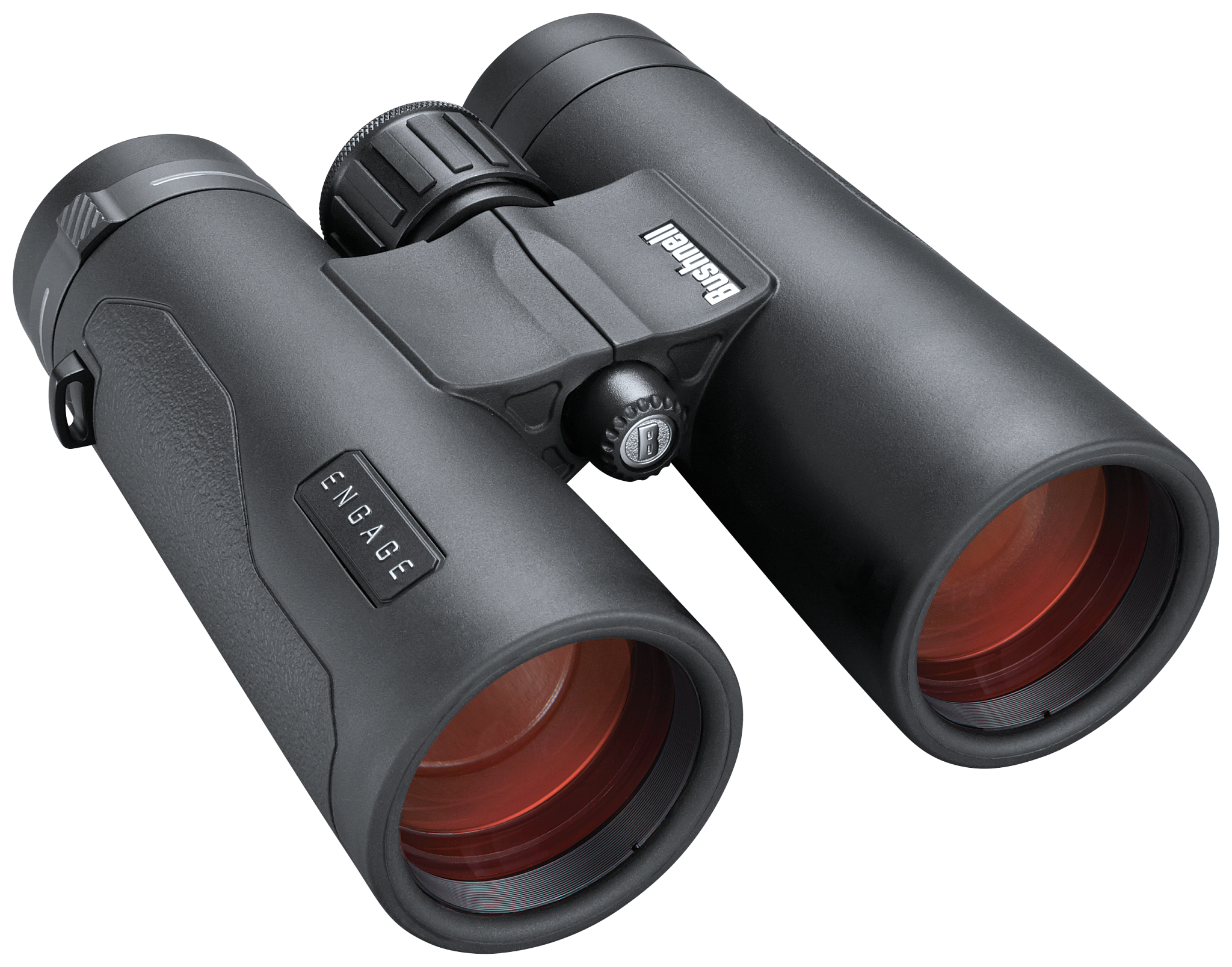
Sources: Bushnell’s exact EDX 10x42 product page, the Engage collection, and its Engage owner guide (English pages 2–4; table includes BEN1042). The exact page’s transparent-background image is associated by the manufacturer page link; it shares identical image bytes with the EDX 8x42 page. Image production method and reuse rights are undisclosed.
Key specifications
Key details at a glance
| Magnification | 10× |
|---|---|
| Objective diameter | 42 mm |
| Real field of view | 6.49° |
| Field width at 1,000 m | 113 m |
| Exit pupil | 4.2 mm |
| ED glass confirmed for this exact model | Yes |
More specifications and setup details
| Phase coatings confirmed | Yes |
|---|---|
| Locking diopter ring confirmed | Yes |
| Lens and prism coatings | Exact product page lists ED Prime, dielectric and PC3 phase coatings, Ultra Wide Band and EXO Barrier. Shared 12-20 guide defines FMC, dielectric, PC3 and Ultra Wide Band; these are maker statements, not independent performance measurements. |
| Water and fog protection | Current exact page lists IPX7 and argon purge; shared manual describes exposure up to IPX7, dry-gas fog protection and EXO Barrier. Do not infer underwater use or scratch-proof lenses. |
| Tripod use | Manual describes a covered 1/4-20 socket and a compatible separate 90-degree binocular adapter (Bushnell #161002CM is an example). Adapter and tripod package inclusion are not confirmed in captured sources. |
| Published weight note | Page/manual weights disagree; no strict carry cutoff is applied. |
| Manufacturer-rated waterproof | Yes |
| Built-in image stabilization confirmed | No |
| Integrated laser rangefinder | No |
| Onboard ballistic solution display | No |
| Direct 1/4-20 tripod thread confirmed | Yes |
Use the exact model’s instructions for operating limits, supplied equipment and version differences.
Sources for this review
Sources for this assessment
- Bushnell Outdoors Engage EDX 10x42; exact U.S. product ID BU-BEN1042; Add to Bag/available in capture
- Bushnell Engage Binocular Owner’s Guide, 12-20; shared manual names exact BEN842/BEN1042/BEN1050/BEN1250 SKUs
- Bushnell Outdoors Engage collection; exact EDX configuration card linked to U.S. product page
- Exact product-page-linked original image for BU BU-BEN1042; retrieved status 200
Choose your optical trade-off first.
Choose viewing purpose first, then magnification, objective size, scene width and any fit, weather or mounting constraint. A direct-Sun requirement is separate: only exact manufacturer-confirmed solar binoculars can pass it.