
On this page
Your needs, this model
Does it fit your priorities?
Does the 8x42 meet a wide-real-field need?
Yes. The exact product page and sheet publish 7.1 degrees and 371 ft at 1,000 yd, above the finder’s 6-degree boundary.
Explore this need in the finder →Does the published eye-relief figure clear a 17.5 mm minimum?
The exact page and sheet both list 17.9 mm, which clears 17.5 mm; individual glasses fit still depends on face/frame position.
Explore this need in the finder →Does the published 13.1-foot closest-focus distance meet a 14-foot maximum?
Yes; a strict 13-foot maximum does not accept the published 13.1 ft.
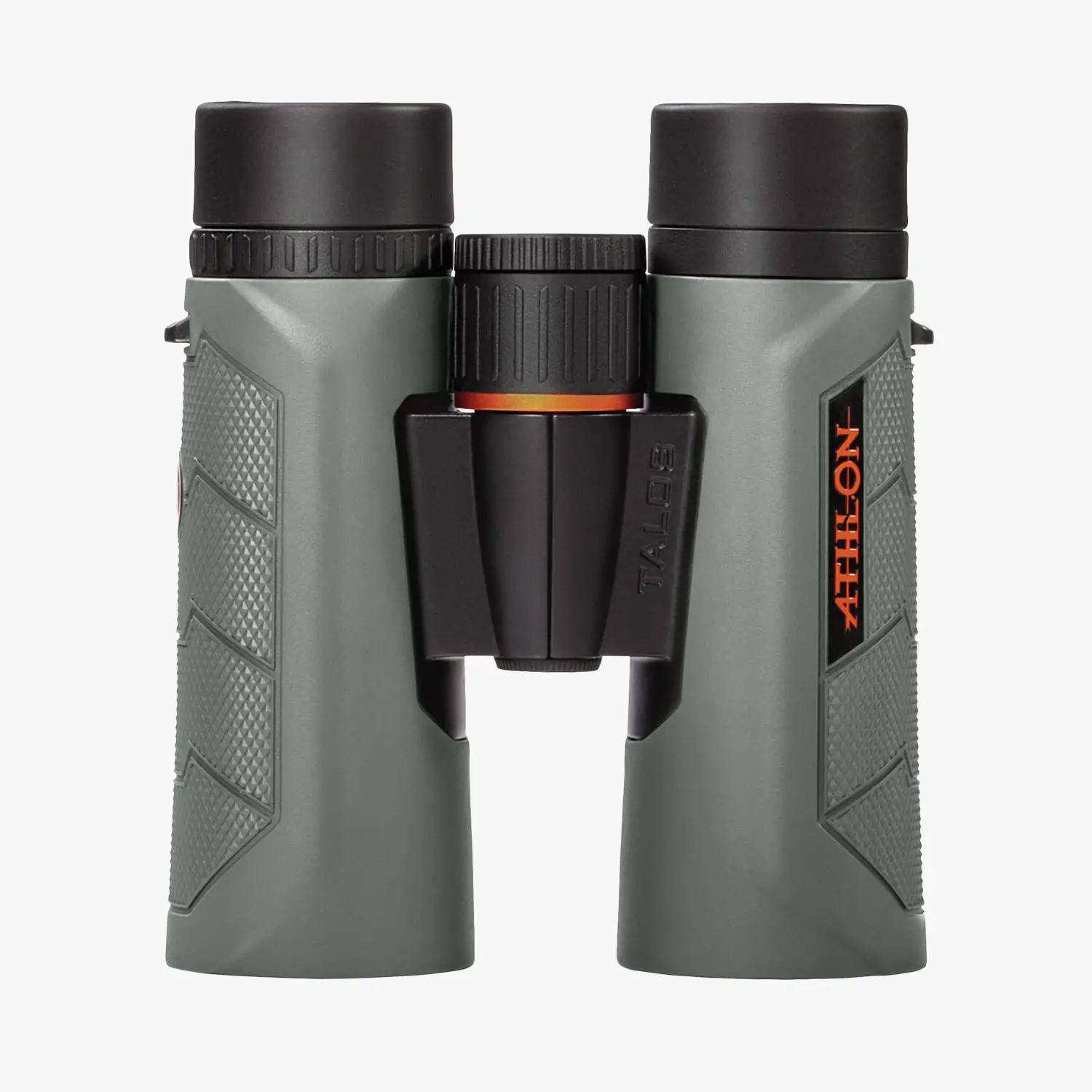
Explore this need in the finder →The Athlon Talos G2 HD 8x42 favors finding and following a subject over maximizing enlargement. Athlon lists a 7.1-degree real field, 371 feet at 1,000 yards, 17.9 mm eye relief and 20.8 ounces for the instrument. Its 10x42 sibling shows a narrower 319-foot scene at the same listed weight. The 8x42 is the more forgiving fixed-power starting point for general wildlife scanning, but its model-number conflict and one-millimeter interpupillary discrepancy should be visible before a shopper relies on an ID or fit cutoff.
Wide framing is the real reason to choose the 8x42
Eight power leaves more of the scene visible than the Talos 10x42. Athlon’s 8x model lists 371 feet at 1,000 yards and a 7.1-degree real field; the 10x42 lists 319 feet and 6.1 degrees. The difference helps when you are sweeping tree lines, reacquiring a moving bird, or watching several animals without keeping every target centered. It is a framing advantage, not a claim that the 8x42 resolves more detail or is optically brighter. The manufacturer pages do not publish a lab comparison between the two powers.
Both Talos configurations use 42 mm objectives, weigh 20.8 ounces in the product sheets and share a 13.1-foot closest-focus distance. The 8x42 therefore is not the lighter, smaller-objective member. It trades some enlargement for a broader scene and longer stated eye relief. If you usually watch a stationary animal at distance, the 10x42 provides more apparent size without an instrument-weight penalty. For general walks, movement and quick scene-finding, 8x makes that trade easier to justify.
Eye relief and interpupillary fit
The product-specific sheet and exact page both list 17.9 mm eye relief for the 8x42, a longer published figure than the 10x42’s 16.1 mm. That can be a useful screening point for eyeglass wearers, but it is not a guarantee that every frame will show the full field. Athlon’s shared manual says to lower the twist-up eyecups for glasses and use an intermediate stop if that gives the best view. Try the exact model with your usual glasses if full-field access is essential.
One fit value does conflict: the 8x42 page and category table give a 56–76 mm interpupillary range, while its individual sheet gives 56–77 mm. The minimum agrees; the upper endpoint does not. We leave the hard-match maximum unknown rather than selecting the wider number. If your eye spacing is near the upper limit, physically check whether the barrels align into one unshaded circle before relying on this model.
Athlon lists dimensions of 5.7 by 5 inches and 13.1 feet of close focus. The closest-focus figure is not suited to nearby butterflies or tabletop observation. The dimensions are a body-size reference, not a packed-system measurement. The 20.8-ounce listing is for the instrument; the product sheet separately gives package weight, which should not be mistaken for binocular mass.
Optical and weather claims in plain terms
Athlon identifies HD glass, advanced fully multi-coated lenses and BaK-4 prisms, and describes the line as waterproof and nitrogen-purged. These are manufacturer construction and protection claims, not independent test results. “HD” does not by itself establish an ED-glass designation, and the reviewed Talos materials do not provide an IP code, immersion depth or underwater-use condition. The 8x42 is an ordinary outdoor binocular; do not use the waterproof wording as a substitute for a stated immersion rating. The manual also explicitly warns against looking at the Sun with the instrument.
For first setup, the family manual’s sequence is useful: set the eyecups for your face, align the barrels until there is one full circle, then focus the left view with the center wheel and fine-tune the right eye with the diopter ring. Once set for your eyes, use the center focus wheel for ordinary distance changes. A standard 1/4-20 tripod-adapter socket is located beneath the logo plate at the center hinge. A compatible adapter is needed; neither the page nor the manual establishes that it is included in the retail package.
One identity detail remains unsettled
The category card and product page consistently name the 8x42 optical configuration, but their SKU fields do not agree with Athlon’s own individual sheet: the product page displays 115007, while the 8x42 sheet identifies SKU 115008. The 10x42 shows the reverse pairing. The product configuration is still clear from its title, power and objective, but the identifier is not. This assessment and its purchase search therefore use the exact “Talos G2 HD 8x42” model name rather than treating either SKU as settled. Do not use an ID suffix alone to distinguish a listing.
Choose the Talos G2 HD 8x42 if a broad real field and the longer 17.9 mm eye-relief specification suit your viewing better than the sibling’s extra power. Prefer the 10x42 for more enlargement at similar carry weight. Reconsider either model if exact SKU traceability, a particular IPD upper limit, an immersion rating or a verified ED-glass requirement is essential; those points are not all settled by the current manufacturer pages.
Manufacturer references: Talos G2 HD 8x42 product page, 8x42 specification sheet, and Talos G2 HD binocular manual.
Key specifications
Key details at a glance
| Magnification | 8× |
|---|---|
| Objective diameter | 42 mm |
| Real field of view | 7.1° |
| Field width at 1,000 m | 124 m |
| Eye relief | 17.9 mm |
| Close focus distance | 13.1 ft |
More specifications and setup details
| Manufacturer-published weight | 20.8 oz |
|---|---|
| Lens and prism coatings | The exact Talos sheet lists HD glass, advanced fully multi-coated lenses and BaK-4 prisms. It does not establish a distinct ED-glass designation, phase/dielectric coatings, or a measured performance comparison. |
| Water and fog protection | Athlon claims waterproof/fog-proof protection with nitrogen purge; no standardized ingress rating, immersion depth/duration, or underwater-use condition is published in the exact page/sheet. |
| Tripod use | The family manual confirms a standard 1/4-20 socket. A compatible adapter is required; package inclusion is unknown. |
| Published weight note | Exact model-specific specification sheet gives 20.8 oz instrument weight; the separate package weight is not instrument mass. |
| Manufacturer-rated waterproof | Yes |
| Integrated laser rangefinder | No |
| Onboard ballistic solution display | No |
| Direct 1/4-20 tripod thread confirmed | Yes |
Use the exact model’s instructions for operating limits, supplied equipment and version differences.
Sources for this review
Sources for this assessment
- Athlon U.S. binocular family index
- Athlon Talos G2 HD U.S. category
- Athlon Talos G2 HD 8x42 exact product page
- Athlon Talos G2 HD 8x42 product-specific specification sheet
- Athlon Talos G2 HD binocular user manual
- Athlon Talos G2 HD 8x42 page-linked manufacturer image
- CPSC public recall search (targeted Athlon Talos G2 HD name queries)

Choose your optical trade-off first.
Choose viewing purpose first, then magnification, objective size, scene width and any fit, weather or mounting constraint. A direct-Sun requirement is separate: only exact manufacturer-confirmed solar binoculars can pass it.