
On this page
Your needs, this model
Does it fit your priorities?
Does the 10x42 meet a fixed 10x need while retaining a broad real field?
Yes. The exact model is 10x42 and its 6.1-degree field clears the site’s 6-degree boundary; the 8x answer is a different power.
Explore this need in the finder →Does the published eye-relief figure clear a 16 mm minimum?
The exact page and sheet both list 16.1 mm, which clears 16 mm; individual glasses fit still depends on face/frame position.
Explore this need in the finder →Does the published 13.1-foot closest-focus distance meet a 14-foot maximum?
Yes; a strict 13-foot maximum does not accept the published 13.1 ft.
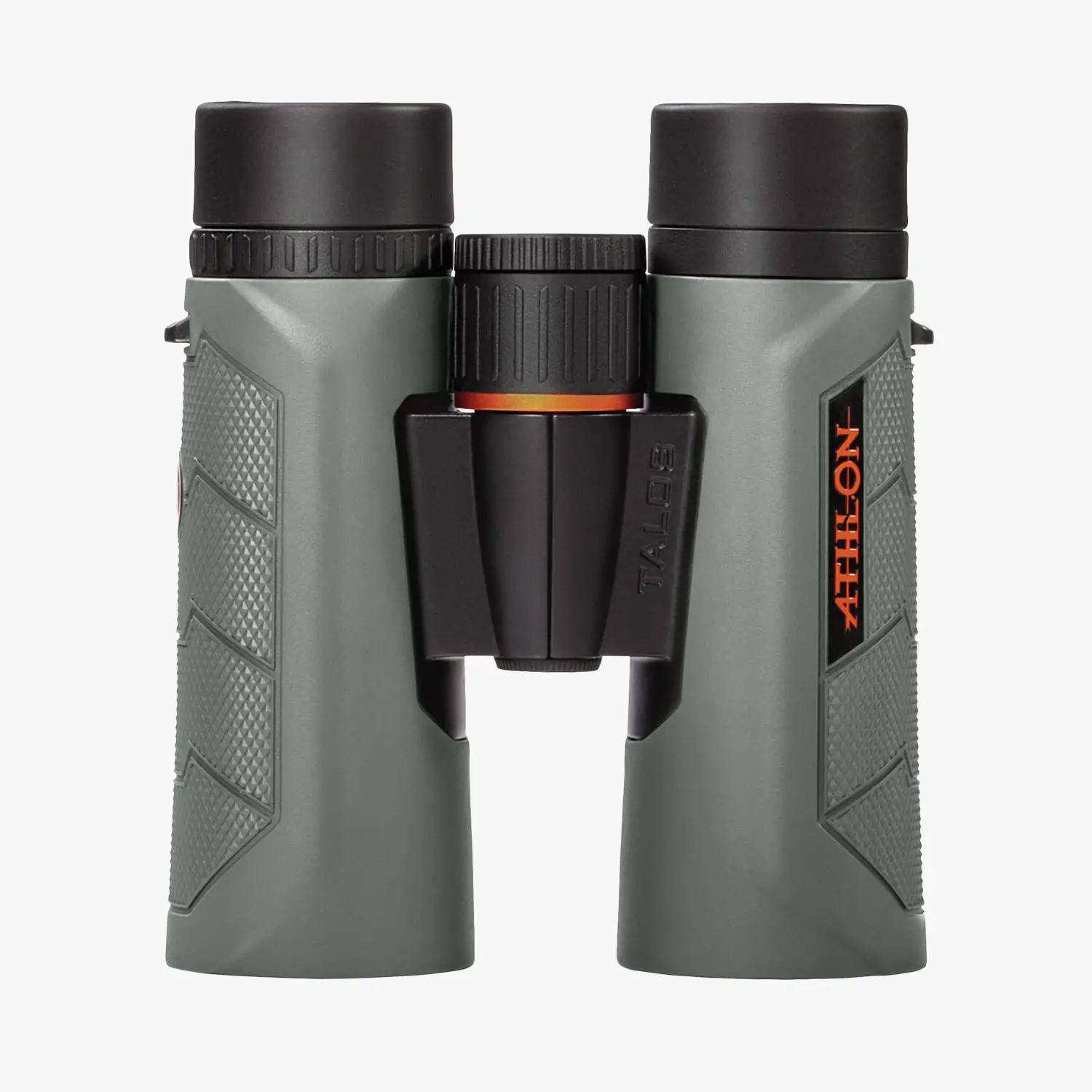
Explore this need in the finder →The Athlon Talos G2 HD 10x42 is the reach-oriented choice in this two-model 42 mm line. Its fixed 10x power, 6.1-degree real field and 319 feet at 1,000 yards give a distant subject more enlargement than the 8x42, while the product sheet lists the same 20.8-ounce instrument weight. The exchange is a narrower scene and slightly shorter eye relief. Choose it for stationary or slower subjects at distance, not simply because 10x is a bigger number.
What the higher power changes
The Talos 10x42 gives up 52 feet of field width at Athlon’s 1,000-yard reference compared with the 8x42: 319 feet rather than 371. Its real field is 6.1 degrees against 7.1 degrees. That still meets the finder’s broad-real-field boundary, but it is visibly narrower than the 8x model. For distant perched birds, animals across a clearing or details that are hard to resolve without approaching, the 10x view brings more enlargement. For a flock in motion or targets that disappear in brush, the smaller framing window can take more deliberate aiming to reacquire.
These two Talos versions have 42 mm objectives and the same published 20.8-ounce instrument weight, dimensions and 13.1-foot closest-focus distance. The 10x is not heavier in Athlon’s table. Higher magnification can make hand movement more noticeable, however, so try the power from your normal stance and for the length of time you expect to hold it. The manufacturer does not provide a side-by-side steadiness or resolution test. If ease of framing is more important than distant enlargement, the 8x42 is the simpler option.
Fit and close focus
Athlon lists 16.1 mm of eye relief for the 10x42 on both the exact page and the individual specification sheet, and a 56–76 mm interpupillary range. That is shorter than the 8x42’s 17.9 mm eye-relief figure, so glasses users have less published margin on paper. It still cannot guarantee that a particular frame or eyecup position will reveal the whole field. The manual says to turn the eyecups down for glasses and permits intermediate positions; if eye relief is essential, check the 10x42 through your own lenses before relying on a numeric screen.
The 13.1-foot closest-focus specification is the same as the 8x42’s. That distance is adequate for ordinary wildlife viewing but too far for very close feeder work, flowers at arm’s length or tabletop subjects. The stated body dimensions are 5.7 by 5 inches. Athlon’s 20.8-ounce figure is the instrument mass, not a packed kit; the product sheet separately labels package dimensions and weight.
Construction is not a substitute for testing
Athlon’s Talos G2 HD materials list HD glass, advanced fully multi-coated lenses and BaK-4 prisms; the family page also describes waterproofing and nitrogen purging. Those are maker descriptions, not measured comparative findings. The exact materials do not identify this configuration as ED glass, and they do not give a standardized water-ingress rating, immersion depth or duration. Treat “waterproof” and “fog-proof” as manufacturer claims, not as permission for underwater use or high-pressure rinsing. The manual’s solar warning applies here too: this is not a dedicated solar viewer.
Initial setup is ordinary center-focus binocular work. The shared Talos manual describes twisting eyecups up or down, setting interpupillary distance until a single full circle is visible, using the central wheel to focus the left side, and then setting the right-eye diopter. For a tripod, the manual confirms a standard 1/4-20 adapter socket under the center-hinge logo plate. A compatible adapter is required and its inclusion in the box is not established. Before cleaning, remove grit; use a soft lens brush or clean microfiber cloth rather than a dirty or rough fabric.
Verify the identifier, not just the magnification
The exact 10x42 product page says SKU 115008, but its product-specific sheet identifies the 10x42 as 115007. The 8x42 page and sheet reverse the same two numbers. The family category and exact page titles consistently show distinct 8x42 and 10x42 configurations, so the optical model is identifiable even though its SKU bridge is unresolved. For that reason, this review and the shopping query use the precise “Talos G2 HD 10x42” name; neither number is asserted as the settled identifier. Check the named configuration on the retailer page rather than relying on a trailing SKU alone.
Pick the Talos G2 HD 10x42 when extra enlargement for slower, distant subjects is worth a narrower view and the listed 16.1 mm eye relief works for you. Pick the 8x42 when scene-finding, a wider field and longer eye relief matter more, without a weight penalty. Neither is the right shortcut if your essentials include a verified manufacturer SKU, guaranteed eyeglass fit, a close-focus distance under 13.1 feet or a defined immersion rating. Those facts are either conflicting or not published in the reviewed materials.
Manufacturer references: Talos G2 HD 10x42 product page, 10x42 specification sheet, and Talos G2 HD binocular manual.
Key specifications
Key details at a glance
| Magnification | 10× |
|---|---|
| Objective diameter | 42 mm |
| Real field of view | 6.1° |
| Field width at 1,000 m | 106 m |
| Eye relief | 16.1 mm |
| Close focus distance | 13.1 ft |
More specifications and setup details
| Manufacturer-published weight | 20.8 oz |
|---|---|
| Lens and prism coatings | The exact Talos sheet lists HD glass, advanced fully multi-coated lenses and BaK-4 prisms. It does not establish a distinct ED-glass designation, phase/dielectric coatings, or a measured performance comparison. |
| Water and fog protection | Athlon claims waterproof/fog-proof protection with nitrogen purge; no standardized ingress rating, immersion depth/duration, or underwater-use condition is published in the exact page/sheet. |
| Tripod use | The family manual confirms a standard 1/4-20 socket. A compatible adapter is required; package inclusion is unknown. |
| Published weight note | Exact model-specific specification sheet gives 20.8 oz instrument weight; the separate package weight is not instrument mass. |
| Manufacturer-rated waterproof | Yes |
| Integrated laser rangefinder | No |
| Onboard ballistic solution display | No |
| Direct 1/4-20 tripod thread confirmed | Yes |
Use the exact model’s instructions for operating limits, supplied equipment and version differences.
Sources for this review
Sources for this assessment
- Athlon U.S. binocular family index
- Athlon Talos G2 HD U.S. category
- Athlon Talos G2 HD 10x42 exact product page
- Athlon Talos G2 HD 10x42 product-specific specification sheet
- Athlon Talos G2 HD binocular user manual
- Athlon Talos G2 HD 10x42 page-linked manufacturer image
- CPSC public recall search (targeted Athlon Talos G2 HD name queries)

Choose your optical trade-off first.
Choose viewing purpose first, then magnification, objective size, scene width and any fit, weather or mounting constraint. A direct-Sun requirement is separate: only exact manufacturer-confirmed solar binoculars can pass it.