
On this page
Your needs, this model
Does it fit your priorities?
Does the fixed 8x42 meet a broad-scene need?
Yes. Athlon identifies a fixed 8x42 and publishes a 7-degree real field (367 ft at 1,000 yd), above the finder’s 6-degree broad-scene threshold.
Explore this need in the finder →Does the stated 21-ounce instrument weight meet a 22-ounce carry ceiling?
Yes for the instrument-only figure. A 20-ounce ceiling is stricter than the manufacturer’s 21-ounce listing.
Explore this need in the finder →Does the published 13.1-foot close focus fit a 14-foot maximum?
Yes at 13.1 ft; a stricter 13-foot maximum does not accept the published 13.1-ft minimum-focus distance.
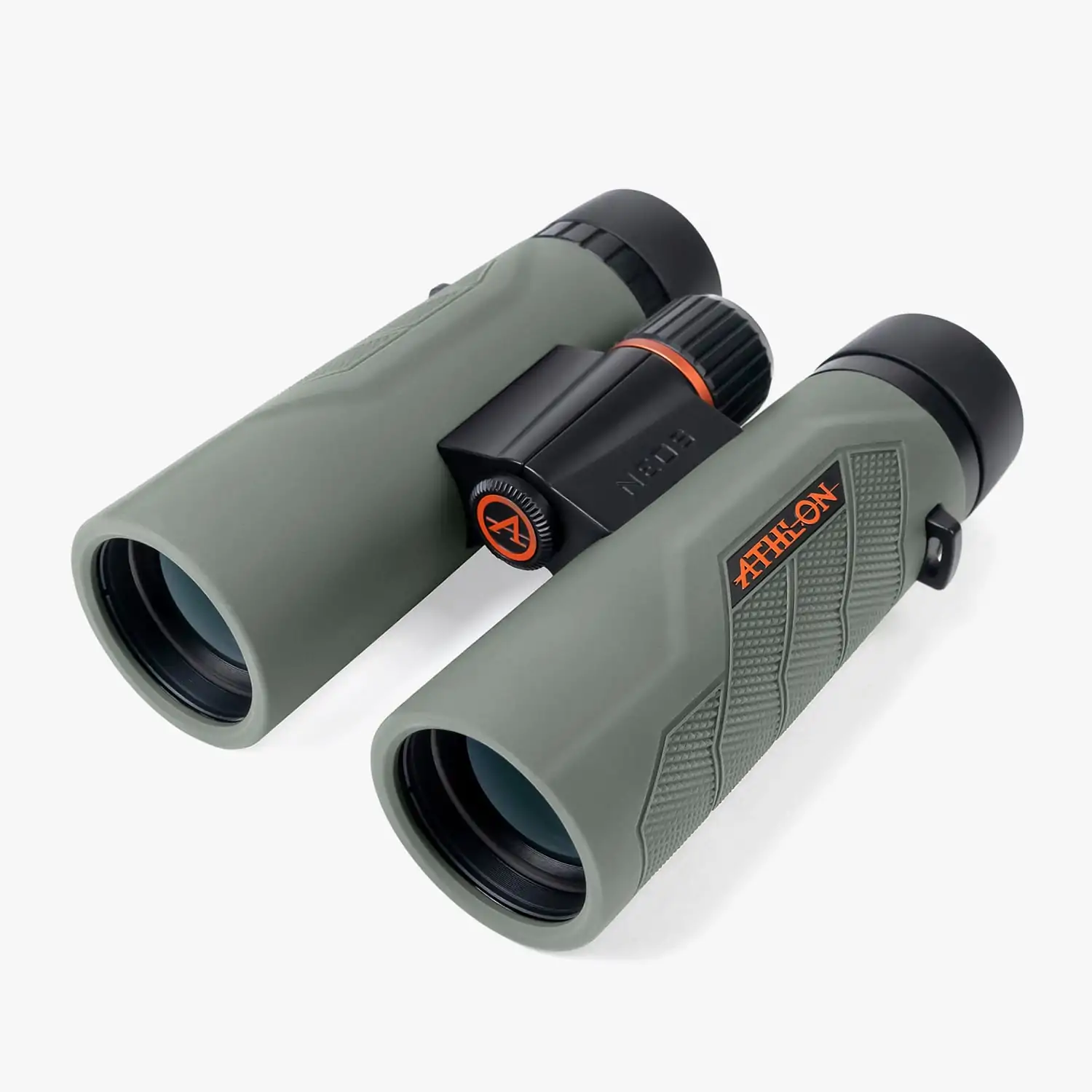
Explore this need in the finder →The Athlon Neos G2 HD 8x42 is the more forgiving of the two 42 mm Neos G2 HD choices for sweeping a hedgerow, finding a bird in a moving flock or sharing a view with another person. Athlon publishes a 7-degree real field (367 feet at 1,000 yards), an 8x fixed power and a 21-ounce instrument weight. The 10x42 uses the same objective size and listed weight but frames a narrower 309-foot scene. Choose this 8x42 for easier scene-finding, not for a verified advantage in optical sharpness or eye relief.
Why the 8x view is easier to work with
Eight power gives a wider view of the scene than the companion 10x42: 367 feet versus 309 feet at Athlon’s 1,000-yard reference, and 7 degrees versus 5.9 degrees of real field. That difference matters when you are trying to locate a small bird, follow movement through branches or sweep a hillside without repeatedly losing the subject at the edge. The wider view is a published framing advantage; it is not a measurement of resolution, contrast or color, and it does not prove that every observer will find the binocular steady. Hand movement, posture and how long you hold a view still matter.
Both models are fixed-power 42 mm binoculars and weigh 21 ounces as specified. The 8x42 therefore is not the lightened version of a heavier 10x. It gives up some apparent subject enlargement while holding the same stated mass, dimensions and closest-focus distance. If your usual subject is a distant, relatively stationary animal and extra enlargement matters more than a broad scene, the 10x42 is the better fit within this pair. For birds that pop in and out of cover, travel viewing or casual wildlife scanning, the 8x42’s broader frame is a useful everyday trade.
Fit facts: focus, field and an unresolved eye-relief figure
The manufacturer publishes a 13.1-foot closest-focus distance (also shown as 4 meters). That is adequate for ordinary distant viewing but too long for close butterfly work, flowers on a nearby branch or tabletop detail. If close-focus distance is an essential requirement, compare the exact stated limit before choosing; the 8x configuration does not improve on its 10x sibling here.
Athlon’s sources disagree on eye relief for this exact model. The current product page and category comparison list 17 mm, while the product-specific specification sheet lists 17.9 mm. Because those figures affect eyeglass fit, we leave the hard-match number unknown rather than selecting the more convenient value. The manual does confirm twist-up eyecups that can be lowered for glasses, plus intermediate stops, but that setup does not resolve the numeric disagreement or promise a full field through every frame. If you wear glasses and need a dependable minimum, try the exact pair at your normal eyecup setting before buying.
The published interpupillary range is 56–72 mm. Set the barrels until you see one full circle without shaded edges; that fit check is distinct from eye relief. Athlon gives overall dimensions as 5.9 by 4.9 inches without specifying a complete set of axes, so those numbers should not be treated as a detailed packed-system measurement. The listed 21-ounce figure is the instrument, not a strap, case or complete carry kit.
Construction claims, care and mounting
Athlon describes the Neos G2 HD as having a composite chassis, O-ring sealing, nitrogen purging, rubber armor, fully multi-coated optics and BaK-4 prisms. It calls the instrument waterproof and fog-proof, but the reviewed page and sheet do not provide an IP code, immersion depth or duration. Treat the language as the manufacturer’s protection claim, not a rating for underwater use, surfacing or high-pressure washing. “HD” is the model-family label; the consulted exact materials do not establish an ED-glass designation or comparative optical performance test.
The shared Neos G2 HD manual is practical for first setup: raise or lower the eyecups for your face, adjust the hinge to your interpupillary distance, then focus the left view with the center wheel and fine-tune the right eye with the diopter ring. The manual suggests using a detailed object at least 20 yards away when setting the diopter. Once adjusted, ordinary distance changes use the center focus wheel. The manual also identifies a standard 1/4-20 tripod-adapter socket under the center-hinge logo plate. A compatible adapter is needed; the page and manual do not establish that it is included in the retail box.
For care, remove grit before wiping, use a clean lens brush or soft microfiber cloth, and avoid rough or dirty material that can scratch the glass. Athlon’s manual explicitly warns not to look directly at the Sun through ordinary binoculars. This model is for normal viewing, not solar observation.
Who should choose it?
Pick the Neos G2 HD 8x42 if you want a broad real field in a conventional 42 mm pair and value finding a subject more than squeezing additional enlargement from the same listed weight. It is the more natural of the two Neos configurations for moving wildlife, general outdoor viewing and easy hand-held scanning. Its limits are equally clear: a 13.1-foot closest focus, no manufacturer-published apparent field, no established ED-glass designation, and conflicting eye-relief numbers that prevent a numeric glasses-fit recommendation. The 10x42 is the sensible alternative when you specifically want higher fixed power and accept a narrower real field. If the exact eye-relief minimum or waterproof immersion conditions are essential, neither model has an uncontested published answer for that requirement.
Manufacturer references: Neos G2 HD 8x42 product page, 8x42 specification sheet, and Neos G2 HD binocular manual.
Key specifications
Key details at a glance
| Magnification | 8× |
|---|---|
| Objective diameter | 42 mm |
| Real field of view | 7° |
| Field width at 1,000 m | 122 m |
| Close focus distance | 13.1 ft |
| Manufacturer-published weight | 21 oz |
More specifications and setup details
| Lens and prism coatings | The Neos G2 HD exact materials identify BaK-4 prisms and fully multi-coated optics/lenses. The pages do not establish phase or dielectric coatings, a specific ED-glass type, or comparative measured optical performance. |
|---|---|
| Water and fog protection | Athlon describes the composite chassis as O-ring sealed and nitrogen-purged and calls the model waterproof/fog-proof. No standardized IP code, immersion depth/duration or underwater-use condition was found in the exact page/sheet. |
| Tripod use | The family manual confirms a standard 1/4-20 tripod adapter socket. A compatible adapter is required; product page/manual do not establish package inclusion. |
| Published weight note | Instrument weight reported by the exact manufacturer product page and product-specific specification sheet; the separate 2.5 lb package weight is not binocular mass. |
| Manufacturer-rated waterproof | Yes |
| Integrated laser rangefinder | No |
| Onboard ballistic solution display | No |
| Direct 1/4-20 tripod thread confirmed | Yes |
Use the exact model’s instructions for operating limits, supplied equipment and version differences.
Sources for this review
Sources for this assessment
- Athlon U.S. binocular family index
- Athlon Neos G2 HD U.S. category snapshot
- Athlon Neos G2 HD 8x42 exact U.S. product page
- Athlon Neos G2 HD 8x42 product-specific specification sheet
- Athlon Neos G2 HD binocular user manual and care instructions
- Athlon Neos G2 HD 8x42 manufacturer exact-page-linked image
- CPSC public recall-search landing page (targeted Neos G2 HD name queries)

Choose your optical trade-off first.
Choose viewing purpose first, then magnification, objective size, scene width and any fit, weather or mounting constraint. A direct-Sun requirement is separate: only exact manufacturer-confirmed solar binoculars can pass it.