
On this page
Your needs, this model
Does it fit your priorities?
Does the 8x42 fit a broad-real-field outdoor plan with waterproofing required?
Yes. The exact Midas UHD sheet lists 8x42, an 8.1-degree/426 ft field and waterproof construction. The broader field is a specification-based reason to select 8x over 10x for scanning, not a measured quality comparison.
Explore this need in the finder →Does the listed 17.2 mm eye relief clear a 17 mm minimum?
Yes, narrowly on the published number. An 18 mm requirement excludes the model; frames and eye position determine actual comfort.
Explore this need in the finder →Does the 6.5 ft close-focus figure satisfy a 7 ft maximum?
Yes. A stricter 6 ft maximum is nearer than the manufacturer-listed 6.5 ft limit.
Explore this need in the finder →Does the 25 oz instrument weight fit a 25 oz carry ceiling?
Yes at the stated boundary; a 24 oz maximum excludes this full-size model. The listing is instrument weight, not a weighed kit.
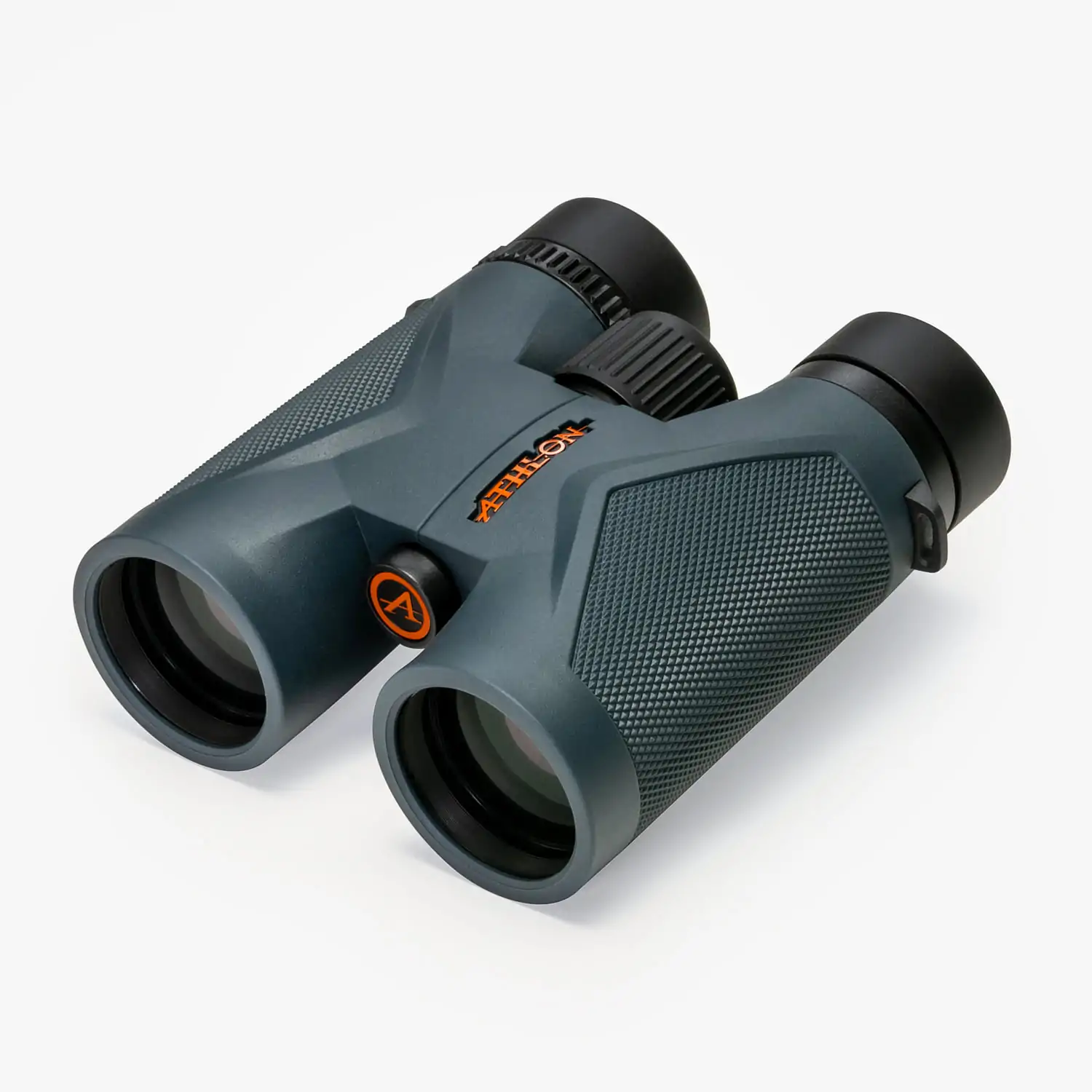
Explore this need in the finder →The Athlon Midas UHD 8x42 (SKU 113004) is the broad-view member of this limited-distribution Midas pair. Its one-page Athlon specification sheet lists an 8.1-degree real field (426 feet at 1,000 yards), 17.2 mm eye relief, a 6.5-foot close-focus distance and a 25-ounce instrument mass. The lower 8x power is the main practical distinction: it shows less apparent magnification than a 10x42, but puts more of the scene in view and is easier to keep on a moving subject by hand.
Scanning and subject tracking
The 426-foot published field is notably wider than the 341-foot figure for the Midas UHD 10x42 and the Forerunner 10x42’s 336 feet. That width is useful when panning for birds in cover, following a moving animal, or sharing a view with someone who is still learning to position the binocular. It does not mean the 8x42 resolves a distant subject better than every 10x model; the magnification trade is real. Choose 8x when field and steady acquisition dominate, and compare 10x when you commonly view distant targets and can keep the image still.
The sheet describes a roof-prism layout using BaK-4 glass, ED glass, phase-corrected prisms, Athlon’s ESP dielectric coating, advanced full multi-coating, magnesium chassis, XPL exterior lens protection and argon purging. These details separate this Midas UHD from the Forerunner line. They are manufacturer specifications rather than a measured comparison of edge sharpness, low-light brightness or color fringing.
Fit, glasses and nearby subjects
The stated 17.2 mm eye relief is the longer of these three new Athlon 42 mm configurations. It is a helpful threshold for eyeglass wearers but not a fit guarantee; eyecup height, frame shape and eye position still determine whether the whole field is visible. Athlon’s Midas UHD manual gives a sensible adjustment sequence: set interpupillary width, use the twist eyecups for your viewing setup, then focus and set the right-side diopter for your eyes. The published 57–74 mm IPD range should be checked if you have a narrow eye spacing or expect several people to share the binocular.
At 6.5 feet, the listed close-focus distance is the closest of the new group. That can help with nearby birds, flowers or exhibits; it does not make the binocular a macro instrument. If close subjects are a core use, compare the stated distance with the actual working range you need rather than relying on the general label “close focus.”
Carry and weather tradeoffs
At 25 ounces, this is a full-size pair, not a featherweight compact. Athlon’s limited-distribution page lists it among current products, but that listing is not a promise of ongoing dealer stock. The exact sheet calls the optical instrument waterproof and argon-purged. It does not give a tested immersion depth, duration or IP-style protection rating; people who need a quantified underwater limit should not treat that unknown as a pass.
The manual covers eyecup setup, hinge width, diopter adjustment and lens care; it warns against looking at the Sun. It also describes a lifetime warranty with stated exclusions. The evidence for this old Midas UHD configuration does not confirm a direct tripod thread or an included tripod adapter, so plan on handheld use unless a separate, exact accessory listing establishes a compatible support route. Do not assume the nearby Forerunner’s confirmed 1/4-20 port transfers to this model.
Questionnaire choices that change the result
For general viewing, select 8x and 42 mm when those are your actual preferences, then choose the broad-real-field option if a six-degree minimum is important; the Midas UHD clears that threshold at 8.1 degrees. Its 17.2 mm eye relief passes a 17 mm requirement but not an 18 mm one. A 25-ounce maximum accepts the manufacturer-listed instrument weight, while 24 ounces excludes it. A seven-foot close-focus ceiling admits its 6.5 feet; a six-foot ceiling does not. The exact 57 mm minimum IPD matters too: a user who requires the minimum spacing to be 56 mm or less should not treat this model as a fit.
The manufacturer documents ED glass, phase coating and dielectric coating on this exact specification sheet. Those may be selected as essential filters when they are genuine priorities. By contrast, a required tripod-adapter port should not return this model on the evidence reviewed, and the waterproof label cannot satisfy an immersion-depth requirement because no depth is published.
Alternatives and the exact identity
The Midas UHD 10x42 (SKU 113003) retains the 42 mm objectives and coated ED-glass design while narrowing the listed field to 341 feet and reducing eye relief to 15.2 mm; it is the better starting point when extra reach matters. The Forerunner 10x42 weighs one ounce less and confirms a 1/4-20 adapter socket, but its published field is narrower and its exact sources do not confirm ED, phase or dielectric coatings. Athlon separately sells a Midas G2 UHD 8x42 (SKU 113009); do not collapse it into this Midas UHD SKU 113004 just because both say 8x42. The 113004 is the clearest fit here for a viewer who values a wide scene, longer listed eye relief and a closer stated focus distance, accepts the full-size weight, and does not require unverified tripod or immersion details.
Manufacturer references: Midas UHD 8x42 product page (SKU 113004), SKU 113004 specification sheet, and Midas UHD binocular manual.
Key specifications
Key details at a glance
| Magnification | 8× |
|---|---|
| Objective diameter | 42 mm |
| Real field of view | 8.1° |
| Eye relief | 17.2 mm |
| Close focus distance | 6.5 ft |
| Manufacturer-published weight | 25 oz |
More specifications and setup details
| ED glass confirmed for this exact model | Yes |
|---|---|
| Phase coatings confirmed | Yes |
| Lens and prism coatings | Athlon lists ED glass, phase-corrected BaK-4 roof prisms, ESP dielectric coating and advanced full multi-coating. These are manufacturer specifications, not independent comparative test results. |
| Water and fog protection | Athlon labels this exact configuration waterproof and identifies its gas purge, but no IP-style code or immersion depth/duration is published in the reviewed exact sources. |
| Tripod use | Tripod compatibility and adapter inclusion are not established by the exact reviewed page, sheet or family manual. |
| Published weight note | Manufacturer-listed binocular weight only; it was not independently measured and excludes the carrying kit. |
| Manufacturer-rated waterproof | Yes |
| Integrated laser rangefinder | No |
| Onboard ballistic solution display | No |
Use the exact model’s instructions for operating limits, supplied equipment and version differences.
Sources for this review
Sources for this assessment

Choose your optical trade-off first.
Choose viewing purpose first, then magnification, objective size, scene width and any fit, weather or mounting constraint. A direct-Sun requirement is separate: only exact manufacturer-confirmed solar binoculars can pass it.