
On this page
Your needs, this model
Does it fit your priorities?
Does SKU 113003 meet a 10x42 waterproof plan that requires confirmed ED glass?
Yes. The exact Midas UHD page and SKU-specific sheet identify a fixed 10x42 and list ED glass, waterproof construction, phase-corrected prisms and dielectric coating.
Explore this need in the finder →Does the 25 oz listed instrument weight satisfy a 25 oz maximum?
Yes, exactly at the printed boundary. A 24 oz ceiling is too strict for the listed 25 oz body.
Explore this need in the finder →Does the 15.2 mm eye-relief figure meet a 15 mm minimum?
Yes, by 0.2 mm on the published number only. A 16 mm minimum excludes it and individual glasses fit is still unproven.
Explore this need in the finder →Does the 8.2 ft close-focus specification fit a 9 ft maximum?
Yes. A strict 8 ft ceiling is shorter than the exact sheet’s 8.2 ft figure.
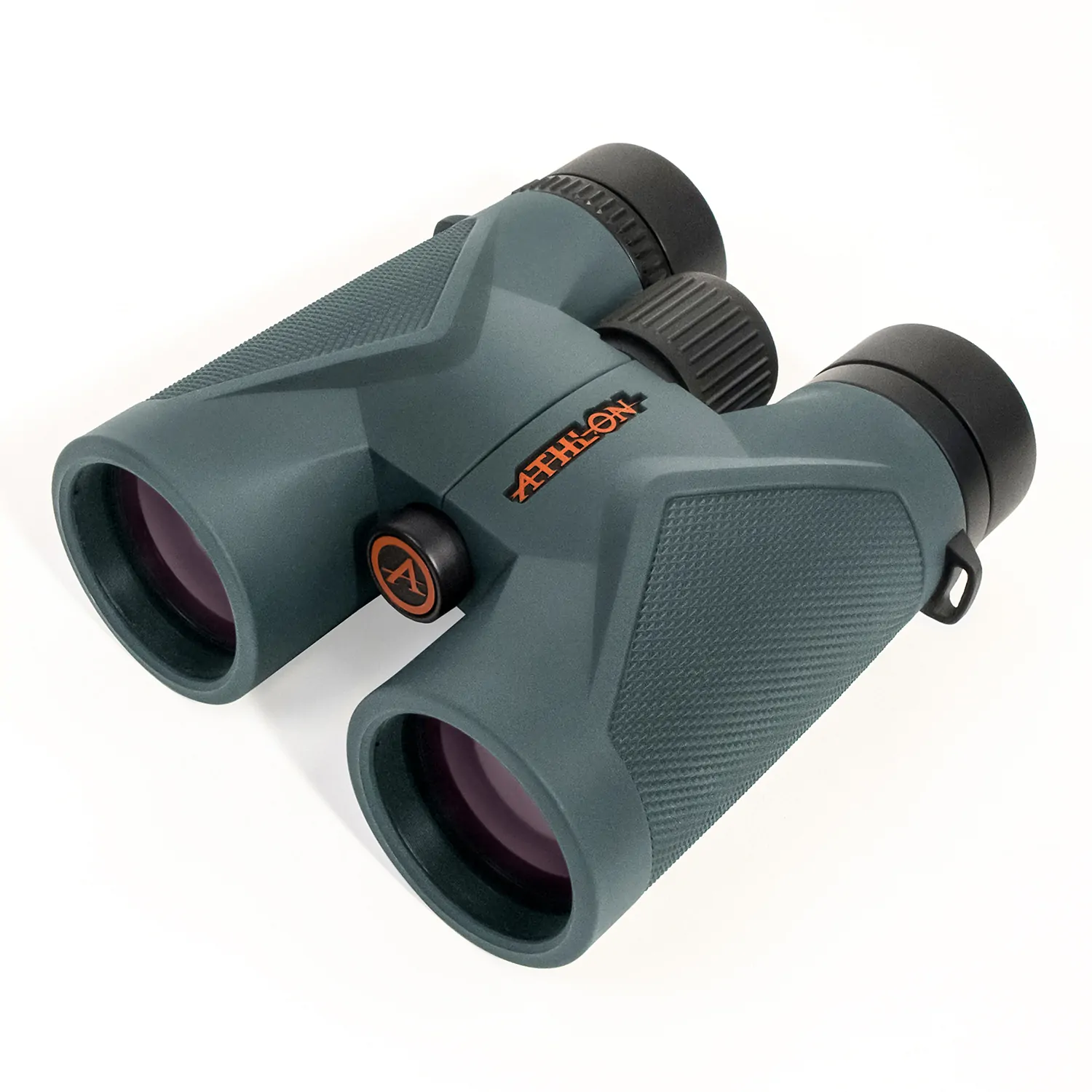
Explore this need in the finder →Athlon’s Midas UHD 10x42 (SKU 113003) is a distinct limited-distribution model, not the later Midas G2 UHD 10x42 (SKU 113008). Its exact sheet lists 10x magnification, 42 mm objectives, 341 feet of field at 1,000 yards, 15.2 mm eye relief, 8.2-foot close focus and a 25-ounce instrument weight. The model’s appeal is the combination of 10x reach with a well-specified ED and coated-prism system; the practical decision still turns on handling, field width and the limits of the published evidence.
What the 10x42 layout is for
Ten power gives a distant subject more apparent size than an 8x binocular, which can be helpful when watching wildlife across an open field or picking detail from a fixed overlook. The trade is a smaller real scene: Athlon publishes 6.5 degrees, or 341 feet at 1,000 yards. That is a workable general-use field, but a viewer following a quick, close-moving bird may find the 8x42’s 8.1-degree, 426-foot field easier to reacquire. Fixed 10x also makes steadiness matter; the specification does not say that the binocular stabilizes its image.
The manufacturer identifies a magnesium chassis and roof-prism layout with BaK-4 glass, ED objective glass, phase correction, ESP dielectric prism coating, advanced full multi-coating and an exterior XPL protective coating. Those are concrete design claims, not independent comparative image tests. They help distinguish this older Midas UHD from the simpler Forerunner 10x42, whose exact sources do not confirm ED, phase or dielectric coatings.
Eye placement and focus
At 15.2 mm, the listed eye relief is shorter than the matching Midas UHD 8x42’s 17.2 mm. An eyeglass wearer can use 15 mm as a screening threshold, but a published number cannot promise a full, comfortable field with every frame. The listed interpupillary span is 57–74 mm, so check the minimum setting if a child or a narrower-set adult will use the binocular. The manufacturer manual explains how to rotate the eyecups, set the hinge width and adjust the diopter before relying on the center focus wheel. That setup matters more than chasing a single specification in isolation.
The 8.2-foot close-focus figure is more useful around nearby subjects than the Forerunner’s 14.7 feet, though it is not a dedicated close-focus instrument. If your regular use includes nearby plants, butterflies or display cases, choose an explicit ceiling that suits that distance rather than treating “close focus” as an unqualified feature.
Weather, handling and ownership
Athlon describes the body as waterproof, shockproof and argon-purged. The source sheet does not provide an IP code or a depth-and-duration immersion rating, so it cannot answer an essential underwater-use requirement. The listed 25 ounces are for the binocular; accessories and carry kit are not included in that instrument weight. A neck strap is described in the family manual, but this evidence does not establish every item present in every retail package.
The manual’s care section advises removing grit before wiping the lenses and warns never to look directly at the Sun. Follow those basic precautions; a coating list is not a substitute for careful handling. The exact page is marked limited distribution. That is a current manufacturer listing designation, not a claim that every dealer has stock or that the model will remain available. The manual describes Athlon’s lifetime warranty and also lists exclusions, so consult the current terms rather than treating a brief summary as a warranty determination.
Matching this configuration to a real need
Choose 10x and 42 mm if those are essential, then decide whether a 6-degree real field is broad enough for your typical subject. A 15 mm minimum eye-relief preference passes narrowly at 15.2 mm; 16 mm does not. A 25-ounce weight ceiling passes at the listed instrument weight, whereas 24 ounces does not. The 9-foot close-focus setting admits the stated 8.2 feet, while an 8-foot cap is too strict. A 57 mm maximum for the instrument’s minimum interpupillary setting does not reject this model; setting that maximum below 57 mm does. These boundaries make the questionnaire useful without pretending a fit number guarantees comfort.
If you require ED glass, phase coating or dielectric coating rather than merely preferring them, the exact Midas UHD sheet confirms all three. It also confirms waterproof construction, but not a quantified depth rating. The old Midas manual does not establish that a tripod adapter is included; the evidence reviewed does not confirm tripod compatibility for this SKU, so it should not pass an essential tripod-support filter.
Alternatives and who should look elsewhere
Consider the Midas UHD 8x42 when you want a wider scene, longer listed eye relief, closer minimum focus and more relaxed handheld scanning; it is also listed at 25 ounces. Consider the Forerunner 10x42 if you want to keep 10x reach but need its lower listed mass (24 ounces), narrower 53 mm minimum IPD, or confirmed standard 1/4-20 tripod-adapter socket; its exact sheet does not confirm the Midas UHD’s ED/phase/dielectric features. The later Midas G2 UHD 10x42 is yet another distinct 10x42 profile. This Midas UHD 113003 makes sense when its specific combination of 10x reach, close-to-eight-foot focus and confirmed coatings fits your operating plan; it is a poor pick for a strict sub-25-ounce limit, broadest-view priority, confirmed tripod-port requirement, or a quantified immersion need.
Manufacturer references: Midas UHD 10x42 product page (SKU 113003), SKU 113003 specification sheet, and the Midas UHD binocular manual linked by the exact family pages.
Key specifications
Key details at a glance
| Magnification | 10× |
|---|---|
| Objective diameter | 42 mm |
| Real field of view | 6.5° |
| Eye relief | 15.2 mm |
| Close focus distance | 8.2 ft |
| Manufacturer-published weight | 25 oz |
More specifications and setup details
| ED glass confirmed for this exact model | Yes |
|---|---|
| Phase coatings confirmed | Yes |
| Lens and prism coatings | Athlon lists ED glass, phase-corrected BaK-4 roof prisms, ESP dielectric coating and advanced full multi-coating. These are manufacturer specifications, not independent comparative test results. |
| Water and fog protection | Athlon labels this exact configuration waterproof and identifies its gas purge, but no IP-style code or immersion depth/duration is published in the reviewed exact sources. |
| Tripod use | Tripod compatibility and adapter inclusion are not established by the exact reviewed page, sheet or family manual. |
| Published weight note | Manufacturer-listed binocular weight only; it was not independently measured and excludes the carrying kit. |
| Manufacturer-rated waterproof | Yes |
| Integrated laser rangefinder | No |
| Onboard ballistic solution display | No |
Use the exact model’s instructions for operating limits, supplied equipment and version differences.
Sources for this review
Sources for this assessment

Choose your optical trade-off first.
Choose viewing purpose first, then magnification, objective size, scene width and any fit, weather or mounting constraint. A direct-Sun requirement is separate: only exact manufacturer-confirmed solar binoculars can pass it.