
On this page
Your needs, this model
Does it fit your priorities?
Does the 8x42 prioritize a wide real scene?
Yes. The spec sheet lists 8.1° (426 ft/1,000 yd), wider than the 10x42 and 12x50 in this group. It trades some apparent reach for a broader scene.
Explore this need in the finder →Does 17.2 mm eye relief clear a 17 mm minimum?
Yes, just above that published threshold; it does not prove comfort with every eyeglass frame or eye position.
Explore this need in the finder →Is waterproof construction confirmed?
Athlon specifies waterproof construction and argon purging. The page and reviewed sheet do not state a depth/time rating, so do not treat the label as an immersion rating.
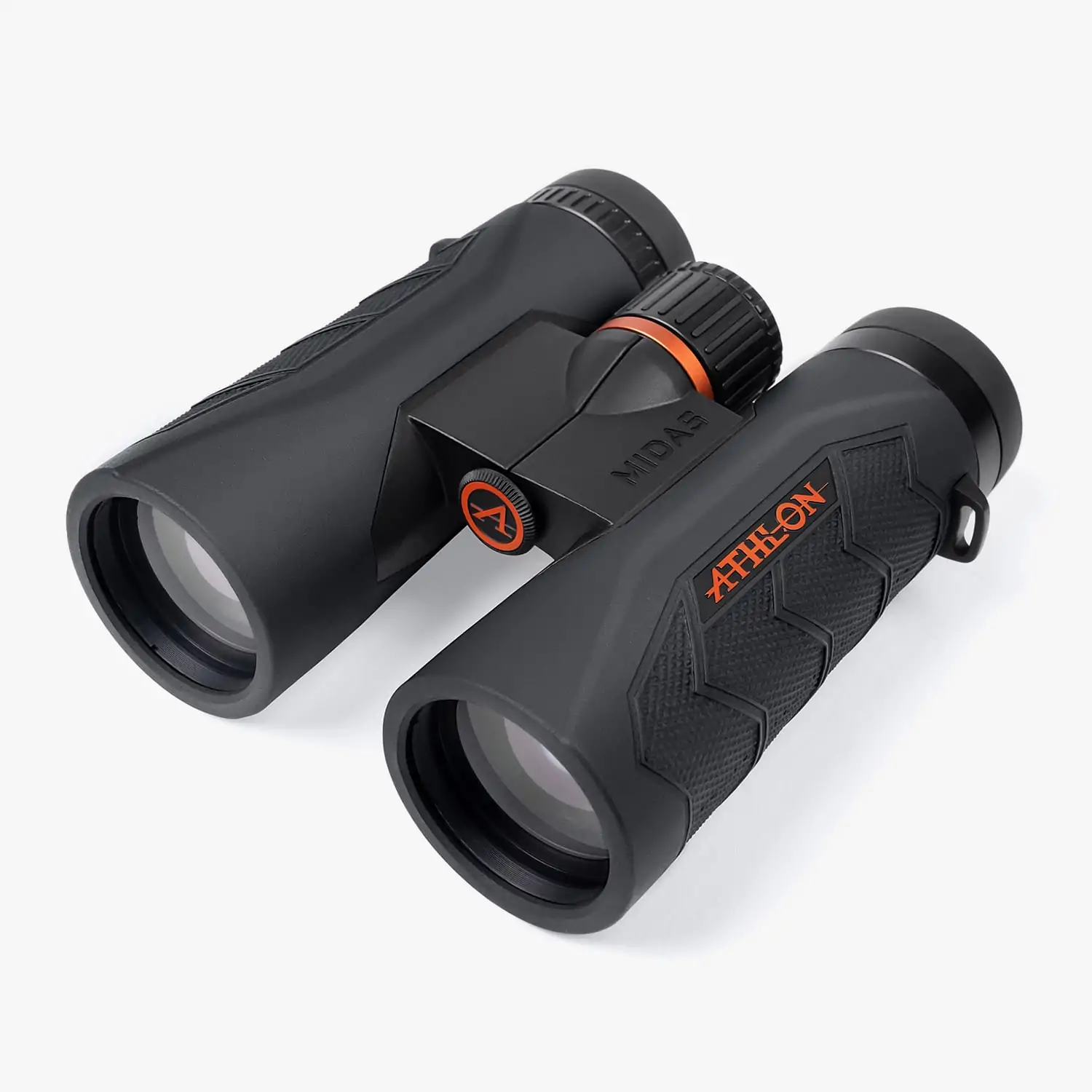
Explore this need in the finder →The Midas G2 UHD 8x42 is the standard Midas configuration to start with when an easy-to-scan view matters more than the highest magnification. Athlon lists an 8.1-degree real field (426 feet at 1,000 yards), 17.2 mm eye relief, a 6.5-foot close-focus distance and 23.3-ounce weight. The 42 mm objectives keep it a full-size binocular rather than a pocket model, but the broad field and moderate power make this the most forgiving Midas G2 choice for locating and following wildlife.
Why 8x and the wide field matter
Finding a subject is part of using binoculars. A bird moving through a hedgerow or an animal crossing an open slope can be easier to acquire when the view covers more of the scene. Athlon’s published field for this 8x42 is 426 feet at 1,000 yards. The standard Midas 10x42 and 10x50 narrow to 341 feet, while both 12x50 variants narrow to 281 feet. Those are meaningful differences when scanning; choose the 8x42 if quick target acquisition and broader context are more useful than added enlargement.
At 8x, small hand motion is less magnified than at 10x or 12x. That is an optical consequence, not an instrument stability test. For extended observation, it can be a practical advantage over a higher-power pair, particularly if you prefer not to carry a support. The 23.3-ounce manufacturer-listed instrument weight is shared with the Midas 10x42, so choosing 8x does not add weight compared with that alternative.
Comfort and near focus are unusually favorable in this line
The spec sheet lists 17.2 mm eye relief, the longest among the five standard Midas G2 UHD configurations. That is a useful screening point for eyeglass wearers, not a guarantee that every frame will show the full field. The right eye-cup position, your interpupillary distance and the shape of your glasses still matter. Athlon specifies a 57–74 mm interpupillary range, and its manual explains how to set the barrels for a single, unshaded circle before adjusting focus and diopter.
At 6.5 feet, its published close-focus limit is shorter than the 8.2 feet on the 10x42, 9.8 feet on the 10x50 and 11.5 feet on either 12x50. That gives the 8x42 more flexibility if nearby details sometimes enter the outing. The figure is still a manufacturer specification, not a promise that every close subject will appear comfortable or sharp for every viewer. If close observation is central, confirm how the view behaves at the distances you use.
Optics and construction, with claim boundaries
Athlon describes the Midas G2 UHD as a roof-prism binocular with extra-low-dispersion (“UHD”) glass, fully multi-coated lenses, BaK-4 prisms, phase correction, ESP dielectric prism coating, magnesium chassis, XPL exterior lens coating and argon purging. The maker lists waterproof construction and describes a protective design for outdoor use. These terms explain what Athlon says is in the system; they are not independent resolution, light-transmission or impact results. The exact product materials do not establish an IP submersion depth, and “waterproof” should not be read as a reason to deliberately immerse the binocular.
The Midas manual gives useful setup guidance. Set the twist-up eyecups for glasses or bare eyes, align the two barrels to your eyes, focus a distant detailed object with the center wheel, then cover one side at a time to set the right-side diopter. It also identifies a 1/4-20 tripod adapter socket. That is compatible with a standard tripod adapter; the page and sheet do not establish that one is supplied in the package. The manual’s cleaning directions—remove grit first, then use microfiber and suitable lens fluid—are more important than any exterior coating claim.
Choose between the standard Midas sizes
Stay with 8x42 if you value the 426-foot field, the longest eye relief in this five-model group and the closest published focus. The 10x42 adds reach without changing the 23.3-ounce listed weight, but its field and eye relief are narrower and shorter. The 10x50 keeps 10x and the same published field as the 10x42 while increasing the objective to 50 mm and the listed weight to 28.5 ounces. The 12x50 gives more magnification but cuts the field to 281 feet; support may matter more if you need a settled view. The 10x25 is far easier to carry but sacrifices objective size and view width. Do not use a single “best” label to erase those compromises: the right option depends on whether you spend more time scanning, inspecting distant subjects or carrying the binocular between viewing stops.
Manufacturer references: Athlon’s exact Midas G2 UHD 8x42 page, linked 8x42 specification sheet and Midas G2 UHD manual. No retailer or customer-review claims are used.
Key specifications
Key details at a glance
| Magnification | 8× |
|---|---|
| Objective diameter | 42 mm |
| Real field of view | 8.1° |
| Eye relief | 17.2 mm |
| Close focus distance | 6.5 ft |
| Manufacturer-published weight | 23.3 oz |
More specifications and setup details
| ED glass confirmed for this exact model | Yes |
|---|---|
| Phase coatings confirmed | Yes |
| Lens and prism coatings | Athlon lists ED objective glass, phase-corrected BaK-4 roof prisms, ESP dielectric reflective coating, and advanced fully multicoated optics. These manufacturer specifications are not independent comparative test results. |
| Water and fog protection | Athlon describes the construction as waterproof and argon-purged. The reviewed exact page/sheet do not publish an IP rating or immersion depth/time; do not infer underwater use. |
| Tripod use | Manufacturer manual confirms a tripod-adapter socket / adaptability; tripod adapter included in the retail box is unknown. |
| Published weight note | Manufacturer-listed optical-instrument weight only; not independently measured and excludes carrying kit. |
| Manufacturer-rated waterproof | Yes |
| Integrated laser rangefinder | No |
| Onboard ballistic solution display | No |
Use the exact model’s instructions for operating limits, supplied equipment and version differences.
Sources for this review
Sources for this assessment
Choose your optical trade-off first.
Choose viewing purpose first, then magnification, objective size, scene width and any fit, weather or mounting constraint. A direct-Sun requirement is separate: only exact manufacturer-confirmed solar binoculars can pass it.