
On this page
Your needs, this model
Does it fit your priorities?
Does it combine fixed 10x power with 50 mm objectives?
Yes. The exact Athlon page and sheet identify 10x50 and SKU 113007.
Explore this need in the finder →Does the published 6.5° field meet the wide-real setting?
Yes. Athlon lists 6.5° real field (341 ft/1,000 yd), above the finder’s 6° wide-real threshold.
Explore this need in the finder →Does its listed eye relief clear 16 mm?
Yes at 16.9 mm, but the individual glasses view still needs a real fit check.
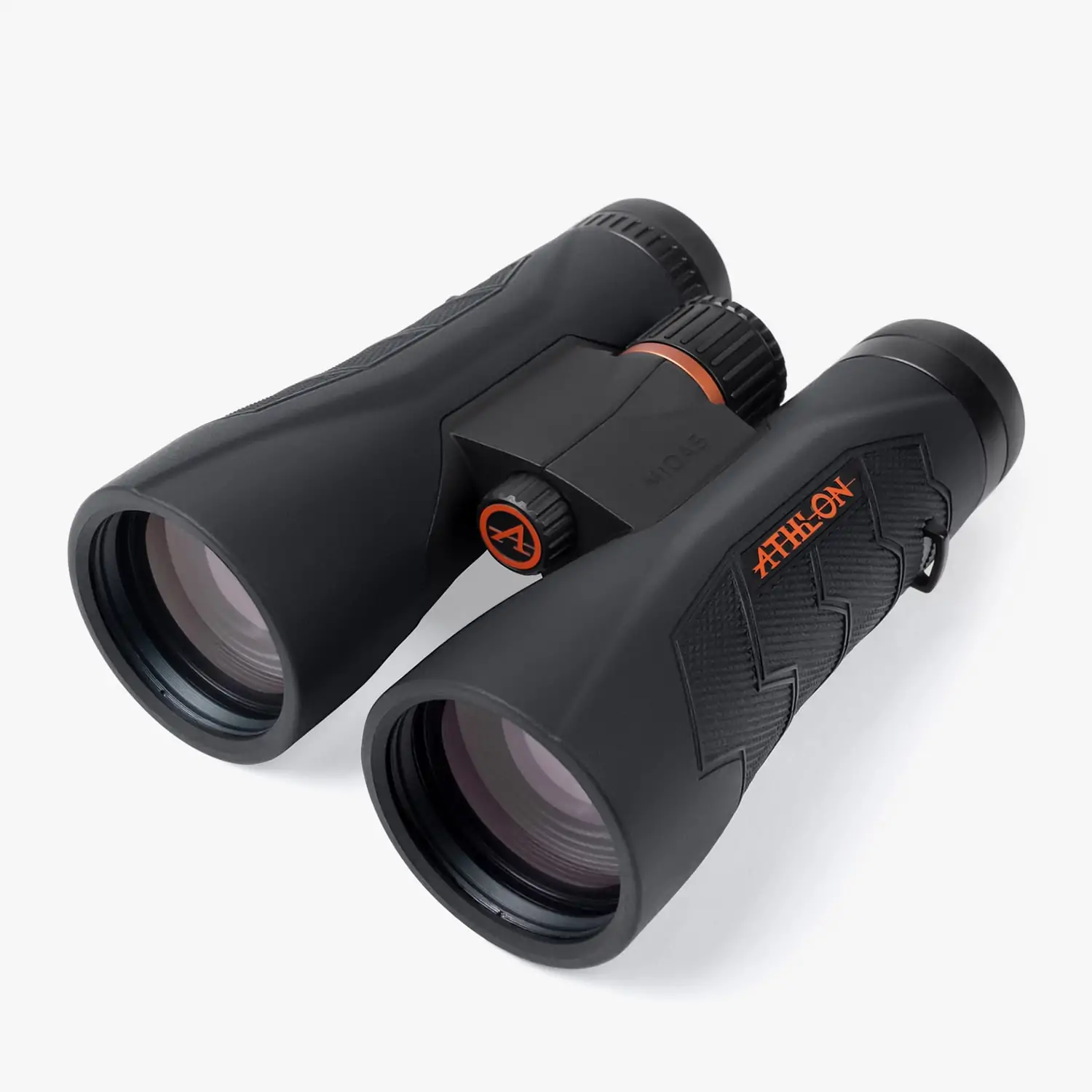
Explore this need in the finder →The Midas G2 UHD 10x50 pairs ten-power magnification with 50 mm objectives. Its exact product page and 113007 sheet list 28.5 ounces, while Athlon’s 2025 comparison chart lists 32 ounces; the weight conflict is unresolved for hard matching. Athlon lists 16.9 mm eye relief, a 341-foot field at 1,000 yards and 9.8-foot close focus. It suits a viewer who specifically wants the larger objective but not the narrower 12x50 view. The 10x50 has larger labeled dimensions than the 10x42, whose listing gives a 341-foot field and 23.3-ounce weight.
Why choose 10x50 over the similar 10x42?
The 10x42 and 10x50 have the same stated magnification and linear field width: 341 feet at 1,000 yards, or 6.5 degrees. On those two dimensions, moving to the 50 mm version does not buy more view width or a stronger power. It does increase objective diameter and the manufacturer-labeled dimensions (6.7 by 5.4 inches versus 5.7 by 5.2 inches for the 42 mm body). The exact 10x50 page and sheet list 28.5 ounces, but the 2025 chart gives 32; its mass is unresolved for a strict screen. Both values exceed the 10x42’s published 23.3 ounces, but the exact difference is not settled. If you carry binoculars all day, the larger body is a meaningful cost, not a rounding error.
A larger objective can offer more potential light-gathering area than a smaller one, but that alone does not establish how bright or sharp an image will look. Lens transmission, coatings, pupil size, viewing conditions and eye fit all matter. Athlon’s feature list identifies UHD extra-low-dispersion glass, fully multi-coated optics, BaK-4 prisms, phase correction, ESP dielectric coating, XPL exterior coating, magnesium chassis and argon purging. These are manufacturer claims; this review does not report an independent low-light comparison. Choose 10x50 when the larger aperture is a deliberate part of your use plan and you accept its mass.
Handling, field, and eye fit
The 341-foot field is broad enough to avoid the very narrow view of a 12x50, but it is still 85 feet narrower than the Midas 8x42’s 426-foot field at the same distance. If you mainly scan and follow movement, 8x42 remains the easier family choice. For a steady observation station or distant subjects in open country, the 10x50 is a more considered trade: 10x magnification, 50 mm objectives, and a field width matching the 10x42. A support can be useful during long, static sessions, particularly when you want to minimize hand motion; that is an operating suggestion, not a stability measurement.
Athlon states 16.9 mm eye relief and a 59–74 mm interpupillary range. The eye-relief value is longer than the 10x42’s 15.2 mm, but shorter than the 8x42’s 17.2 mm. Eyeglass wearers should verify that their frames still allow them to see the entire field with the eyecups in the appropriate position. This is particularly worth checking if you are comparing 10x42 and 10x50, because the nominal magnification and field width are shared while the eye-relief and objective values differ.
Setup, weather, and maintenance
The Midas G2 UHD manual covers eyecup use, the hinge adjustment for interpupillary distance and the separate diopter adjustment. A practical routine is to align the barrels until each eye sees one full circle, focus a distant detailed target with the center wheel, then set the right-eye diopter as the manual describes. The manual identifies a 1/4-20 tripod-adapter socket, but Athlon’s page and spec sheet do not confirm an adapter in the box. The product page also calls the construction waterproof and argon-purged; it does not publish a submersion depth on the reviewed product sheet. Respect the manual’s cleaning guidance, especially clearing grit before touching the glass.
Protection labels are not a substitute for careful handling. Athlon lists an XPL coating for the exterior lenses, but dirt and oil can still obscure a view, and abrasion can still scratch glass. Blow or brush loose grit away first, then use clean microfiber and appropriate lens fluid. Use the binocular for ordinary observation only; Athlon’s manual warns never to look directly at the Sun through these optics.
When the 12x50 or 8x42 makes more sense
Pick the 10x50 over 12x50 when you want the larger objective but value the wider 341-foot field and longer 16.9 mm eye relief. Both exact 50 mm models have conflicting published weights, so a strict mass cap cannot distinguish them. Pick 12x50 if you want 12x and can accept its narrower 281-foot field, shorter 15.0 mm eye relief and 11.5-foot close focus. Return to 8x42 if comfort while scanning, a broad field or closer focus matters more than 50 mm objectives. The Midas 10x50’s published figures are useful for narrowing the choice, but no specification table can determine whether its size, balance or eyepiece fit suits your face and hands.
Manufacturer references: Athlon’s exact Midas G2 UHD 10x50 page, linked 10x50 specification sheet and Midas G2 UHD manual. The exact page and SKU sheet list 28.5 oz; the 2025 chart prints 32 oz. The conflict remains unresolved, and neither value is used as a hard-match weight.
Key specifications
Key details at a glance
| Magnification | 10× |
|---|---|
| Objective diameter | 50 mm |
| Real field of view | 6.5° |
| Eye relief | 16.9 mm |
| Close focus distance | 9.8 ft |
| ED glass confirmed for this exact model | Yes |
More specifications and setup details
| Phase coatings confirmed | Yes |
|---|---|
| Lens and prism coatings | Athlon lists ED objective glass, phase-corrected BaK-4 roof prisms, ESP dielectric reflective coating, and advanced fully multicoated optics. These manufacturer specifications are not independent comparative test results. |
| Water and fog protection | Athlon describes the construction as waterproof and argon-purged. The reviewed exact page/sheet do not publish an IP rating or immersion depth/time; do not infer underwater use. |
| Tripod use | Manufacturer manual confirms a tripod-adapter socket / adaptability; tripod adapter included in the retail box is unknown. |
| Published weight note | Exact 113007 product page and sheet report 28.5 oz; Athlon 2025 catalog printed pp.24–25 reports 32 oz. Unresolved official-source conflict; weight is unknown for hard matching. Not independently weighed; accessory mass is separate. |
| Manufacturer-rated waterproof | Yes |
| Integrated laser rangefinder | No |
| Onboard ballistic solution display | No |
Use the exact model’s instructions for operating limits, supplied equipment and version differences.
Sources for this review
Sources for this assessment
- Athlon U.S. binocular family category index
- Athlon Midas G2 UHD binocular category
- Athlon exact Athlon Midas G2 UHD 10x50 product page
- Athlon exact Athlon Midas G2 UHD 10x50 specification sheet
- Athlon Midas G2 UHD family manual
- Athlon 2025 official product catalog, printed binocular comparison pages 24–25
Choose your optical trade-off first.
Choose viewing purpose first, then magnification, objective size, scene width and any fit, weather or mounting constraint. A direct-Sun requirement is separate: only exact manufacturer-confirmed solar binoculars can pass it.