
On this page
Your needs, this model
Does it fit your priorities?
Does the 10x25 match a compact 10x/25 mm choice?
Yes. Athlon specifies fixed 10x magnification and 25 mm objectives. At 8.3 oz, it is substantially lighter than the full-size Midas models, but the smaller objective and 2.5 mm exit pupil are tradeoffs, not a measured brightness promise.
Explore this need in the finder →Does its listed eye relief clear a 15 mm minimum?
The 15.5 mm manufacturer figure clears a 15 mm numeric threshold; glasses comfort still depends on eye position and is not guaranteed by the number alone.
Explore this need in the finder →Can it be attached to a tripod if a separate adapter is used?
The manual confirms a tripod-adapter socket. Whether an adapter is included in the box is not established, so compatibility should not be read as an included kit.
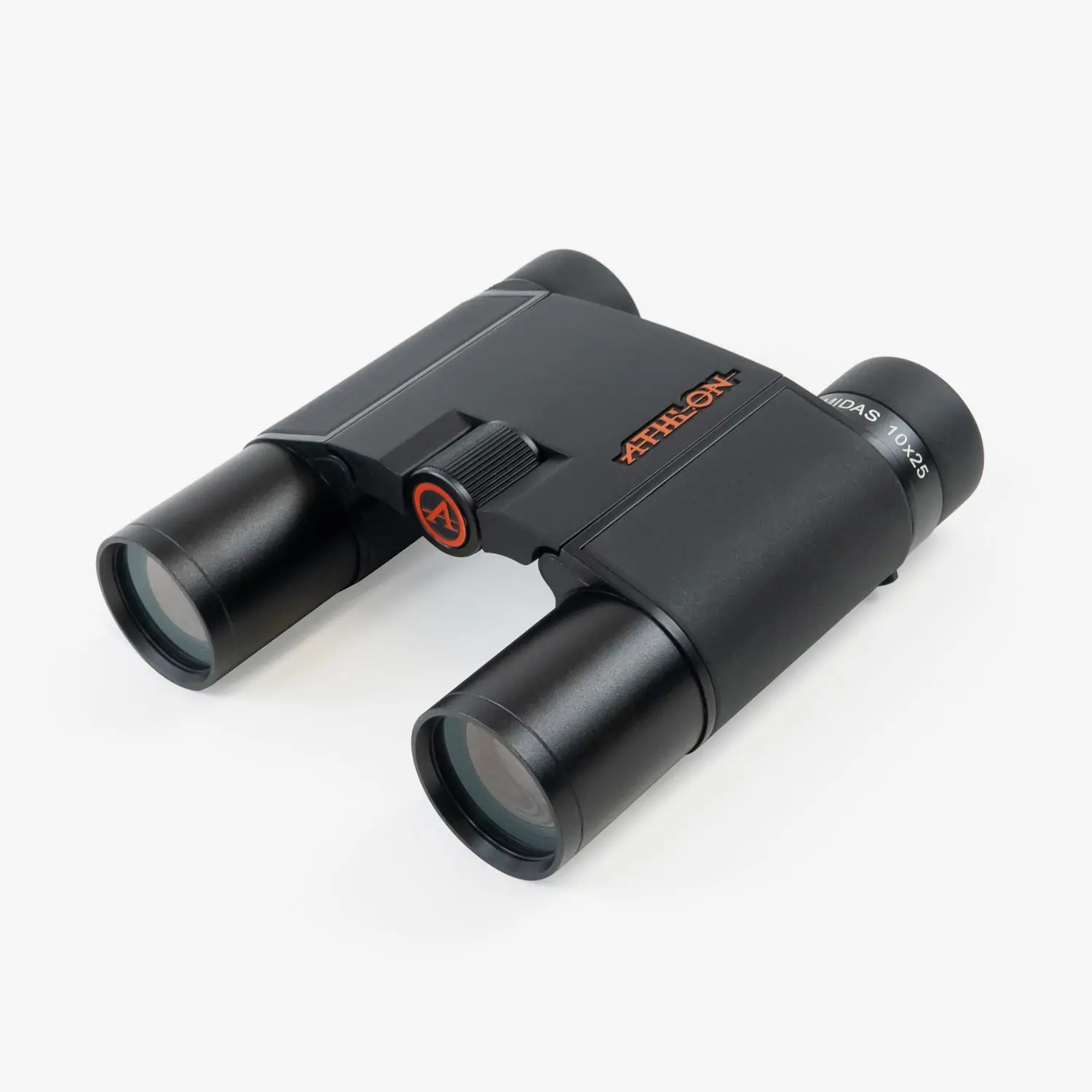
Explore this need in the finder →The Athlon Midas G2 UHD 10x25 is the small, light member of Athlon’s standard Midas binocular family: the manufacturer lists it at 8.3 ounces and 4.3 by 4.1 inches. Its ten-power view is paired with compact 25 mm objectives, a 285-foot field at 1,000 yards, 15.5 mm eye relief and 5.2-foot close focus. That makes this a carry-first choice for travel and quick outdoor checks, not a substitute for a wider 8x42 when moving subjects or dimmer hours are the priority.
Small body, ten-power view
The strongest reason to choose the 10x25 is that it takes much less space and weighs much less than the 42 mm and 50 mm Midas options. The spec sheet puts the body at 8.3 ounces, compared with 23.3 ounces for either 8x42 or 10x42 and 28.5 ounces for the standard 10x50 and 12x50. The compact dimensions also make it easier to reserve space for other travel or day-hike gear. These are manufacturer-listed instrument figures, not a measured packed-system weight; a strap and case add to what you carry.
Ten power is useful when you want to inspect distant signs, wildlife or a landmark without stepping up to the Midas 12x50. But this configuration’s field is 285 feet at 1,000 yards (5.4 degrees), materially narrower than the 8x42’s 426 feet and the 10x42’s 341 feet. If you are trying to locate a moving bird through branches, the extra width of the 8x42 is an easier starting point. Higher magnification also makes hand movement more apparent than at 8x; Athlon does not list image stabilization for this model, so someone wanting a steadier long-duration view should consider a supported pair instead.
What the 25 mm objective changes
A 25 mm objective keeps this model compact, but it is a smaller light-collecting opening than the 42 mm and 50 mm Midas choices. That trade is most relevant near dawn, dusk or under deep tree cover. The maker describes the Midas G2 UHD line as using extra-low-dispersion glass, fully multi-coated lenses, BaK-4 prisms, phase correction, an ESP dielectric prism coating, protective XPL exterior coating and argon purging. Those are product specifications and maker claims—not an independent transmission, dusk or durability test. They do not remove the basic aperture difference between a compact pair and the larger objectives.
The close-focus figure is 5.2 feet, shorter than the 6.5 feet listed for 8x42 and 8.2 feet for 10x42. That may be useful if your ordinary outings include looking at nearby natural details, but it does not make the 10x25 a macro instrument. The 56–74 mm interpupillary range is the narrowest minimum setting among these Midas options; if several people will share the binocular, check that range and the eye-cup fit for each person rather than assuming one adjustment suits all.
Set it up before judging the fit
Athlon’s Midas UHD 10x25 manual describes the usual but important first-use routine: set the eyecups for glasses or bare eyes, adjust the two barrels until one complete image appears, then focus one side and use the diopter to balance the other. After that, normal focusing is done with the center wheel. It also describes the neck-strap attachment and a 1/4-20 tripod socket. A socket confirms a mounting interface, not that an adapter or tripod is included; package contents are not clear in the reviewed product materials. The maker lists waterproofing and argon purging, but gives no immersion rating on the reviewed page, so do not treat the claim as permission to submerge it.
For glasses wearers, 15.5 mm of stated eye relief is a reason to verify full-field visibility through your own frames. It is not automatically unsuitable, but the number is shorter than the 17.2 mm specified for the Midas 8x42. People who are sensitive to blackouts or who share the binocular should test the eyecup positions, interpupillary adjustment and focus routine before committing to long sessions.
When another Midas is the better decision
Pick the 10x25 when minimizing bulk has real value and you expect mostly daylight, brief observations. Move to the 8x42 if locating a subject quickly, viewing a wider scene or keeping a longer eye-relief margin matters more. Choose the 10x42 for a similar ten-power view but a larger objective, a wider published field and a still manageable 23.3-ounce listed weight. The 10x50 keeps 10x power and the same 341-foot field as the 10x42 while adding a 50 mm objective; it is heavier and substantially larger. The 12x50 is for users who explicitly want the extra magnification and accept its narrower field. None of those differences establishes which image will look best to a particular viewer; eye fit and preferred handling remain personal.
Manufacturer references: Athlon’s exact Midas G2 UHD 10x25 page, linked 10x25 specification sheet and 10x25 manual. Product statements are attributed to Athlon; no customer review or independent optical test is used.
Key specifications
Key details at a glance
| Magnification | 10× |
|---|---|
| Objective diameter | 25 mm |
| Real field of view | 5.4° |
| Eye relief | 15.5 mm |
| Close focus distance | 5.2 ft |
| Manufacturer-published weight | 8.3 oz |
More specifications and setup details
| ED glass confirmed for this exact model | Yes |
|---|---|
| Phase coatings confirmed | Yes |
| Lens and prism coatings | Athlon lists ED objective glass, phase-corrected BaK-4 roof prisms, ESP dielectric reflective coating, and advanced fully multicoated optics. These manufacturer specifications are not independent comparative test results. |
| Water and fog protection | Athlon describes the construction as waterproof and argon-purged. The reviewed exact page/sheet do not publish an IP rating or immersion depth/time; do not infer underwater use. |
| Tripod use | Manufacturer manual confirms a tripod-adapter socket / adaptability; tripod adapter included in the retail box is unknown. |
| Published weight note | Manufacturer-listed optical-instrument weight only; not independently measured and excludes carrying kit. |
| Manufacturer-rated waterproof | Yes |
| Integrated laser rangefinder | No |
| Onboard ballistic solution display | No |
Use the exact model’s instructions for operating limits, supplied equipment and version differences.
Sources for this review
Sources for this assessment
Choose your optical trade-off first.
Choose viewing purpose first, then magnification, objective size, scene width and any fit, weather or mounting constraint. A direct-Sun requirement is separate: only exact manufacturer-confirmed solar binoculars can pass it.