
On this page
Your needs, this model
Does it fit your priorities?
Does the fixed 10x42 layout meet an ordinary 10-power, 42 mm viewing plan?
Yes. The exact product page and SKU 117001 sheet identify fixed 10x magnification and 42 mm objectives; the sheet lists a 6.4-degree real field and waterproof construction.
Explore this need in the finder →Does the 16.1 mm stated eye relief clear a 16 mm minimum?
Yes, narrowly. A 17 mm minimum excludes it; the number does not guarantee comfort with every glasses frame.
Explore this need in the finder →Does the listed 24 oz instrument weight fit a 24 oz carry ceiling?
Yes, at the stated boundary. A 23 oz maximum does not fit the listed 24 oz weight; this excludes the binocular body only, not a carrying kit.
Explore this need in the finder →Does the listed 14.7 ft close focus meet a 15 ft maximum distance?
Yes. A stricter 14 ft maximum is shorter than the manufacturer-listed 14.7 ft close-focus distance.
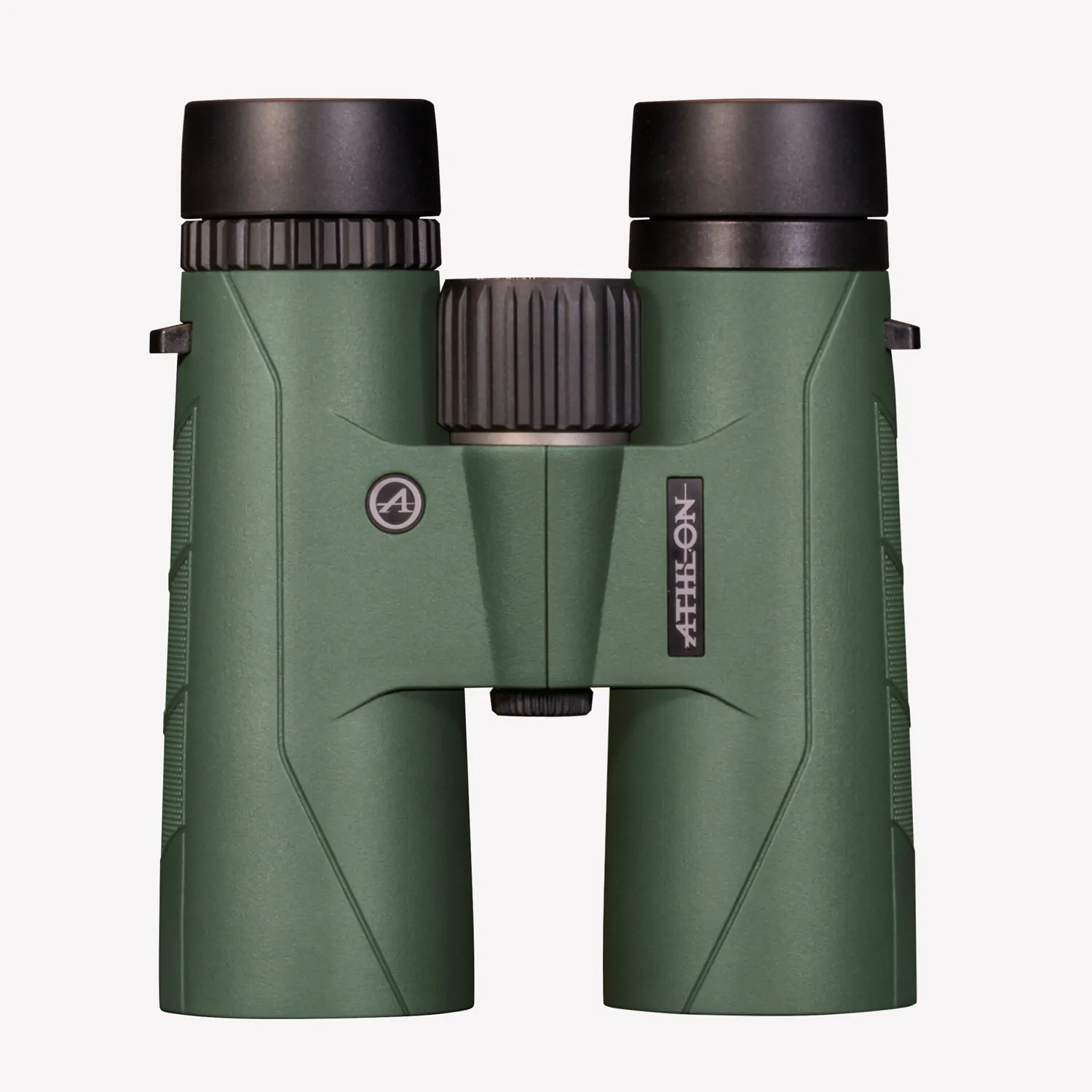
Explore this need in the finder →The Athlon Forerunner 10x42 is a fixed-power, full-size binocular for viewers who want 10x reach in a relatively manageable 24-ounce body. Its useful published distinctions are a 6.4-degree real field, 16.1 mm eye relief, 14.7-foot close focus and a 53–72 mm interpupillary range. Those numbers make it easy to screen against concrete needs; they do not establish comparative sharpness or guarantee fit on a particular face.
Reach and scene width
At 10x, distant details look larger than through an 8x binocular, but the narrower view and greater sensitivity to hand movement make it harder to keep a moving bird centered. Athlon lists a 6.4-degree real field, equivalent to 336 feet at 1,000 yards. That clears a six-degree “wide real field” threshold, but it is not the broadest way to scan a busy hedgerow or follow a nearby flock. If finding a subject quickly matters more than apparent reach, the 8x42 alternative is the more forgiving starting point. If you routinely observe far-off wildlife or sporting action, the extra magnification can be the more useful compromise.
The fixed 10x power is simple: there is no zoom range to adjust, and no claim of image stabilization. The specification sheet names BaK-4 prisms and fully multi-coated optics. It does not identify ED glass, phase correction, or a dielectric prism coating for this exact SKU, so those features should not be assumed from the brand or appearance.
Fit, focus and close subjects
The listed 16.1 mm eye relief and 53–72 mm interpupillary range are useful first checks if more than one person will share the binocular. In particular, the 53 mm minimum may matter to a narrower-set viewer. Neither number promises that a specific glasses frame will leave the full field visible; face shape, eyecup position and eye placement still matter. The manual describes twist-up eyecups and a separate diopter adjustment used with the center-focus control. Take time to set both before judging the view, and reset the diopter if another viewer changes it.
Athlon lists a 14.7-foot close-focus distance. That is adequate for many normal outdoor observations but not a close-focus specialist design; a user who often studies nearby insects or exhibits should set a much shorter close-focus ceiling and compare models that actually meet it. The published figure is a manufacturer specification, not a measurement from our own bench.
Carry, weather and support
At 24 ounces for the instrument, the Forerunner is lighter on paper than the Midas UHD 10x42 (25 ounces) but remains a full-size 42 mm pair rather than a pocket binocular. The manufacturer describes it as waterproof and nitrogen-purged. No immersion depth, duration, or protection-code rating appears in the reviewed model sheet, so “waterproof” should not be read as a quantified diving or underwater-use promise.
The model manual documents a tripod-adapter socket with standard 1/4-20 threads. That confirms an optional support path, not an adapter in the box: the package contents were not established in the reviewed evidence. A tripod can help when a stationary 10x view feels tiring, but handheld use remains the straightforward plan. Like any ordinary binocular, this one must never be pointed at the Sun; the manual warns that direct solar viewing can injure your eyes.
How to use the questionnaire
For ordinary birding, wildlife, travel or outdoor events, start with general viewing, then select 10x and 42 mm if those are firm preferences. The published field clears a six-degree real-view requirement, and the listed waterproof construction can meet a waterproof-essential choice. A 16 mm minimum eye-relief setting narrowly passes at 16.1 mm; raising the minimum to 17 mm removes this model. A 24-ounce carry ceiling passes exactly, while a 23-ounce maximum does not. Likewise, a 15-foot close-focus limit admits the listed 14.7 feet, but a stricter 14-foot limit rejects it. These are different needs, not one universal “best” setting.
Use ED glass, phase coatings, or a direct 1/4-20 port as strict filters only when those capabilities matter to you. The reviewed Forerunner sources do not confirm the first two; the manual does confirm tripod-adapter compatibility. Unknown coating details cannot satisfy an essential coating requirement.
Alternatives and limits
The older Athlon Midas UHD 8x42 offers a much broader listed field (426 feet per 1,000 yards), 17.2 mm eye relief and 6.5-foot close focus, at 25 ounces. Choose that 8x configuration when broad scanning, a longer stated eye-relief figure or closer focus outranks the Forerunner’s 10x reach and one-ounce lower listed mass. The separate Midas UHD 10x42 keeps 10x/42 mm dimensions but adds manufacturer-listed ED glass, phase and dielectric coatings, and a shorter 8.2-foot close focus; its listed mass is 25 ounces and eye relief is 15.2 mm. These Midas UHD configurations are not the later Midas G2 UHD 10x42, which has its own SKU and assessment. The Forerunner is most defensible when the 10x42 format, its measured-on-paper fit limits, and straightforward hand-held operation match your plan—not when you need undocumented optical coatings, a pocketable instrument, or a quantified immersion rating.
Manufacturer references: Forerunner 10x42 product page, SKU 117001 specification sheet, and Forerunner binocular manual.
Key specifications
Key details at a glance
| Magnification | 10× |
|---|---|
| Objective diameter | 42 mm |
| Real field of view | 6.4° |
| Eye relief | 16.1 mm |
| Close focus distance | 14.7 ft |
| Manufacturer-published weight | 24 oz |
More specifications and setup details
| Lens and prism coatings | Athlon lists BaK-4 prisms and fully multi-coated optics. The exact reviewed sheet does not list ED, phase or dielectric coatings. |
|---|---|
| Water and fog protection | Athlon labels this exact configuration waterproof and identifies its gas purge, but no IP-style code or immersion depth/duration is published in the reviewed exact sources. |
| Tripod use | Manual confirms an adapter socket with 1/4-20 thread; the adapter is not confirmed as a package item. |
| Published weight note | Manufacturer-listed binocular weight only; it was not independently measured and excludes the carrying kit. |
| Manufacturer-rated waterproof | Yes |
| Integrated laser rangefinder | No |
| Onboard ballistic solution display | No |
| Direct 1/4-20 tripod thread confirmed | Yes |
Use the exact model’s instructions for operating limits, supplied equipment and version differences.
Sources for this review
Sources for this assessment

Choose your optical trade-off first.
Choose viewing purpose first, then magnification, objective size, scene width and any fit, weather or mounting constraint. A direct-Sun requirement is separate: only exact manufacturer-confirmed solar binoculars can pass it.