
On this page
Your needs, this model
Does it fit your priorities?
Does the exact SKU 111004 meet a fixed 10x42 preference?
Yes. Athlon’s exact product page and 111004 sheet identify a fixed 10x42 configuration.
Explore this need in the finder →Does the published 19.3 mm eye relief clear a 19 mm screening minimum?
Yes, by 0.3 mm on Athlon’s published number; individual eyeglass comfort and full-field visibility still depend on fit.
Explore this need in the finder →Can an essential close-focus maximum be verified for this exact 111004 model?
No. The exact page and SKU sheet say 6.6 ft, but Athlon’s 2025 comparison chart lists 338 ft in the close-focus column; keep the value unknown for hard matching.
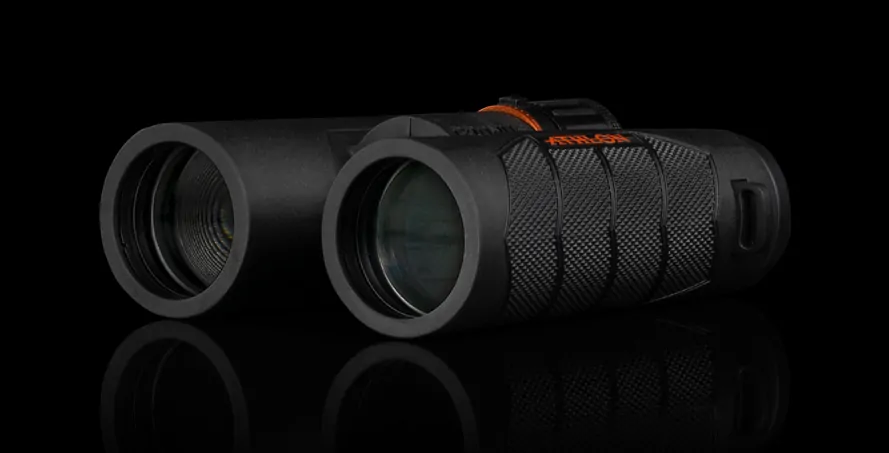
Explore this need in the finder →Athlon’s Cronus G2 UHD 10x42 is a fixed-power roof binocular with a 6.5° real field (338 feet at 1,000 yards), 19.3 mm listed eye relief and 27.8-ounce instrument weight. Its close-focus distance is unresolved in Athlon’s own sources: the exact 111004 product page and sheet both list 6.6 feet, while the 2025 catalog comparison chart prints 338 feet in the close-focus column. That conflict makes a near-focus threshold unsafe to treat as verified. It is the more manageable Cronus option for general wildlife and bird observation when you want 10x reach, but not the 45.2-ounce 15x56. It is still a full-size 10x instrument, not a pocket pair or a promise of a shake-free view.
Ten power is a deliberate compromise
Magnification changes how a distant subject appears, but it also makes the view harder to keep steady and narrows the scene compared with a lower-power model. Athlon lists 338 feet per 1,000 yards for this Cronus. Its own Midas G2 8x42 specification lists 426 feet at that distance, so the 8x configuration gives a broader real scene for locating a bird in brush or tracking movement. The Cronus 10x42 is more compelling when subjects are often distant, the viewer is comfortable scanning in a narrower window, and extra reach matters more than the easier framing of 8x.
Within the Cronus pair, this model is the practical carry choice. The 15x56 raises fixed magnification but has a 235-foot field and weighs 45.2 ounces. The 10x42’s published 27.8 ounces leaves less weight on a walk, while its field is wider and its listed eye relief longer. Those differences are useful selection facts; they are not evidence that one specimen resolves finer detail or is brighter in a controlled comparison.
Near focus and fit matter more than a coating checklist
The SKU-specific product page and sheet give a 6.6-foot close-focus figure, but the 2025 Athlon catalog chart shows 338 feet in this model’s close-focus column. Athlon’s archived sources do not explain or correct the discrepancy, so the hard-matching value remains unknown. If a short limit matters for butterflies, a nearby feeder, or an object across a small garden, do not select the 10x42 solely on its 6.6-foot figure; verify it with the manufacturer or compare an alternative whose exact sources agree. Even an agreed published figure would not be a real-world focusing guarantee for every eyesight setting.
The listed 19.3 mm eye relief clears a 19 mm numerical screen only narrowly. If you wear glasses, that number is a sensible filter, not proof that your frames will leave the full field visible. The Cronus manual explains how to lower the twist-up eyecups for glasses, set interpupillary distance, focus the left side with the center wheel, then lock the right-side diopter adjustment. A short hands-on fit check remains worthwhile when eyeglass comfort is essential.
Athlon describes UHD/ED glass, phase-corrected BaK-4 roof prisms, ESP dielectric reflective coating and advanced fully multi-coated optics. It also lists a magnesium chassis. Those construction details identify what the maker built; they do not substitute for comparative field testing, and they cannot guarantee a personal impression of color, edge sharpness or low-light performance.
Weather protection and a stable view
The manufacturer describes the instrument as waterproof and argon purged. The reviewed page and specification sheet do not provide an immersion depth, duration or IP rating, so do not treat those terms as permission for underwater use. The manual recommends careful lens cleaning: remove grit first with a soft lens brush or air, then use a clean microfiber cloth rather than a coarse fabric.
A standard 1/4-20 tripod socket is confirmed in the shared Cronus manual. You can build a supported viewing plan around a separate compatible adapter, but whether an adapter is included in a particular retail package was not established. The regular handheld plan is still the natural one for 10x42; mounting is a useful option for longer, stationary sessions.
Who should choose it
Choose this model if your ordinary answers are “10x,” “42 mm,” and “general wildlife or birding,” and the published 27.8-ounce mass and 19.3 mm eye relief meet your own limits. If quick framing, moving subjects or a strict lightweight kit dominate, compare an 8x42. If the task is distant detail from a supported position and higher power is the priority, the 15x56 is the more specialized Cronus, but its narrower field, greater weight and longer close-focus distance are substantial trade-offs. Because the 10x42’s exact-source close-focus distance is unresolved, an essential six-foot (or similar) maximum cannot be confirmed; leave it unmatched for that requirement instead of interpreting the chart cell. None of these binoculars is for direct solar viewing; the manufacturer manual warns against looking at the Sun.
Key specifications
Key details at a glance
| Magnification | 10× |
|---|---|
| Objective diameter | 42 mm |
| Real field of view | 6.5° |
| Eye relief | 19.3 mm |
| Manufacturer-published weight | 27.8 oz |
| ED glass confirmed for this exact model | Yes |
More specifications and setup details
| Phase coatings confirmed | Yes |
|---|---|
| Locking diopter ring confirmed | Yes |
| Lens and prism coatings | Athlon specifies UHD/ED glass, phase-corrected BaK-4 roof prisms, ESP dielectric coating and advanced fully multi-coated optics. These are manufacturer descriptions, not independent comparative test results. |
| Water and fog protection | Athlon describes the instrument as waterproof and argon purged; no immersion depth/time or IP rating was found in the exact page/sheet. |
| Tripod use | The manual confirms the standard 1/4-20 tripod socket. A separate adapter is needed to use a tripod, and whether one is included is unknown. |
| Published weight note | Athlon-listed optical instrument weight only; not independently measured and excludes carrying kit. |
| Manufacturer-rated waterproof | Yes |
| Built-in image stabilization confirmed | No |
| Integrated laser rangefinder | No |
| Onboard ballistic solution display | No |
| Direct 1/4-20 tripod thread confirmed | Yes |
Use the exact model’s instructions for operating limits, supplied equipment and version differences.
Sources for this review
Sources for this assessment
- Athlon U.S. binocular family index
- Athlon Cronus G2 UHD binocular category
- Athlon Cronus G2 UHD 10x42 exact manufacturer product page
- Athlon Cronus G2 UHD 10x42 product-specific specification sheet
- Athlon Cronus G2 UHD binocular user manual
- Athlon Cronus G2 UHD 10x42 manufacturer-linked product image
- Athlon 2025 official product catalog, printed binocular comparison pages 24–25

Choose your optical trade-off first.
Choose viewing purpose first, then magnification, objective size, scene width and any fit, weather or mounting constraint. A direct-Sun requirement is separate: only exact manufacturer-confirmed solar binoculars can pass it.