
On this page
Your needs, this model
Does it fit your priorities?
Would a fixed 8x42 fit a general-viewing choice?
Yes. Athlon names this exact fixed 8x42 configuration and SKU 114012 on its U.S. page and sheet.
Explore this need in the finder →Does its 17.3 mm published eye relief clear a 17 mm minimum?
Yes numerically by 0.3 mm; this is not a guarantee of full-field glasses fit.
Explore this need in the finder →Does the stated 13 ft close-focus distance meet a 13 ft maximum?
Yes at the published boundary; it does not meet a stricter 12 ft maximum.
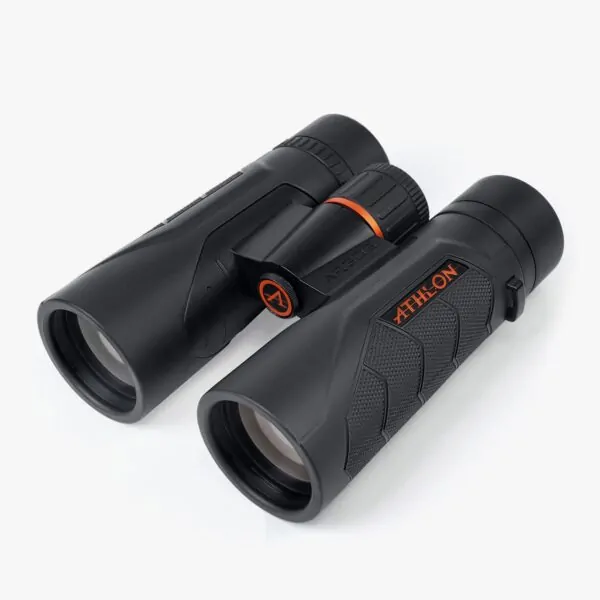
Explore this need in the finder →The Athlon Argos G2 UHD 8x42 is the broader-view member of this two-model Argos 42 mm pair. Athlon lists a 7.1-degree real field (371 feet at 1,000 yards), 17.3 mm of eye relief, a 13-foot close-focus distance and a 25.5-ounce instrument weight. Choose it when easy scene finding and 8-power steadiness matter more than squeezing extra magnification from the same-size objective; it is not lighter than the 10x42 sibling.
Why choose 8x42 over 10x42?
Both Argos models use 42 mm objectives and weigh the same 25.5 ounces, so this is a viewing-style decision rather than a compact-versus-full-size trade. The 8x42 gives a wider real scene: 371 feet at 1,000 yards versus the 10x42’s 319 feet. That difference is useful when you are locating a bird in branches, following movement across a clearing or scanning a landscape without frequently losing the subject at the edge of the view. Lower power is also easier to keep steady for many people, although posture, hand steadiness and viewing time still matter.
The 10x42 brings more apparent reach for a distant stationary subject, but asks you to accept a narrower field and typically more visible hand movement. If your usual answer is “find and follow” rather than “inspect from far away,” the 8x42 is the more forgiving choice. The listed field and magnification describe the specification, not a laboratory comparison of resolution, contrast or edge quality.
Eye relief and close focus are useful screens, not guarantees
Athlon publishes 17.3 mm of eye relief for the 8x42, 1.2 mm more than it lists for its 10x42 sibling. That makes the 8x the stronger numerical starting point if you wear glasses, but it cannot promise that a particular frame will reveal the whole field. The shared Argos G2 UHD manual says to lower the twist-up eyecups for glasses and to adjust interpupillary distance until the two images merge. It also describes focusing the left side with the center wheel before setting the right-eye diopter ring. If full-field visibility with glasses is essential, try the exact binocular with your glasses rather than treating the spec as a fit certificate.
The manufacturer lists 13 feet as the close-focus distance for both 42 mm Argos models. This is adequate for many distant outdoor subjects but is not a close-focus choice for nearby butterflies or objects across a small room. A shorter maximum-distance questionnaire answer would rule this model out; do not round 13 feet down to meet a strict 12-foot need.
What the optical feature list does and does not tell you
Athlon’s exact product page and sheet describe UHD/extra-low-dispersion glass, BaK-4 prisms, phase correction, ESP dielectric prism coating, XPL protective coating and advanced fully multi-coated lenses. The specification also identifies a magnesium chassis. These are concrete construction claims, not a promise that every viewer will perceive a particular sharpness, color balance or low-light result. No independent transmission, resolution or durability test is claimed here, and those properties cannot be ranked from the coating names alone.
The manufacturer calls the binocular waterproof, fog-proof and argon-purged. The reviewed materials do not give an IP code or immersion depth and duration, so these terms should not be converted into an underwater rating. Use the supplied care instructions: remove grit with a soft lens brush or air before wiping, then use clean microfiber; rough or dirty material can scratch the optical surfaces.
Handheld use first; mounting remains an option
At 8x, this model is well suited to ordinary handheld birding, wildlife observation and general outdoor viewing. The manual confirms a tripod socket beneath the center-hinge logo plate with a standard 1/4-20 thread. A compatible adapter may still be needed to attach a tripod, and the sources reviewed do not establish that one is included in the retail box. The 25.5-ounce listed instrument mass also makes this a full-size carry, not a pocket pair; a neck strap and a supportive carry plan matter on longer walks.
Who should buy it—and what to compare
Put the Argos G2 UHD 8x42 on your shortlist if you want fixed 8x power, a 42 mm objective, a published wide real field and manufacturer-stated weather protection. Its more comfortable framing than the matching 10x42 is the strongest reason to prefer it, especially for moving wildlife or casual scanning. It does not save weight, focus closer or claim a different weather rating from the sibling.
Choose the Argos 10x42 instead if your ordinary subjects are distant and you accept its 6.1-degree field and slightly shorter 16.1 mm eye relief. If you want a lower instrument weight or a closer stated focus distance, compare Athlon’s Midas G2 UHD 10x42: its exact sheet lists 23.3 ounces and 8.2 feet, versus 25.5 ounces and 13 feet for this Argos 8x42, though its magnification is 10x and its listed eye relief is 15.2 mm. Compare current exact specifications and try the eyecup position that matches your face. Neither model is a solar-viewing binocular; the manual warns never to look directly at the Sun.
Manufacturer references: Argos G2 UHD 8x42 product page and 8x42 specification sheet.
Key specifications
Key details at a glance
| Magnification | 8× |
|---|---|
| Objective diameter | 42 mm |
| Real field of view | 7.1° |
| Field width at 1,000 m | 124 m |
| Eye relief | 17.3 mm |
| Close focus distance | 13 ft |
More specifications and setup details
| Manufacturer-published weight | 25.5 oz |
|---|---|
| ED glass confirmed for this exact model | Yes |
| Phase coatings confirmed | Yes |
| Lens and prism coatings | Manufacturer lists UHD/extra-low-dispersion glass, phase-corrected BaK-4 prisms, ESP dielectric coating, XPL protective coating and advanced fully multi-coated lenses. Prism geometry and all-prism multilayer coating status are not separately stated. |
| Water and fog protection | Manufacturer states waterproof, fog-proof and argon-purged; no immersion rating is published in the reviewed page/sheet. |
| Tripod use | The manual confirms a socket beneath the center-hinge logo plate with standard 1/4-20 threads. A separate adapter may be needed; box inclusion is unknown. |
| Published weight note | Instrument weight as published on the product-specific specification sheet; the separately listed 2.5 lb package weight is not the binocular mass. |
| Manufacturer-rated waterproof | Yes |
| Direct 1/4-20 tripod thread confirmed | Yes |
Use the exact model’s instructions for operating limits, supplied equipment and version differences.
Sources for this review
Sources for this assessment

Choose your optical trade-off first.
Choose viewing purpose first, then magnification, objective size, scene width and any fit, weather or mounting constraint. A direct-Sun requirement is separate: only exact manufacturer-confirmed solar binoculars can pass it.