
On this page
Your needs, this model
Does it fit your priorities?
Would a fixed 8x42 and wide real field suit general scanning?
Yes. Athlon identifies SKU 114010 as fixed 8x42 and publishes a 7.1-degree real field (371 ft at 1,000 yd), clearing the finder wide-real threshold.
Explore this need in the finder →Does the published 17.3 mm eye relief clear a 17 mm numeric screen?
Yes by 0.3 mm. That published-number pass is not a guarantee of full-field viewing through a particular eyeglass frame.
Explore this need in the finder →Does the stated 13 ft close focus meet a 13 ft maximum?
Yes at the published boundary; it does not satisfy a stricter 12 ft limit.
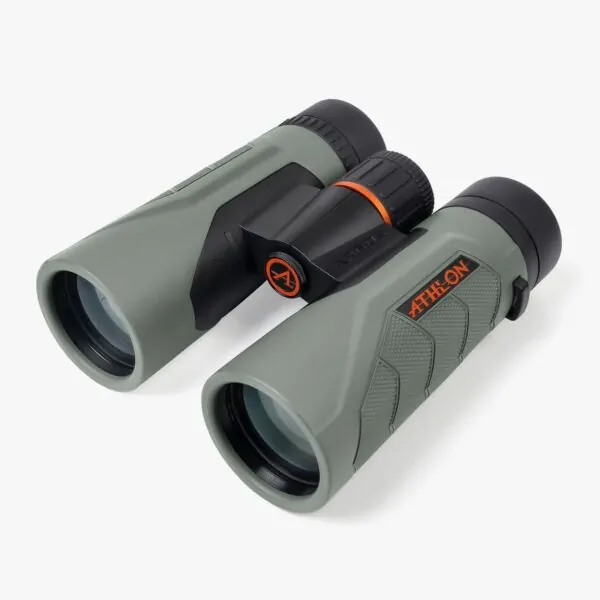
Explore this need in the finder →The Athlon Argos G2 HD 8x42 (SKU 114010) is the broad-view choice in Athlon’s four-model Argos G2 HD line. Its published 371-foot field at 1,000 yards and 7.1-degree real field favor scanning and following movement; the 25.5-ounce body is the same listed weight as the 10x42. Pick this configuration for an easier-to-frame 8x view, not because it is a smaller or lighter package.
Why the 8x42 is the line’s easiest general-viewing option
Eight power gives a relatively wide view for locating a moving bird, finding an animal against brush, or sweeping a landscape without repeatedly losing the subject at the edge. Athlon lists 371 feet at 1,000 yards, compared with 319 feet for the Argos G2 HD 10x42. The 7.1-degree real field is also above the finder’s “wide real view” cutoff. These figures describe framing, not measured sharpness or a guarantee that every viewer will find the image steady; hand control, stance and viewing time still matter.
The useful comparison is the 10x42, not a compact-versus-full-size distinction. Both 42 mm versions are listed at 25.5 ounces, share the 13-foot close-focus claim, and have the same published body dimensions. The 8x42 gives up magnification but gains 52 feet of field width at the manufacturer’s 1,000-yard reference and 1.2 mm of stated eye relief. For casual birding, general outdoor viewing and moving subjects, that is a sensible exchange. For distant perched wildlife, the 10x42 brings more reach without a weight penalty, although its narrower field is more demanding to reacquire through.
Eye relief is a useful starting point, not an eyeglass guarantee
Athlon specifies 17.3 mm of eye relief and a 56–76 mm interpupillary range. That is the better number among the two Argos HD 42 mm models if glasses are part of your setup, but it cannot establish that a particular frame will show the complete field. The manual says to turn the eyecups down for eyeglasses, set barrel spacing until the view is a single full circle, focus the left side with the center wheel, then tune the right-eye diopter. Try the exact instrument with your glasses if full-field visibility is essential. Its fixed 13-foot close focus is not suited to butterflies, close tabletop details or other near-subject work.
HD glass and the coating list need careful interpretation
The exact product page and specification sheet identify this as the HD, not UHD, Argos configuration. Athlon describes the family’s HD glass as low-dispersion glass and lists BaK-4 prisms, phase correction, ESP dielectric prism coating, XPL exterior protection, advanced fully multi-coated lenses and a magnesium chassis. These are manufacturer construction claims; they do not supply a comparative resolution test, measured light transmission or a promise of a particular color balance. The separate Argos G2 UHD 8x42 is the relevant alternative if the manufacturer’s explicit UHD/extra-low-dispersion designation is a priority. Do not treat “HD” and “UHD” as interchangeable names.
Athlon calls the Argos G2 HD waterproof and argon-purged. The reviewed page and sheet do not publish an IP code or immersion depth and duration, so the wording should not be taken as an underwater rating. The Argos manual recommends removing grit before wiping, using a clean microfiber cloth, and avoiding dirty or rough material that can scratch the lenses.
Handheld first, with a practical mounting option
At 8x, the 8x42 is the line’s natural handheld choice when you want a forgiving view. The manual also confirms a tripod-adapter socket with standard 1/4-20 threads beneath the center-hinge logo plate. A compatible adapter is needed to attach a tripod; the product page and manual do not establish that an adapter is included in the retail package. The 25.5-ounce published instrument weight is a real carry consideration for a long walk, even though it is lighter than either 50 mm Argos HD model.
The family’s twist-up eyecups, center focus and right-eye diopter make it adjustable for different viewers, but the diopter’s numeric range and locking status are not stated. The shared manual explains setup and maintenance; its direct-Sun warning matters for every ordinary binocular. This is not a solar viewer.
Who should choose it?
Choose the Argos G2 HD 8x42 if you value scene-finding, moving-subject framing and a 42 mm body more than extra power. The 8x42 does not focus closer, weigh less or claim a different weather rating than its 10x42 sibling; its case rests on the 7.1-degree field and 17.3 mm eye-relief specification. If your target is distant and mostly stationary, compare the 10x42. If you want 10x with a larger objective and accept six additional ounces, compare the 10x50. If a specifically UHD glass designation matters, compare the reviewed Argos G2 UHD 8x42 and decide from the exact feature claims rather than assumed visual superiority.
Manufacturer references: Argos G2 HD 8x42 product page, 8x42 specification sheet, and Argos G2 HD manual.
Key specifications
Key details at a glance
| Magnification | 8× |
|---|---|
| Objective diameter | 42 mm |
| Real field of view | 7.1° |
| Field width at 1,000 m | 124 m |
| Eye relief | 17.3 mm |
| Close focus distance | 13 ft |
More specifications and setup details
| Manufacturer-published weight | 25.5 oz |
|---|---|
| Phase coatings confirmed | Yes |
| Lens and prism coatings | The exact sheet lists HD family glass, BaK-4 prisms, phase correction, ESP dielectric coating, XPL exterior coating and advanced fully multi-coated lenses. Athlon describes HD glass as low dispersion but does not identify this SKU as UHD/extra-low-dispersion; explicit ED glass status is left unknown. |
| Water and fog protection | Athlon describes the Argos G2 HD as waterproof and argon-purged/fog protective; reviewed sources publish no IP rating, immersion depth or underwater-use condition. |
| Tripod use | The shared family manual confirms a socket with standard 1/4-20 threads. A compatible tripod adapter is needed; retail box inclusion is unknown. |
| Published weight note | Instrument weight as published on the exact product-specific specification sheet; package weight is separately stated and is not the binocular mass. |
| Manufacturer-rated waterproof | Yes |
| Integrated laser rangefinder | No |
| Onboard ballistic solution display | No |
| Direct 1/4-20 tripod thread confirmed | Yes |
Use the exact model’s instructions for operating limits, supplied equipment and version differences.
Sources for this review
Sources for this assessment
- Athlon U.S. binocular family index
- Athlon Argos G2 HD U.S. category
- Athlon Argos G2 HD 8x42 exact manufacturer product page
- Athlon Argos G2 HD 8x42 product-specific specification sheet
- Athlon Argos G2 HD 42 mm binocular manual
- Athlon Argos G2 HD 8x42 manufacturer page-linked image
- CPSC recalls search (Athlon Argos G2 HD / SKUs 114010–114007)

Choose your optical trade-off first.
Choose viewing purpose first, then magnification, objective size, scene width and any fit, weather or mounting constraint. A direct-Sun requirement is separate: only exact manufacturer-confirmed solar binoculars can pass it.