
On this page
Your needs, this model
Does it fit your priorities?
Would fixed 10x42 fit a general-viewing choice?
Yes. The exact U.S. product page and SKU 114009 specification sheet identify a fixed 10x42 configuration.
Explore this need in the finder →Does the listed 16.1 mm eye relief clear a 16 mm numerical floor?
Yes by 0.1 mm only; the number alone cannot certify full-field fit with glasses.
Explore this need in the finder →Does its 6.1-degree real field pass the wide-real finder threshold?
Yes. The product-specific sheet gives 6.1 degrees and 319 ft at 1,000 yd; it does not establish a wide apparent field.
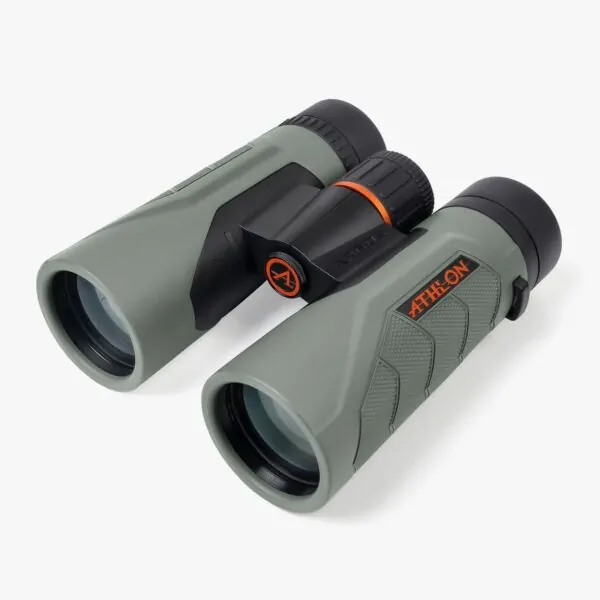
Explore this need in the finder →The Athlon Argos G2 HD 10x42 (SKU 114009) is the reach-oriented 42 mm option in a line whose 8x42 is easier to scan with. Athlon lists a 6.1-degree real field, 319 feet at 1,000 yards, 16.1 mm eye relief, 13-foot close focus and 25.5-ounce instrument weight. It suits distant stationary subjects when you want 10x without moving up to the heavier 50 mm bodies.
More reach, with a tighter frame
At the same 25.5-ounce listed mass as the 8x42, the 10x42 offers stronger magnification rather than a larger or heavier body. The trade is visible in the manufacturer’s field figures: 319 feet at 1,000 yards versus 371 feet for the 8x42. Athlon’s 6.1-degree real field just clears the finder’s “wide real view” threshold, but a moving bird in branches will be less forgiving to acquire than through the 8x. More hand movement is also apparent at higher power for many users, so a steady stance matters even though the package is still intended for ordinary handheld use.
For distant wildlife, a parked vehicle or a fixed point across a valley, 10x can help you inspect more detail than the 8x sibling. That is a use-based advantage, not a claim of measured resolving power. If the subject moves quickly or the binocular is shared among viewers who want quick, relaxed scanning, the 8x42’s wider real view is often the more practical answer. Both models are listed at the same weight, body dimensions and 13-foot near focus, so selecting the 10x42 does not buy a shorter focus distance or save carry weight.
Check eye relief against your own glasses
The 16.1 mm stated eye relief is shorter than the 8x42’s 17.3 mm. A 16 mm questionnaire floor is met numerically, but that tiny margin cannot promise full-field visibility with glasses. Frame shape, how close the lenses sit to your eyes and the eyecup position all affect the result. Athlon’s manual says to turn the cups down for eyeglasses, match the interpupillary spacing until one complete circle is visible, focus one barrel with the center wheel and set the right-eye diopter separately. Test the exact binocular with your glasses before relying on its published eye-relief number for a critical fit.
At 13 feet, the close-focus specification is shared by all four Argos G2 HD configurations. That is a material limit for close nature subjects and small indoor details. A strict 12-foot maximum is not satisfied by a published 13-foot figure; the finder should not round that requirement away.
Understand what the HD construction claim means
The exact page and SKU-specific sheet call this the Argos G2 HD 10x42. The product family describes HD glass as low-dispersion, and the sheet lists BaK-4 prisms, phase-corrected prisms, ESP dielectric coating, XPL protective coating, advanced fully multi-coated lenses and a magnesium chassis. Athlon’s product-category text says the magnesium chassis reduces weight relative to typical aluminum materials, but the useful carry number remains 25.5 ounces for this instrument. The listed features do not substitute for an independent optical test, and no laboratory comparison of edge sharpness, contrast or transmission is claimed here.
Athlon labels the configuration waterproof and argon-purged. The reviewed sources do not state an IP rating or define a submersion depth and time. Treat weather protection as the manufacturer describes it, not as permission to use the binocular underwater. Keep lens care simple: clear grit before wiping, then use a clean soft cloth.
A useful tripod thread, but not a known in-box adapter
The Argos HD manual confirms a tripod-adapter socket with a standard 1/4-20 thread. That means a compatible adapter-based mount is supported, not that the binocular directly clamps onto every tripod or that an adapter is supplied. Package contents are not established by the checked product page, sheet or manual. At 10x, mounting can help for prolonged stationary viewing, while a free-standing 25.5-ounce 42 mm binocular remains more convenient to carry than the 31.5-ounce 50 mm models.
The eye cups turn up and down, and the center-focus/right-diopter setup is documented, but Athlon does not give a numerical diopter range or say that the ring locks. The manual also warns never to look directly at the Sun. This ordinary Argos configuration has no dedicated solar filter.
When to choose another Argos
Choose the HD 10x42 if 10x and the lighter 42 mm body are the priority. Pick the HD 8x42 for a wider field and 1.2 mm more published eye relief without a weight change. The HD 10x50 preserves 10x and adds a 50 mm objective, with 17 mm stated eye relief, but raises the listed weight by six ounces and narrows the real field to 5.8 degrees. The Argos G2 UHD 10x42 is the direct glass-tier comparison if the manufacturer’s UHD/extra-low-dispersion designation matters. Those claims should guide what to compare, not be treated as proof of a visible result for every user.
Manufacturer references: Argos G2 HD 10x42 product page, 10x42 specification sheet, and Argos G2 HD manual.
Key specifications
Key details at a glance
| Magnification | 10× |
|---|---|
| Objective diameter | 42 mm |
| Real field of view | 6.1° |
| Field width at 1,000 m | 106 m |
| Eye relief | 16.1 mm |
| Close focus distance | 13 ft |
More specifications and setup details
| Manufacturer-published weight | 25.5 oz |
|---|---|
| Phase coatings confirmed | Yes |
| Lens and prism coatings | The exact sheet lists HD family glass, BaK-4 prisms, phase correction, ESP dielectric coating, XPL exterior coating and advanced fully multi-coated lenses. Athlon describes HD glass as low dispersion but does not identify this SKU as UHD/extra-low-dispersion; explicit ED glass status is left unknown. |
| Water and fog protection | Athlon describes the Argos G2 HD as waterproof and argon-purged/fog protective; reviewed sources publish no IP rating, immersion depth or underwater-use condition. |
| Tripod use | The shared family manual confirms a socket with standard 1/4-20 threads. A compatible tripod adapter is needed; retail box inclusion is unknown. |
| Published weight note | Instrument weight as published on the exact product-specific specification sheet; package weight is separately stated and is not the binocular mass. |
| Manufacturer-rated waterproof | Yes |
| Integrated laser rangefinder | No |
| Onboard ballistic solution display | No |
| Direct 1/4-20 tripod thread confirmed | Yes |
Use the exact model’s instructions for operating limits, supplied equipment and version differences.
Sources for this review
Sources for this assessment
- Athlon U.S. binocular family index
- Athlon Argos G2 HD U.S. category
- Athlon Argos G2 HD 10x42 exact manufacturer product page
- Athlon Argos G2 HD 10x42 product-specific specification sheet
- Athlon Argos G2 HD 42 mm binocular manual
- Athlon Argos G2 HD 10x42 manufacturer page-linked image
- CPSC recalls search (Athlon Argos G2 HD / SKUs 114010–114007)

Choose your optical trade-off first.
Choose viewing purpose first, then magnification, objective size, scene width and any fit, weather or mounting constraint. A direct-Sun requirement is separate: only exact manufacturer-confirmed solar binoculars can pass it.