
On this page
Your needs, this model
Does it fit your priorities?
Are you looking for this exact earlier 10x42, or only current models?
The exact U.S. page identifies SKU VPR-10-VX and marks it INACTIVE. Include it only when earlier models are allowed; it is an identification/comparison reference, not an offer.
Explore this need in the finder →Does the published field meet your field-of-view preference?
The page lists 6.1° angular field and 391 ft/1,000 yd; these entries conflict but both clear the at-least-6° broad-real choice. Apparent field is not listed, so a 60° apparent-field requirement is unconfirmed.
Explore this need in the finder →Does its stated eye relief meet your minimum?
Vortex lists 16.5 mm. That clears a 16.5 mm minimum, not 17 mm, and does not guarantee a full field behind every pair of glasses.
Explore this need in the finder →Can the instrument meet a strict carry-weight maximum?
The exact page does not list this SKU’s weight. It remains in an unconstrained earlier-model comparison, but unknown weight cannot satisfy a selected maximum.
Explore this need in the finder →Is confirmed waterproofing essential for your use?
The page lists a rainguard but gives no waterproof rating; an eyepiece cover does not establish housing protection. This profile cannot meet an essential waterproof request.
Explore this need in the finder →Vortex’s U.S. inactive directory links Viper 10x42 SKU VPR-10-VX. This earlier fixed-power model is useful for identifying an existing pair or evaluating a particular used unit, not as a current offer. The SKU matters: Viper 10x42 also names a separate Viper HD configuration, and the family label is not a generation bridge.
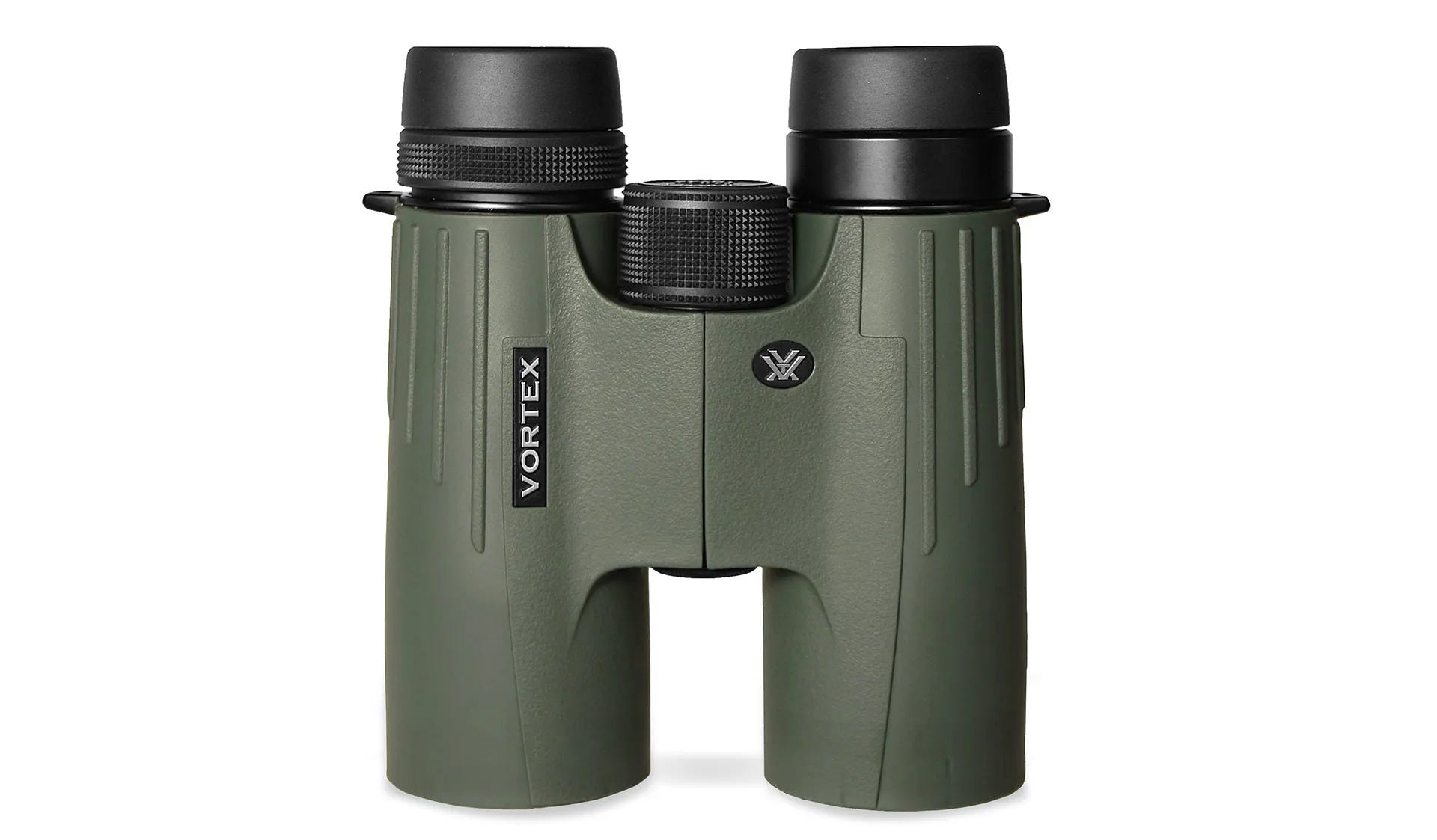
Image source and model notes
What the exact 10x42 profile establishes
The product page identifies fixed 10x magnification and 42 mm objectives. On paper, 10x brings more detail on distant wildlife or an event than 8x, while also enlarging hand movement and leaving less margin when quickly finding a moving subject. Compared with a 12x pair using the same objective size, this 10x configuration is usually the easier handheld starting point; this is an optical tradeoff, not a hands-on stability test. Vortex describes it as an all-around long-distance hunting binocular, but that marketing line does not establish weather protection or field performance.
One specification issue deserves attention. The exact page lists both a 6.1-degree angular field and a linear field of 391 feet at 1,000 yards. Those two published numbers do not reconcile, so neither is silently “corrected” here. Both are retained as the manufacturer’s figures, and the discrepancy means the precise field width remains uncertain. The listed 6.1 degrees does clear a six-degree broad-real-field choice; the page does not publish an apparent-field number, so a requirement for a 60-degree apparent view is not established.
The 4.2 mm exit pupil is the 42 mm objective divided by 10x, a geometric figure rather than a measured brightness or transmission result. A 42 mm objective can be a practical all-purpose size, but it cannot by itself predict how bright or contrasty the image looks at dusk. No independent optical testing is claimed here.
Fit, focus and carrying questions
Vortex lists 16.5 mm eye relief. That is a useful comparison number, not a guarantee that every eyeglass frame will show the full field. If glasses stay on while you view, try the actual pair with your frames before relying on the published figure. In the finder this profile clears a 16.5 mm minimum, but not 17 mm. The listed interpupillary range is 59–75 mm; anyone outside that range should check fit rather than assume the hinge will align comfortably.
The page gives a 5.1-foot close-focus figure. That can be useful when a subject is nearby, although this remains a conventional distant-viewing binocular rather than a dedicated close-up optic. The manufacturer lists 5.8 inches high and 5.3 inches wide. It does not list the instrument’s weight here, so a buyer with a strict weight ceiling cannot treat the unknown as a pass or infer it from the similarly sized Viper HD.
What arrives—and what the page does not say
The listed box contents are a rainguard, tethered objective lens covers, a deluxe contoured neck strap and a deluxe padded carry case. No tripod adapter is on that list. It does not establish whether the binocular accepts a separate adapter, so leave tripod compatibility unresolved if it is essential. The rainguard is an eyepiece cover, not a housing waterproof rating. The exact page does not state waterproofing, fogproofing, gas purging, prism type, glass grade, lens coatings, a locking diopter or a battery-powered rangefinder. Do not transfer those claims from another model just because both say Viper.
Vortex labels VPR-10-VX INACTIVE. That is a useful lifecycle warning, not proof that no secondhand pair exists. Any specific used item has its own unknown condition, accessories, seller, asking price and warranty situation. The generic warranty language on a manufacturer site cannot establish coverage for a particular used unit. Ask for a photograph of the model label, examine the actual optics and included pieces, and confirm any protection or tripod requirement from documentation for this precise code.
How it differs from neighboring Vipers
The earlier Viper 12x42 VPR-12-VX is another reference-only model, not the same binocular. Its page lists 5.1 degrees/267 feet at 1,000 yards, 15.8 mm eye relief and a stated 23.2-ounce instrument weight. Choose between those older profiles based on the exact power and the field/eye-relief figures you value; the 12x is higher power, while this 10x page’s field entries are broader but internally inconsistent. Neither profile has a confirmed weather rating, and only the 12x page lists instrument weight.
A separate Viper HD 10x42 review covers SKU VPR-4210-HD. That exact model has its own source-backed feature and weight record, and must not be used to fill gaps in VPR-10-VX. Read the Viper HD 10x42 VPR-4210-HD review if that distinct configuration is the one on a label or listing. For a closer older-generation power comparison, see the Viper 12x42 VPR-12-VX reference review.
Who should keep it in view?
Keep VPR-10-VX in a comparison only if you are identifying this exact earlier 10x42 or have a real used unit to assess. Its published 10x power, 42 mm objectives, 5.1-foot close focus and 16.5 mm eye relief answer several practical questions; the 6.1-degree line supports a broad-real-field preference, with the listed 391-foot figure preserved as a source conflict. It is not a match for someone requiring a documented weight limit, weather rating, apparent field, tripod fit or current purchase status. Those needs require confirmed facts, not a guess from the word Viper. See the exact Vortex VPR-10-VX page and verify the code on the product itself before treating a secondhand listing as this model.
Key specifications
Key details at a glance
| Magnification | 10× |
|---|---|
| Objective diameter | 42 mm |
| Real field of view | 6.1° |
| Eye relief | 16.5 mm |
| Exit pupil | 4.2 mm |
| Close focus distance | 5.1 ft |
More specifications and setup details
| Water and fog protection | The exact page lists an eyepiece rainguard in the box but no waterproof, fogproof, gas-purge, immersion or shock rating. A rainguard is not evidence of housing protection. |
|---|---|
| Tripod use | The exact product page lists no adapter in the package and does not establish tripod compatibility or thread type. Compatibility remains unknown. |
| Published weight note | The exact product page does not list instrument weight. Keep weight unknown; do not borrow the Viper HD figure. |
| Integrated laser rangefinder | No |
| Tripod adapter in package | No |
Use the exact model’s instructions for operating limits, supplied equipment and version differences.
Sources for this review
Sources for this assessment
- Official Vortex U.S. inactive binocular directory page 3, card row 3; embedded product data identifies VPR-10-VX / Viper 10x42 and links the exact PDP.
- Exact Vortex U.S. product page for Viper 10x42 SKU VPR-10-VX; labels it INACTIVE and gives listed specifications/package contents/manual link/gallery.
- Original 1920 × 1123 image linked in the exact VPR-10-VX gallery. Visually viewed; image does not show SKU/power; photo/render and reuse rights unknown.
- Exact VPR-10-VX page links the same standard Viper manual URL previously archived from Viper inactive SKU pages; existing response is PDF.js viewer HTML, not manual content.

Choose your optical trade-off first.
Choose viewing purpose first, then magnification, objective size, scene width and any fit, weather or mounting constraint. A direct-Sun requirement is separate: only exact manufacturer-confirmed solar binoculars can pass it.