
On this page
Your needs, this model
Does it fit your priorities?
Are you looking for this specific earlier 12x42, or only current-focused binoculars?
The exact U.S. page names SKU VPR-12-VX and marks it INACTIVE. It appears only when you include earlier models; verify the code on a used pair and do not treat this page as an offer.
Explore this need in the finder →Does its manufacturer-listed field meet the broad real-scene choice?
No. The exact page lists 5.1°/267 ft at 1,000 yards, below the finder’s at-least-6° real-field option; apparent field is not listed.
Explore this need in the finder →Does the listed eye relief meet your minimum, including if you wear glasses?
The exact page lists 15.8 mm: the finder’s 15.5 mm option is met, but 16.0 mm is not. This number does not guarantee full-field access behind your frame; try the exact pair.
Explore this need in the finder →Does the listed instrument weight fit your carry ceiling?
The manufacturer lists 23.2 oz for the binocular, not the case and strap. It meets a 23.2 oz maximum but not 23.1 oz.
Explore this need in the finder →Is a confirmed waterproof rating essential?
The exact page does not establish waterproofing. The listed rainguard is an eyepiece cover, not a rating; this profile cannot meet an essential waterproof requirement.
Explore this need in the finder →Do you need integrated laser rangefinding?
The page describes a conventional fixed-power 12x42 optical binocular, not a laser rangefinding configuration. This profile does not satisfy a required integrated rangefinder.
Explore this need in the finder →The exact U.S. Vortex Viper 12x42 is SKU VPR-12-VX, and Vortex labels its product page INACTIVE. It is useful for identifying an existing pair or comparing a specific older offer—not as a current buying recommendation. Do not merge it with Viper HD models or another Viper 12x42 simply because the family and power names look similar.
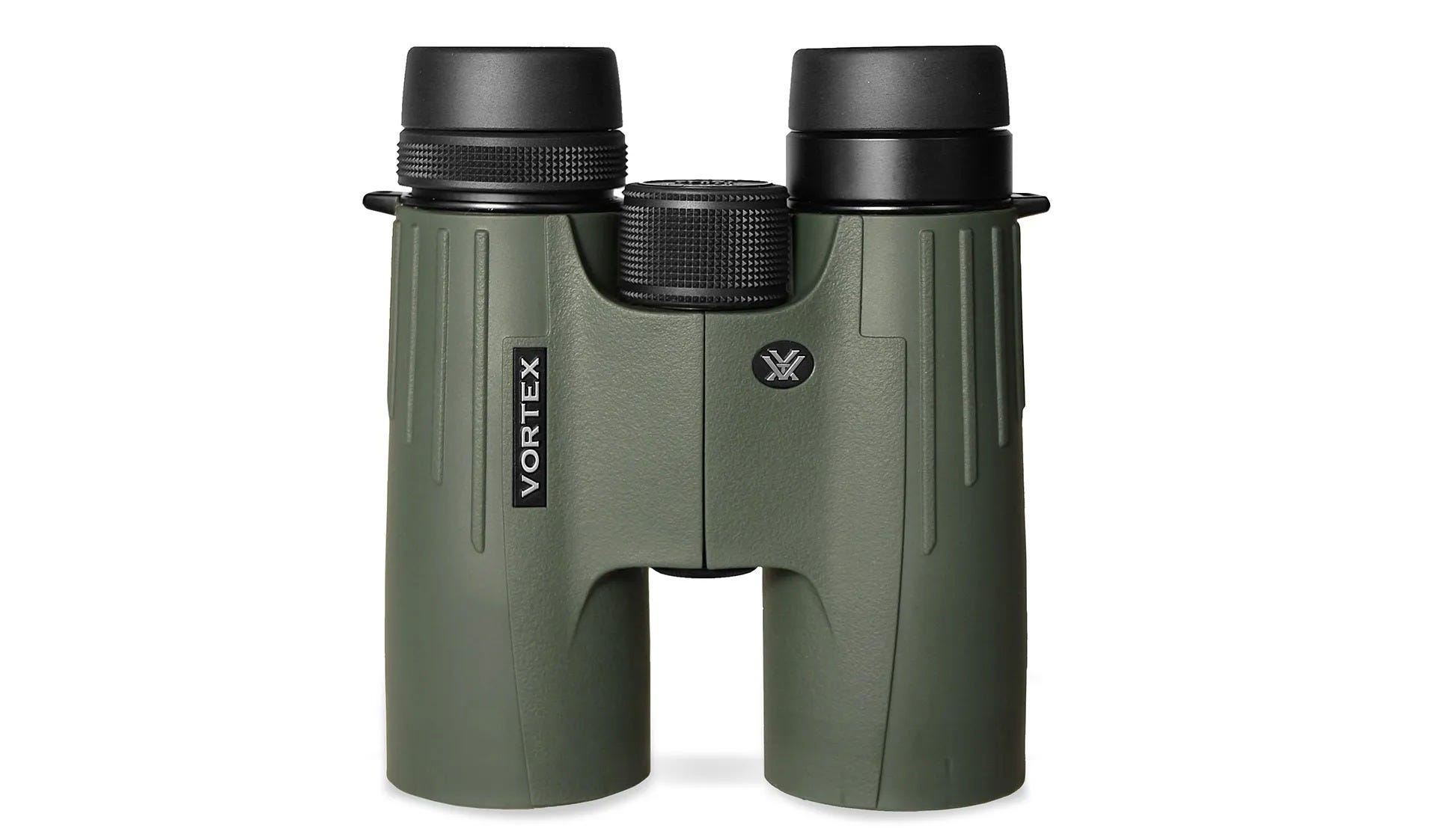
Image source and model notes
Identify the exact generation first
The inactive-directory card links to the Viper 12x42 page, which identifies SKU VPR-12-VX and marks it INACTIVE. Use that code—not just “Viper 12x42”—when checking an old box, manual, or secondhand listing. Do not transfer another Viper model’s glass, coatings, weather ratings, or accessories to this non-HD SKU.
The inactive badge does not prove that no used pair exists, but this is a reference and opt-in earlier-model profile, not a current offer. Stock, seller, condition, included parts and warranty treatment for an individual used unit are unknown. Ask for the SKU label and inspect the actual pair rather than trusting a listing title or this family photograph.
What 12x42 changes in the view
Vortex lists fixed 12x magnification, 42 mm objectives, a 5.1-degree angular field and 267 feet at 1,000 yards. Twelve power brings a distant subject larger in the view than an 8x or 10x pair, which can be useful for a stationary target or observation point. The trade is practical: small hand movement is enlarged too, and the narrower stated field gives less room for a moving animal or a bird that has just left cover. The published 5.1 degrees is below the site’s six-degree “broad real scene” option. An apparent-field figure is not provided, so a wide-apparent-field request also cannot be confirmed.
The page lists a 3.5 mm exit pupil. That matches the 42 mm objective divided by 12x; it is a geometric specification, not a measurement of transmission, contrast, or perceived brightness. With the same 42 mm front aperture, this 12x setup has a smaller exit pupil than a typical 8x42 or 10x42. Avoid assuming that a higher power makes it the better general-purpose or dim-light choice. Try the view in your normal conditions, and consider how steadily you can hold 12x before treating the extra reach as an advantage.
For a more forgiving sweep, the separate earlier Viper HD 8x42 SKU VPR-4208-HD lists 6.6 degrees/347 feet at 1,000 yards; it is also inactive. The distinct Viper HD 10x42, SKU V201, lists 6.5 degrees/341 feet and 17 mm eye relief. That 10x42 is a middle-power comparison if tracking and hand steadiness matter more than the final step to 12x. The full SKUs matter: these are different optical systems.
Eye position, close subjects and carry
The VPR-12-VX page lists 15.8 mm eye relief and an interpupillary range of 59–75 mm. Eye relief is a specification, not a guarantee that every eyeglass frame will show the whole field. If you wear glasses, try the exact pair with your frames and intended eyecup position. On the finder’s half-millimeter steps, this clears a 15.5 mm minimum but not 16.0 mm. The page also lists a 5.1-foot close-focus distance—not a macro specification.
Listed instrument weight is 23.2 ounces, with dimensions of 5.8 inches high and 5.3 inches wide. A 23.2-ounce maximum accepts that instrument figure; 23.1 ounces does not. The weight excludes strap and case; no packed-system figure is given.
Package contents and the limits of the record
The manufacturer page lists a rainguard, tethered objective covers, a deluxe contoured neck strap and a deluxe padded carry case. A rainguard is an eyepiece cover, not evidence that the binocular itself is waterproof. The page does not establish a waterproof or fogproof rating, gas purge, immersion limit, prism type, named lens coatings, or special glass for this exact SKU. Those details remain unknown here and cannot satisfy a must-be-waterproof requirement.
The linked manual is named VTX_VPR-32-50_VPR_BIN_P_PM_WEB.pdf. Its existing archived response is PDF.js viewer HTML, not manual pages, so setup, tripod compatibility, focusing controls, and care procedures are not claimed here. For any of those details, obtain the actual manual or a VPR-12-VX-specific manufacturer answer instead of borrowing instructions from another Viper generation.
How it fits the finder
For ordinary wildlife, travel, events or sky viewing, this is a passive fixed-power 12x42 option only when earlier models are allowed. It is not a direct-solar viewer, not a laser rangefinder, and not a current-model recommendation. Select 12x and 42 mm if those exact dimensions matter; select “include earlier models” to see it at all. Its real field misses the at-least-six-degree choice, its apparent field is unknown, and waterproofing is not confirmed. On the finder’s available numeric steps, 15.8 mm eye relief clears a 15.5 mm minimum but not 16.0 mm; 23.2 ounces meets a 23.2-ounce ceiling but not 23.1 ounces.
If your essential need is a confirmed waterproof rating, longer eye relief, a broader real field, a current-focused model, or integrated ranging, use those requirements to narrow the field first; this SKU fails or cannot verify them. For a steadier general view, compare a verified 8x42 or 10x42. If you specifically want 12x but prefer a larger exit pupil and can accept more weight, the distinct Vortex Razor HD 12x50 lists 4.17 mm and 28.7 ounces; its larger front lenses do not make the older VPR-12-VX equivalent, and it remains a separate model with its own fit and protection checks. The best alternative depends on which need is essential, not on a family name.
Source basis: Vortex’s exact U.S. VPR-12-VX page and the linked Vortex inactive-binocular directory entry. Manufacturer figures are not independent measurements.
Key specifications
Key details at a glance
| Magnification | 12× |
|---|---|
| Objective diameter | 42 mm |
| Real field of view | 5.1° |
| Eye relief | 15.8 mm |
| Exit pupil | 3.5 mm |
| Close focus distance | 5.1 ft |
More specifications and setup details
| Manufacturer-published weight | 23.2 oz |
|---|---|
| Lens and prism coatings | The exact page describes HD (High Density) extra-low dispersion glass; other coating names and measured optical performance are not established here. |
| Water and fog protection | The exact product page’s package list includes an eyepiece rainguard; that cover does not establish waterproofing. The page does not establish a waterproof/fogproof rating, immersion limit, or IP code for VPR-12-VX. |
| Tripod use | Tripod compatibility and adapter requirements are not established by the exact page. The linked manual response is viewer HTML, not usable instructions. |
| Published weight note | The exact VPR-12-VX product page lists 23.2 oz for the instrument. Manufacturer-listed figure, not independently weighed and not the complete carry kit. |
| Integrated laser rangefinder | No |
| Onboard ballistic solution display | No |
Use the exact model’s instructions for operating limits, supplied equipment and version differences.
Sources for this review
Sources for this assessment
- Official U.S. Vortex inactive binocular directory page 3, card row 2; embedded data identifies VPR-12-VX / Viper 12x42 and links to the exact PDP.
- Exact U.S. Vortex Viper 12x42 page for SKU VPR-12-VX; labels exact page INACTIVE and supplies the specification table, package contents, manual link and product gallery.
- Original official Vortex product-page-linked front image archived from the exact VPR-12-VX page; image itself does not show power/SKU.
- Previously archived response for the exact linked shared Viper manual URL; this file is PDF.js viewer HTML rather than the requested manual. Reused without repeated request.

Choose your optical trade-off first.
Choose viewing purpose first, then magnification, objective size, scene width and any fit, weather or mounting constraint. A direct-Sun requirement is separate: only exact manufacturer-confirmed solar binoculars can pass it.