
On this page
Your needs, this model
Does it fit your priorities?
Are you comparing this exact earlier Viper 10x32, or only current models?
The exact U.S. page identifies SKU VPR-3210 and marks it INACTIVE. Include it only with earlier models enabled; it is a reference, not a current offer.
Explore this need in the finder →Does its published real field meet your broad-scene preference?
Vortex lists 6.2° and 325 ft at 1,000 yd. This clears the finder’s at-least-6° real-field option. Apparent field is not listed and cannot satisfy an essential apparent-field threshold.
Explore this need in the finder →Can the listed 15.0 mm eye relief meet your minimum?
The exact page lists 15.0 mm. That meets a 15.0 mm minimum, not a tighter 0.5 mm increment; fit with glasses still depends on the wearer and frame.
Explore this need in the finder →Is the listed instrument weight inside your ceiling?
The page lists 19.4 oz. It meets a 19.4 oz ceiling but not a 19.3 oz ceiling; the lower-power siblings do not weigh less on the published figures.
Explore this need in the finder →Does the exact close-focus figure meet your maximum?
The page lists 3.3 ft. The whole-foot distance screen accepts this at 4 ft, not at a shorter maximum.
Explore this need in the finder →Must confirmed waterproofing be essential?
The exact product listing does not state a waterproof rating. It may remain in an unconstrained comparison, but unknown weather protection cannot pass a required-waterproof answer.
Explore this need in the finder →The Vortex Viper 10x32 (SKU VPR-3210) is an earlier, inactive fixed-power binocular, retained here for identification and opt-in comparison rather than a current offer. Its value in the 32 mm Viper group is clear: it is the highest-power choice, not a lighter one.
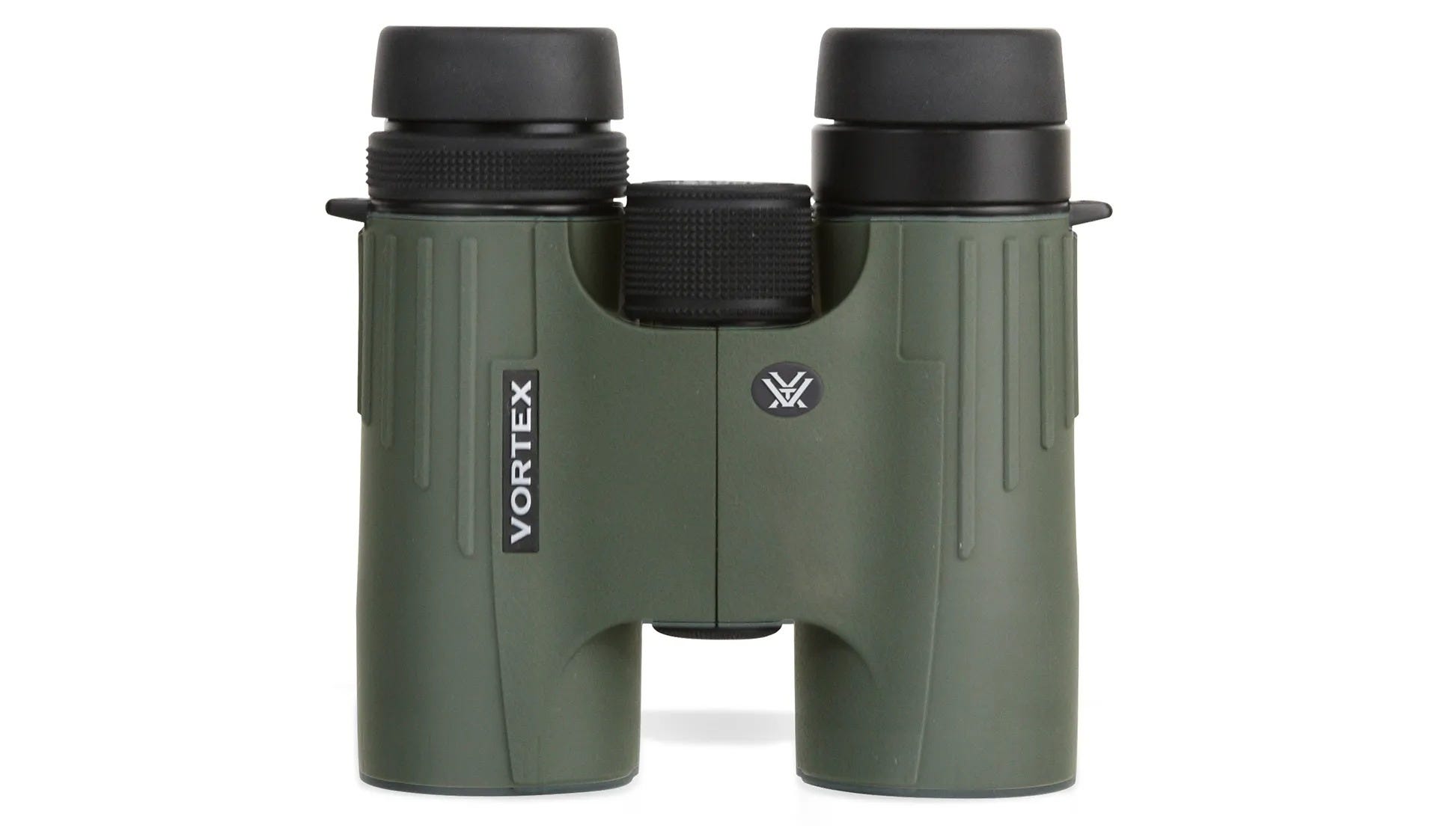
Image source and model notes
Ten power is the decision, not a weight saving
The exact product page lists fixed 10x magnification, 32 mm objectives, a 325-foot field at 1,000 yards (6.2 degrees), and a 3.2 mm exit pupil. That narrower field than the sibling 8x32's 400 feet and 7.6 degrees, or the 6x32's 420 feet and 8 degrees, is the practical cost of choosing more magnification in the same objective size. If the subject is distant and you value the larger view, 10x is the logical power in this trio. If you are sweeping a large area, following movement, or keeping the binocular in hand for long viewing, the lower-power siblings present a wider scene and may be easier to hold steadily. Those are consequences of the published magnification and field values, not field-test claims.
Do not read 10x32 as the group's lightest option. Vortex lists 19.4 ounces for this configuration, the same weight shown for both the 8x32 and 6x32. The 32 mm objectives and listed five-inch width make this a mid-size instrument, but no shorter weight figure is published for choosing the higher power. Its 15 mm eye relief is also the shortest of the trio. That can matter to eyeglass users; a number is a screening aid, not a guarantee that every frame will see the full field.
Nearby subjects and the published fit limits
The 10x32 is listed to focus as close as 3.3 feet. That is useful if you sometimes observe nearby details as well as distant wildlife, though the 8x32 and 6x32 pages list 3 feet. A one-third-foot difference is modest, but if close focus is a strict requirement the 3.3-foot figure—not the sibling's figure—is the one to screen. The manufacturer also gives an interpupillary range of 59–75 mm, height text rendered as “5. inches,” and a width of 5 inches. Because the height entry is incomplete, it remains unknown rather than being rounded or borrowed from the other models. Instrument weight is explicitly listed as 19.4 ounces; height should not be used as a packed-space filter.
The 3.2 mm exit pupil is listed by the manufacturer. It describes the geometric size of the outgoing light bundle, not a measured brightness result. At the same 32 mm objective, it is smaller than the 4 mm value on the 8x32 and 5.33 mm on the 6x32. That difference helps explain why lower magnification is often more forgiving for eye placement; it does not establish a lab-tested low-light advantage for any unit.
What the listing confirms—and what it does not
The box list names a rainguard, tethered objective-lens covers, a deluxe contoured neck strap and a deluxe padded carry case. A protective cover is an accessory, not evidence that the optical tubes are waterproof. The product page labels SKU VPR-3210 INACTIVE. It does not provide a waterproof or fogproof rating, prism type, prism glass, ED-glass claim, phase coating, apparent field, tripod-adapter compatibility, stabilizer specification or manual operating instructions in the readable listing text. Keep those items unknown. If weather sealing, a tripod adapter, long eye relief or a particular optical treatment is essential, this profile cannot confirm it. It is a passive fixed-power binocular, not an integrated laser rangefinder; it does not answer a distance-measuring requirement.
No current retail stock, seller, used-unit condition or warranty coverage for a particular older pair is established here. Before considering one secondhand, verify VPR-3210 on the actual body, inspect hinge and focusing movement, check both barrels for internal haze or damage, and ask the seller about condition and return terms. This is practical inspection advice, not a claim about a specific unit.
How the finder should treat this 10x32
Choose “earlier models” and the exact 10x / 32 mm answers to bring it into an identification or comparison list. Its published 6.2-degree real field clears the guide's broad-scene threshold of six degrees, while a demand for at least 60 degrees of apparent field must reject it because no apparent-field figure is listed. A 15 mm minimum eye-relief answer can include it; 15.5 mm cannot. A maximum weight of 19.4 ounces fits the stated figure, while a lower ceiling does not. For close focus, the available whole-foot screen can accept a four-foot maximum, not a three-foot maximum. Unknown waterproofing must fail an essential waterproof requirement.
For a steadier, wider scan, compare the Viper 8x32; it lists 75 more feet of field per 1,000 yards and one extra millimeter of eye relief, at the same weight. The 6x32 widens the listed field further and offers more eye relief, but gives up more subject enlargement. If you want ten power with a larger objective, the library's Viper 10x42 is another earlier reference, not a current offer. Pick the 10x32 only when its exact 10x/32 mm identity suits the comparison; do not let the word “Viper” blur the non-HD VPR-3210 with Viper HD models.
Identity and figures: Vortex Viper 10x32 product page. Comparisons use the linked 8x32 and 6x32 sibling listings.
Key specifications
Key details at a glance
| Magnification | 10× |
|---|---|
| Objective diameter | 32 mm |
| Real field of view | 6.2° |
| Eye relief | 15 mm |
| Exit pupil | 3.2 mm |
| Close focus distance | 3.3 ft |
More specifications and setup details
| Manufacturer-published weight | 19.4 oz |
|---|---|
| Tripod use | Adapter is not in the exact page package list; tripod compatibility/thread are not established. |
| Published weight note | Exact product page lists 19.4 oz, not grams. |
| Integrated laser rangefinder | No |
| Tripod adapter in package | No |
Use the exact model’s instructions for operating limits, supplied equipment and version differences.
Sources for this review
Sources for this assessment
- Official Vortex U.S. inactive binocular-directory page 3, card row 6; the card identifies Vortex Viper 10x32 and links its exact PDP.
- Exact Vortex U.S. product page for Vortex Viper 10x32, SKU VPR-3210; names the exact configuration and marks it INACTIVE.
- Original 1920 × 1123 JPEG URL linked on the exact VPR-3210 PDP. All three pages returned byte-identical bodies; retained and visually inspected one shared original archive.
- The exact product pages link this shared Viper manual URL. Reuse the identical URL archive already saved; archived response is HTML/PDF.js viewer content rather than readable manual pages. No manual-derived facts asserted.

Choose your optical trade-off first.
Choose viewing purpose first, then magnification, objective size, scene width and any fit, weather or mounting constraint. A direct-Sun requirement is separate: only exact manufacturer-confirmed solar binoculars can pass it.