
On this page
Distance readings without a ballistic display
The exact Fury HD 5000 LRF301 combines a fixed 10x42 view with HCD/LOS laser ranging and lists 32.3 oz with a CR2 included. Its manual does not document onboard BAL, so choose it for distance readouts only when a profile-based ballistic display is not essential; manufacturer range maxima depend on the target and conditions.
Your needs, this model
Does it fit your priorities?
Do you need the binocular itself to measure distance with an integrated laser?
Yes. LRF301 combines 10x42 viewing with HCD/LOS laser ranging, but target return and advertised maximums depend on conditions.
Explore this need in the finder →Would HCD/LOS ranging be enough, or must the display also calculate profile-based ballistic information?
The standard Fury manual documents HCD and LOS, not the onboard BAL mode found on Fury HD 5000 AB.
Explore this need in the finder →Will a 33-ounce listed instrument ceiling fit your carry plan?
The exact page lists 32.3 oz for the instrument, separate from harness and other carried kit.
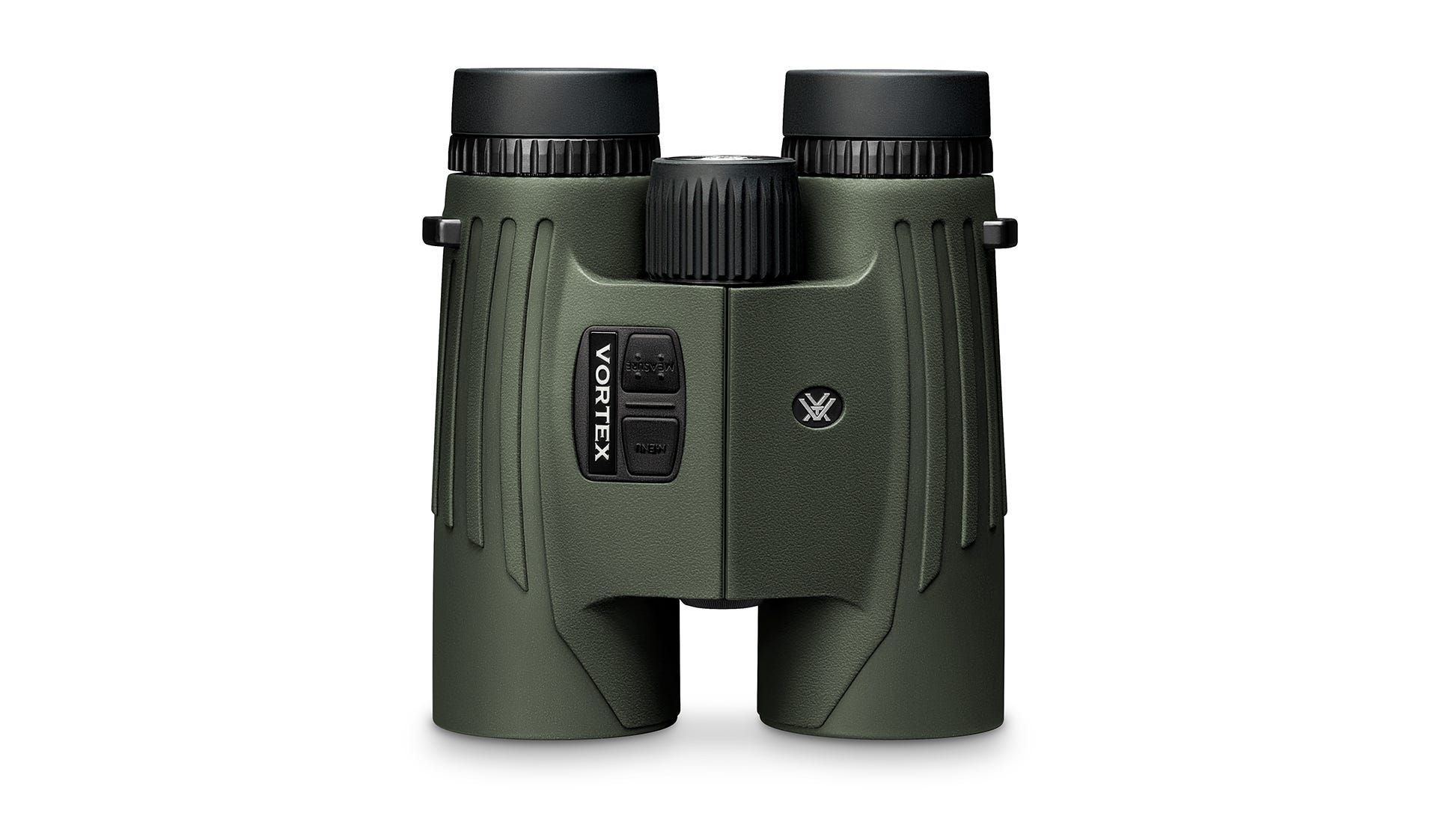
Explore this need in the finder →The Vortex Fury HD 5000 10x42 combines a conventional 10-power binocular view with a built-in laser distance readout. It is for someone who regularly needs both jobs in the same moment, but does not need an onboard ballistic profile display. That distinction matters: the standard Fury is not the AB version, and its manual documents HCD and line-of-sight modes rather than a BAL solver.
A two-function instrument, not a light 10x42
SKU LRF301 keeps the familiar 10x42 format but puts the rangefinding electronics, display and controls in the same body as the optics. Vortex lists a 6.1-degree angular field, or 321 feet at 1,000 yards, 16 mm of eye relief, an 18.5-foot closest optical focus and an interpupillary range of 58–72 mm. If most of your viewing is ordinary birding or hiking and you rarely need a measured distance, a passive binocular avoids the extra laser, display and CR2 battery.
The listed 32.3-ounce weight is the bare instrument figure, not the weight of the harness and other kit. At 32.3 ounces it is lighter than the Talon HD 10K 10x42 (40.8 ounces), which adds an onboard ballistic mode. The Ranger HD 3000 10x42 weighs 32.4 ounces and focuses optically to six feet; its range ceilings are lower. Laser minimum range is not optical close focus.
Know what the distance number can and cannot promise
For the LRF301, Vortex lists maximum ranges of up to 5,000 yards on reflective targets, 2,400 yards on trees and 1,600 yards on deer, with a five-yard minimum. The word “up to” is important. Return strength depends on the target’s size, color, surface, angle and visibility, as well as the steadiness of the instrument and the surrounding conditions. A large bright target may return a signal at a distance where a small dark animal or a target behind brush will not. These are manufacturer specifications, not results from an independent field test, and they are not guaranteed distances for every target.
The Fury provides HCD, which reports a slope-compensated horizontal component distance, and LOS, which reports line-of-sight distance. It also offers Best and Last target modes and a scan function. Best selects the strongest return; Last can help when you want the farthest return beyond intervening objects. Neither mode can tell you which object matters to your task if you have not aimed and interpreted the scene carefully. If you need built-in ballistic calculations and wind/drop information, this standard model is the wrong Fury: the separate Fury HD 5000 AB adds those functions, while the Ranger does not document an onboard BAL mode.
Setup and power are part of the choice
The manual treats optical and display focus as separate jobs. Set the binocular for your eyes with the central focus and right-eye diopter adjustment, then bring the illuminated readout into focus with its reticle-focus control. Take time to practice the buttons and mode sequence at a safe target before relying on them outdoors. The product page lists several display brightness levels and a ten-second automatic shutoff; it does not publish a battery-runtime figure, so do not plan around an assumed number of hours.
The standard Fury uses a CR2 battery, listed in the box. Battery power is necessary for the laser and display, even though the binocular can still be treated as an optical instrument when not ranging; keep the manual’s handling guidance in mind. Its package includes a carrying harness, neck strap, tethered objective covers, eyepiece rain guard, lens cloth and battery. The model is tripod adaptable, but the Pro Binocular Adapter is listed separately rather than as an included accessory. A tripod can make a small distant target easier to hold on; it is not required for normal viewing.
Fit, weather and safety
At 16 mm, the stated eye relief is a useful number to compare, not a promise that every eyeglass wearer will see the full field. The manual’s eyecup and diopter adjustments help set a personal position, but fit is individual. Try the exact model with your glasses if that is an essential requirement. Vortex describes the unit as waterproof, fogproof and shockproof and says it is nitrogen purged, but the exact page does not give an IP code or an immersion depth. Do not interpret those descriptions as an underwater rating.
Because the Fury includes a laser, its manual’s safety rules are different from those for passive binoculars. Do not look at the Sun, stare into the laser, aim at a person’s eyes or disassemble the device; read the full instructions before use. That care is part of what you take on when you choose a powered ranging instrument.
Who should keep it on the list?
Keep the LRF301 in consideration when integrated ranging is essential, the 10x42 view suits your observation, and a dedicated ballistic display would add complexity rather than value. It offers a lighter alternative to the Talon 10K but is still a substantial object to carry compared with passive 10x42 binoculars. Choose the Ranger if closer optical focus and a lighter system matter more than the Fury’s higher manufacturer range ceilings; choose the Talon or the separate AB only when you have a real use for ballistic functions and can manage the added weight and profile setup. The exact U.S. Fury page classifies LRF301 under Limited Distribution and does not establish current retailer stock or an Amazon ASIN. If shopping, use the exact model name and SKU rather than assuming a near-identical Fury configuration is the same item.
Product identity and stated specifications are from the Vortex Fury HD 5000 10x42 product page and its linked Fury HD 5000 manual. The page links a manual with M-00243-2 in its filename, while the delivered PDF footer reads M-00243-3; check the manufacturer’s current instructions for the device in hand. No independent optical, laser-range, weatherproofing or ballistic test is claimed here.
Key specifications
Key details at a glance
| Magnification | 10× |
|---|---|
| Objective diameter | 42 mm |
| Real field of view | 6.1° |
| Eye relief | 16 mm |
| Exit pupil | 4.2 mm |
| Close focus distance | 18.5 ft |
More specifications and setup details
| Manufacturer-published weight | 32.3 oz |
|---|---|
| Lens and prism coatings | Exact page describes HD optical system and coatings; specific ED-glass and prism-coating fields remain unknown. |
| Water and fog protection | Manufacturer describes waterproof, fogproof and shockproof performance; no IP code or immersion depth is given. |
| Tripod use | Manufacturer calls it tripod adaptable; adapter is not listed in the package. The AB manual says a binocular tripod adapter is needed for mounting. |
| Published weight note | Manufacturer lists 32.3 oz instrument weight; do not treat it as full carry-system weight or an independent measurement. |
| Manufacturer-rated waterproof | Yes |
| Power source | CR2 |
| Integrated laser rangefinder | Yes |
| Onboard ballistic solution display | No |
| Maximum reflective-target range (manufacturer) | 5000 yd |
| Maximum tree range (manufacturer) | 2400 yd |
| Maximum deer range (manufacturer) | 1600 yd |
| Minimum range (manufacturer) | 5 yd |
| Tripod adapter in package | No |
Use the exact model’s instructions for operating limits, supplied equipment and version differences.
Sources for this review
Sources for this assessment
- Official Vortex Limited Distribution page 1; row position 8 is Fury HD 5000 10x42, one of 11 visible rows; broader counts conflict.
- Official Vortex U.S. exact product page, SKU LRF301; category Limited Distribution and availability false in captured page state.
- Official linked 13-page product manual. Linked filename M-00243-2; delivered PDF footer M-00243-3.
- Official linked LRF301 one-page parts diagram and box list.
- Exact-page-linked original manufacturer image, 1920 by 1123, viewed locally; production method not stated.

Choose your optical trade-off first.
Choose viewing purpose first, then magnification, objective size, scene width and any fit, weather or mounting constraint. A direct-Sun requirement is separate: only exact manufacturer-confirmed solar binoculars can pass it.
Your needs, this model
Binoculars without earlier-model profiles
Choose it when: This exact 10x42 LRF301 is a current-reference comparison record and remains visible with earlier models turned off.
Binoculars without earlier-model profiles →Include earlier binocular models for comparison
Choose it when: This current-reference sibling provides a concrete reminder to compare exact SKU suffixes rather than treating nearby Fury names as interchangeable.
Include earlier binocular models for comparison →Include earlier integrated laser-rangefinding binoculars
Choose it when: The LRF301 is the current-reference configuration in the same exact-family comparison and its manual explicitly documents HCD/LOS modes.
Include earlier integrated laser-rangefinding binoculars →