Binoculars · Choose by your needs
Binoculars with an integrated laser rangefinder: choose the readout
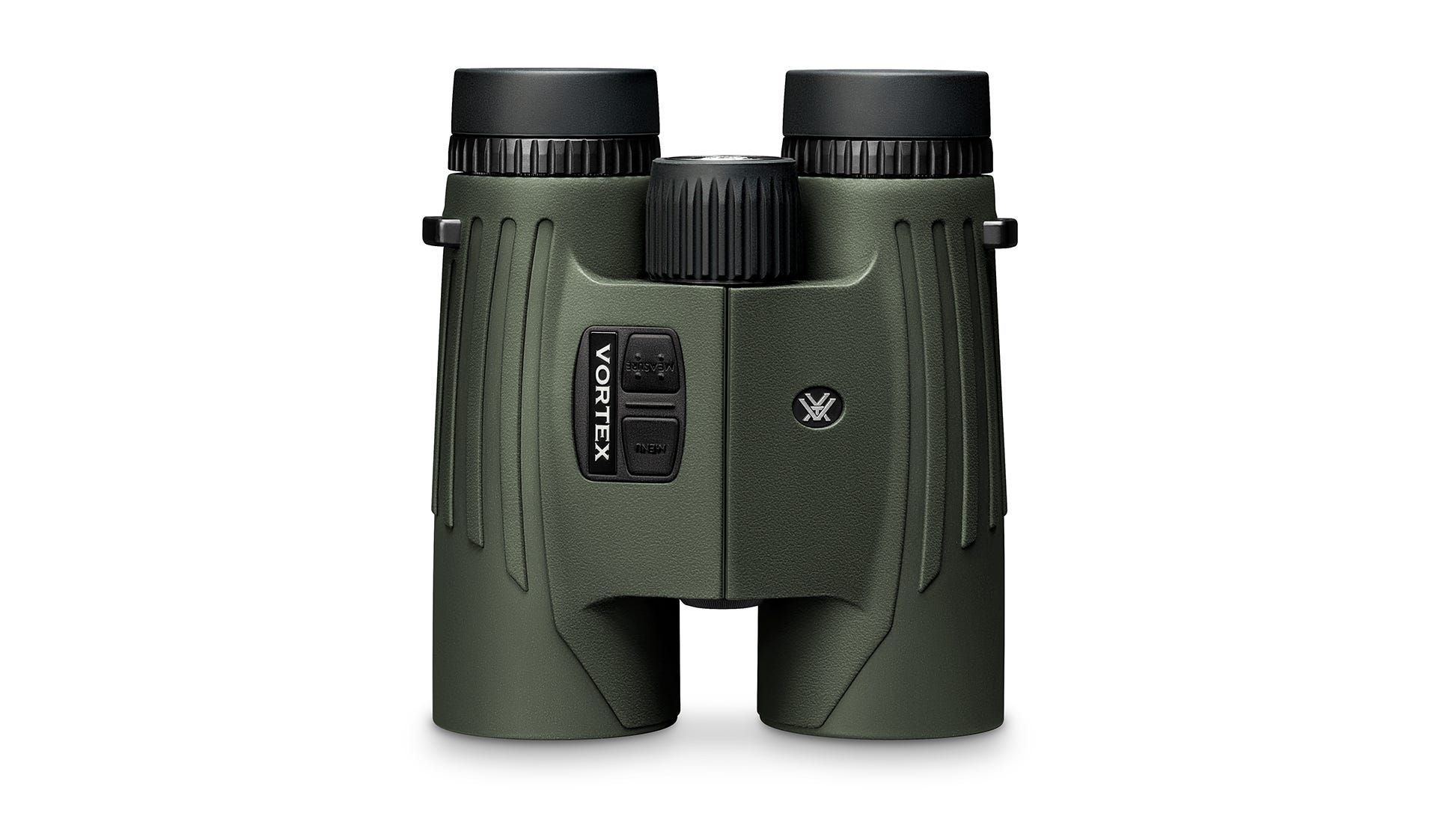
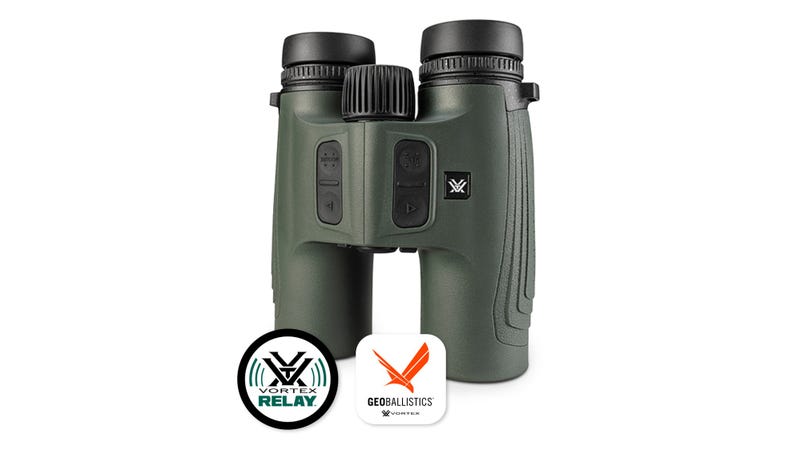
If the binocular itself must measure target distance, first decide whether HCD/LOS range readings are enough or an on-device ballistic mode is necessary: the Vortex Fury HD 5000 10x42 documents HCD/LOS only and lists 32.3 oz with an included CR2, while the Vortex Talon HD 10K 10x42 adds BAL and lists 40.8 oz with its included CR123. These are manufacturer-listed specifications, not independent range tests; returns vary with target and conditions. If ballistic output is essential, use the separate output-focused answer rather than treating every laser rangefinder as a solver.
- This answer keeps integrated laser ranging as the hard requirement. It adds no magnification, objective-size, waterproofing, weight or maximum-range cutoff; the other products that meet the same condition remain available in the complete results.
- The ordinary-viewing and current-model questionnaire defaults still apply here. Choose the earlier-model option explicitly if an older identification or comparison reference is relevant.
- A laser rangefinder and an onboard ballistic display are separate capabilities. Select a verified ballistic mode only if the displayed profile-based output is part of your actual task.
- Manufacturer maximum range figures depend on target and conditions; they are not guaranteed return distances or independent performance measurements.
Comparison updated 29 October 2026.
A short range output and a ballistic output are not interchangeable
The standard Fury HD 5000 LRF301 manual documents HCD and LOS distance modes, with Best/Last target selection and scan; it does not document a profile-based BAL mode. The Talon HD 10K adds a distinct BAL display that uses a selected ballistic profile. If the task is only to obtain a laser distance, the first kind of readout may be all you need; if the display must provide profile-based wind/drop information, compare only a model whose exact manual establishes that output. A phone app attached to some other rangefinder does not, by itself, prove onboard ballistic capability.
Treat range ceilings as target-specific context
The Vortex manuals list different ceilings for reflective, tree and deer-size targets, and explain that return depends on target size, reflectivity, surface, angle, visibility and steadiness. For the two featured 10x42 models, the listed maxima are respectively 5,000/2,400/1,600 yd and 10,000/4,000/2,400 yd; those figures are not independent field tests and do not promise that a particular target will range at those distances. A higher headline ceiling alone is not a sound reason to buy one.
Check the other exact rangefinder options against your workflow
The Vortex Ranger HD 3000 10x42 is another HCD/LOS-only configuration, lists a 6 ft optical close focus and 32.4 oz with its CR123; its 6 yd laser minimum is a different function from optical focusing. Leupold's BX-4 Range HD Gen 2 TBR/W 10x42 and 12x50 document TBR/W, LOS, Bow and Trig modes, but their exact product pages list 37 oz while the shared manual lists 39 oz with battery installed, so their matching weight fact remains unknown. The Bushnell Fusion X FX1042AD guide documents Regular, Bow and Rifle A–J ARC modes; its exact-page and guide maximum-range figures conflict, so do not treat one as a guaranteed distance. Compare these and the other exact qualifying models as well; the featured examples do not exhaust the choice.
Current-reference profiles versus earlier rangefinders
With earlier models left off, this rangefinder answer keeps earlier and inactive records out of the comparison; enable the earlier option when identifying a legacy pair. The Fury HD LRF300, Fury HD 5000 AB LRF302 and Fury HD 5000 LRF301 are separate exact configurations: the LRF301 manual documents HCD/LOS, while the inactive LRF302 manual documents HCD/BAL. Never transfer range modes between suffixes or treat a current-reference page as a live stock check.
Questions that change the choice
Does every binocular with a laser rangefinder also calculate ballistic holdover?
No. The Fury HD 5000 LRF301 and Ranger HD 3000 manuals document HCD/LOS range modes, not onboard BAL; a laser range reading is not the same as a profile-based ballistic display. The Talon HD 10K manual documents BAL, and the exact Leupold and Bushnell rangefinding models have their own distinct documented output modes.
Should I choose the Talon only because its reflective-target maximum is higher?
No. Manufacturer maximums vary by target and conditions and are not guaranteed returns. Start with the target type and readout you actually need, then check battery, listed instrument weight, setup and the exact operating modes.
Is the listed weight the total hunting or field kit?
No. The cited values describe the instrument, with the Talon figure explicitly including its supplied CR123. They do not include a harness or other carried equipment, and no field measurement is claimed.
Sources for the comparison
- Official Vortex U.S. exact product page, SKU LRF301; category Limited Distribution and availability false in captured page state.
- Official linked 13-page product manual. Linked filename M-00243-2; delivered PDF footer M-00243-3.
- Vortex U.S. exact model page and SKU LRF-TLN1042
- Vortex Talon HD 10K product manual linked from both exact pages; 43-page English PDF
- Exact U.S. product page identifies Ranger HD 3000 10x42, SKU LRF-RGR3000, specifications, features, package and image gallery
- Fifteen-page exact product manual; final page identifies revision M-00390-1
- Leupold exact BX-4 Range HD Gen 2 TBR/W 10x42 product page, part 185699
- Leupold BX-4 Range HD TBR/W Gen 2 operating manual (page-linked from both exact product pages; part 186606, artwork 186618)
- Bushnell Fusion X 10x42 Rangefinding Binoculars, product model BU-FX1042AD, variant 51340714410280, GTIN 029757008084; OutOfStock in the captured U.S. offer.
- Bushnell Fusion X owner guide, model FX1042AD, edition 4-21; official PDF, 62 pages.
- Exact U.S. Vortex Fury HD 10x42 page; product identifier LRF300, category Inactive.
- Official Vortex U.S. exact product page, SKU LRF302; category Inactive and availability false in captured page state.
- Official linked 13-page AB manual; filename M-00275-0, delivered PDF footer M-00275-1.