
On this page
Your needs, this model
Does it fit your priorities?
Do you want a 10x42 binocular rather than a different power or objective size?
The exact Vortex page identifies Vortex Eagle HD 10x42 as 10x42 SKU CAMO-215ADY; its sibling Vortex 8x42 is a distinct power configuration.
Explore this need in the finder →Is a 21.5-ounce instrument ceiling acceptable for this 10x42?
The product page lists 21.3 oz for the binocular, not for its case or harness; it meets a 21.5-ounce cap but not 21.2 oz.
Explore this need in the finder →Do you need at least 15 mm stated eye relief in a 10x42?
The exact page lists 15.0 mm; it meets a 15 mm minimum and fails 15.5 mm. Individual eyeglass fit still needs checking.
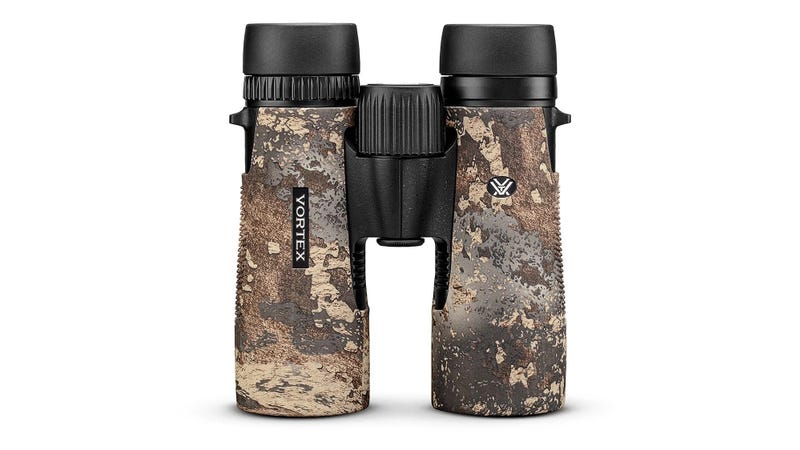
Explore this need in the finder →Vortex Eagle HD 10x42 is a U.S. Limited Distribution binocular listed as SKU CAMO-215ADY. The exact page gives 10x magnification, a 42 mm objective, 15 mm eye relief, a 330-foot field at 1,000 yards, five-foot close focus, 55–73 mm interpupillary distance, and 21.3 ounces for the instrument. The page-linked image shows a camouflage-patterned body. Its box list names a GlassPak binocular case and harness, plus a comfort neck strap and lens covers.
Decide whether ten power suits your viewing
A 10x42 combines extra apparent reach over 8x with a moderate full-size objective. That can be appealing when observing distant animals across an open area or picking out activity from a fixed viewing point. The trade is less generous framing than a wider-scanning 8x model and more apparent hand movement. The manufacturer lists 330 feet of scene width at 1,000 yards; that is useful for comparison, but does not by itself predict how easily you will hold a subject or how bright the image will look in your conditions.
For a wide scene and a little more stated eye relief, compare an 8x42 rather than stretching the Eagle into a use it was not designed to solve. Vortex’s Diamondback HD 8x42 is listed at 393 feet per 1,000 yards and 17 mm eye relief; Celestron’s Nature DX 8x42 item 71332 lists 388 feet and 17.5 mm. These alternatives are 8x configurations, not optical equivalents. If ten power is essential, the Eagle’s 330-foot field and 15 mm relief are the figures to evaluate. Glasses wearers should check the full view with their own eyewear because millimeters on a specification page do not guarantee personal fit.
What the exact SKU changes
CAMO-215ADY is the manufacturer’s exact SKU; the page calls it Eagle HD 10x42 and labels the product Limited Distribution. The photographed finish is patterned rather than plain gray, a visible styling difference from the Stonerun HD 10x42 GRY-215WW. Do not assign a named camouflage pattern based on appearance alone: the exact page identifies the Eagle model and SKU but does not name the pattern in its text.
The Eagle’s included-box list contains a GlassPak binocular case and harness as one named package item, a comfort neck strap, tethered objective covers, a rainguard eyepiece cover, and a lens cloth. By contrast, Stonerun’s list names its GlassPak binocular case and GlassPak case harness separately. That is a real package-list difference; it should not be turned into an unsupported claim about the fit, durability, or comfort of either system. Both specifications list 21.3 ounces for the binocular body, which excludes the carrying pieces.
On the Eagle page, Vortex lists fully multi-coated lenses, phase correction, ArmorTek, rubber armor, and waterproof, fogproof, and shockproof construction. The page does not give a numeric immersion rating or IP code. It also does not specify the angular field figure, prism glass type, ED designation, focus control details, tripod compatibility, or diopter range. An “HD” product name and a weather claim do not fill in those unknowns. The page’s 330-foot linear field is the supported field number; do not import Stonerun’s explicit 6.3-degree line or another model’s specifications without a specific Eagle source.
What remains unconfirmed before purchase
The exact Eagle page has no Manuals & Parts heading or model-specific manual link. I have therefore left its focus and diopter setup, maintenance directions, adapter details, and manual-backed safety wording unconfirmed rather than borrowing instructions from another Vortex binocular. If you need those details, ask Vortex or the seller for the manual associated with CAMO-215ADY. The page lists close focus at five feet, but that is not a substitute for a control diagram.
For ordinary observation, the page indicates a passive binocular: there is no rangefinder, display, battery, or electronic function in its listed configuration. Its weather language is broad; it does not promise a particular immersion depth, time, or underwater use. Keep it separate from a laser rangefinder if distance readout is important. No ordinary binocular without a certified solar filter is safe for direct solar viewing.
Who should shortlist the Eagle
Consider CAMO-215ADY if you want a 10x42 body, the published 330-foot field, a 21.3-ounce listed instrument mass, and prefer the pictured camouflage finish and the package described as a GlassPak case and harness. The 15 mm eye-relief figure is a potential limitation for some glasses wearers; check it in person. The product is listed in Vortex’s Limited Distribution directory with a Where to Buy route, which is not a guarantee of stock at any particular dealer.
The Stonerun HD 10x42 shares the Eagle’s listed power, objective, linear field, eye relief, close focus, interpupillary range, dimensions, and instrument weight. Stonerun’s exact page adds a 6.3-degree field figure and calls out an HD Optical System, while Eagle’s exact page does not provide those same statements. That wording difference does not demonstrate a measurable optical advantage. If color and kit contents do not matter, the manufacturer’s published data do not offer a sound basis for ranking one view above the other. Choose the exact SKU whose finish and included pieces suit you, then compare the other documented tradeoffs before committing.
For a direct model comparison, see the Vortex 10x42 guide and the Stonerun HD 10x42 assessment.
Key specifications
Key details at a glance
| Magnification | 10× |
|---|---|
| Objective diameter | 42 mm |
| Eye relief | 15 mm |
| Exit pupil | 4.2 mm |
| Close focus distance | 5 ft |
| Manufacturer-published weight | 21.3 oz |
More specifications and setup details
| Phase coatings confirmed | Yes |
|---|---|
| Lens and prism coatings | The exact Eagle page lists fully multi-coated lenses, phase correction, ArmorTek, rubber armor, waterproof, fogproof and shockproof construction. It does not state a separate HD Optical System description, identify ED glass, or publish an angular field, numeric water rating, or tripod interface. ArmorTek is described for scratches, oil and dirt; the exact page does not explicitly establish a hydrophobic water-repellent coating. |
| Water and fog protection | The exact Vortex page labels the model waterproof, fogproof, and shockproof. It gives no IP code, immersion depth or duration; underwater use is not established. |
| Tripod use | The exact product page does not list a tripod adapter in the included box or establish tripod compatibility. Treat the mount interface as unconfirmed. |
| Published weight note | The manufacturer lists 21.3 oz for the binocular; case/harness mass is not included in this instrument figure. |
| Manufacturer-rated waterproof | Yes |
| Integrated laser rangefinder | No |
| Onboard ballistic solution display | No |
| Tripod adapter in package | No |
Use the exact model’s instructions for operating limits, supplied equipment and version differences.
Sources for this review
Sources for this assessment

Choose your optical trade-off first.
Choose viewing purpose first, then magnification, objective size, scene width and any fit, weather or mounting constraint. A direct-Sun requirement is separate: only exact manufacturer-confirmed solar binoculars can pass it.