
On this page
Your needs, this model
Does it fit your priorities?
Do you want the distinct Classic 10x50 D5010 configuration?
The exact product page and exact-SKU listing identify D5010 as Diamondback Classic 10x50. Another 10x50 Diamondback HD is a separate model.
Explore this need in the finder →Is the listed 31-ounce Classic body within your limit?
The D5010 page lists 31 oz. It meets a 31.5-ounce limit but not 30.5 oz.
Explore this need in the finder →Do you need 19 mm listed eye relief?
The exact D5010 page lists 19 mm; the sibling HD DB-216 lists 17 mm. This does not guarantee comfort through glasses.
Explore this need in the finder →Vortex Diamondback Classic 10x50 binoculars (U.S. SKU D5010) are a distinct 10x50 model in the manufacturer’s Limited Distribution category, not another name for the newer Diamondback HD 10x50. The exact Classic page lists a 283-foot field at 1,000 yards, 19 mm eye relief, 31-ounce weight and nine-foot close focus. Those published details make the identity and the differences from HD easy to preserve rather than blur together.
Classic and HD are not interchangeable labels
Both the Classic D5010 and HD DB-216 are 10x50 binoculars, but their exact pages describe different optical and physical specifications. The Classic lists 5.4 degrees of real field (283 feet at 1,000 yards), compared with the HD’s 6 degrees (315 feet). It weighs 31 ounces, one ounce more than DB-216’s listed 30, and its close-focus minimum is nine feet rather than six. On the other hand, its 19 mm eye-relief figure is longer than the HD’s 17 mm and may be a useful reason to try it if you wear glasses. It still does not guarantee a full, comfortable field for your face or frames.
The calculated exit pupil is 5 mm for both 10x50 models. That geometry does not mean identical image brightness or optical quality. The HD page explicitly lists a fully multi-coated lens system, dielectric prism coatings, phase correction, ArmorTek, argon purging and O-ring sealing; the Classic page lists fully multi-coated optics, phase-corrected prisms, rubber armor, and waterproof/fogproof descriptions, but does not explicitly state argon gas purging or a dielectric coating. A missing claim should remain unknown rather than be borrowed from its newer sibling. Neither exact page establishes an IP code, submersion depth/duration or ED glass.
Fit, field and handling
The 5.4-degree field is narrower than the current HD 10x50’s and narrows the scene available while scanning. That matters if your subject is moving, or you routinely search a busy tree canopy. If following wildlife is the main use, compare the wider 8x42 or 10x42 configurations. The Classic’s 9-foot close focus is enough for many ordinary outdoor views but not as close as the HD 10x50 or 10x42. Its manufacturer-listed dimensions are 6.8 by 5.6 inches, and 31 ounces is a substantial weight for repeated neck carry. For a fixed observation point or vehicle-based outing, the package may be more manageable than on a long trail.
Its stated 61–74 mm interpupillary range is narrower at the minimum than the HD 10x50’s 60–75 mm and the HD 10x42’s 55–73 mm. If your eyes do not align within that range, another model is a better fit. The exact page lists center focus and adjustable eyecups; the linked five-page Classic manual describes setting the eyepieces and diopter, cleaning coated lenses and avoiding direct solar viewing. The manual does not include a numerical spec table, so the measurements here come from the exact D5010 product page, not a nearby manual table.
What is in the D5010 package
The exact page lists a rainguard, tethered objective caps, neck strap and Deluxe custom-molded carrying case. A tripod adapter is not in the stated box list. The page calls the binocular tripod adaptable; if supported viewing matters, confirm the correct separate adapter before making a plan around a tripod or window mount. Nothing in the listed configuration is electronic: there is no battery, image stabilization or integrated rangefinder.
Vortex describes the Classic as waterproof and fogproof and gives it rubber armor, fully multi-coated lenses and phase-corrected prisms. The page provides no water depth/duration standard and does not call out a specific gas purge. Those details may matter to a user who needs a documented immersion rating or exact construction specification. Do not convert general weather wording into an underwater rating, and do not assume similarly named models have identical protection.
When to consider the Classic
The Classic D5010 deserves consideration when you want 10x50 and the longer 19 mm published eye relief is appealing, and when its current Limited Distribution page provides a realistic path to a retailer. It is less compelling for someone whose priority is wide scanning or short close focus: DB-216 is both wider and focuses closer while weighing one ounce less. The HD model also carries more explicitly listed optical and construction features; that is a difference in published claims, not a laboratory judgment of which view is better. A user who prefers a broader, steadier field should compare 8x or 10x 42 mm models instead.
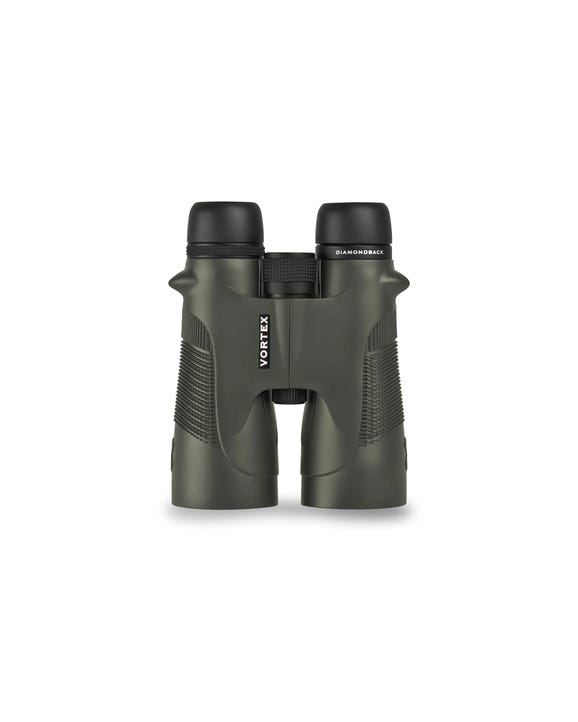
The manufacturer’s D5010 page routes to “Where to Buy.” Limited Distribution does not tell us current store stock, and it is not a price quote. The page-linked product image was archived and visually inspected, but the body image does not establish magnification; the exact SKU page does. Vortex does not disclose whether the image is a photograph or render. The manufacturer’s Classic manual warns not to look at the Sun through ordinary binoculars. These are specification-based recommendations, not personal ownership or lab-testing claims.
Key specifications
Key details at a glance
| Magnification | 10× |
|---|---|
| Objective diameter | 50 mm |
| Real field of view | 5.4° |
| Eye relief | 19 mm |
| Exit pupil | 5 mm |
| Close focus distance | 9 ft |
More specifications and setup details
| Manufacturer-published weight | 31 oz |
|---|---|
| Phase coatings confirmed | Yes |
| Lens and prism coatings | The exact Classic page lists fully multi-coated optics and phase-corrected prisms. It does not explicitly state ED glass, dielectric coatings or argon gas purging; these HD sibling claims are not transferred. |
| Water and fog protection | Exact Classic page describes waterproof and fogproof construction with rubber armor; it does not give an IP code or immersion depth/duration. Argon gas purging and shockproof claims are not asserted from this page. |
| Tripod use | Vortex describes the model as tripod adaptable; the exact D5010 in-box list does not include a tripod adapter. A compatible separate adapter is required for mounting; tripod itself is not listed in box. |
| Published weight note | Manufacturer-listed instrument weight only; excludes the case and carry items; not independently measured. |
| Manufacturer-rated waterproof | Yes |
| Built-in image stabilization confirmed | No |
| Integrated laser rangefinder | No |
| Onboard ballistic solution display | No |
| Tripod adapter in package | No |
Use the exact model’s instructions for operating limits, supplied equipment and version differences.
Sources for this review
Sources for this assessment
- Official Vortex U.S. exact product page, Diamondback Classic 10x50 SKU D5010; Limited Distribution
- Official Vortex Limited Distribution product listing, page 7, position 11; 131 total directory products, pagination incomplete
- Official linked five-page Diamondback Classic owner manual; footer BIN-DBK-12A
- Official Vortex image linked from exact D5010 product page; archived original bytes

Choose your optical trade-off first.
Choose viewing purpose first, then magnification, objective size, scene width and any fit, weather or mounting constraint. A direct-Sun requirement is separate: only exact manufacturer-confirmed solar binoculars can pass it.