
On this page
Your needs, this model
Does it fit your priorities?
Do you specifically want the older 12x50 configuration?
The exact U.S. page and inactive-directory record identify Diamondback 12x50 SKU DB-207, marked INACTIVE. Enable earlier models for comparison; an 8x or 10x answer is not this fixed 12x profile.
Explore this need in the finder →Does a 29-ounce instrument limit work for your kit?
The exact page lists the binocular at 28.7 oz. A 29 oz ceiling accepts that listed bare-instrument figure; a 28 oz ceiling does not, and the case and strap add pack weight.
Explore this need in the finder →Do you need at least 14 mm of listed eye relief?
The exact page lists 14 mm. This reaches a 14 mm floor but not 14.5 mm; the number alone cannot guarantee full-field eyeglass comfort.
Explore this need in the finder →The Vortex Diamondback 12x50, U.S. SKU DB-207, is the older standard-power model—not the separately named Diamondback HD 12x50. Vortex’s exact U.S. page labels DB-207 INACTIVE, so this article keeps it as an opt-in comparison, not a current purchase recommendation. Its role is clear from the numbers: 12-power enlargement and large objectives, with a small real field and a substantial handheld package.
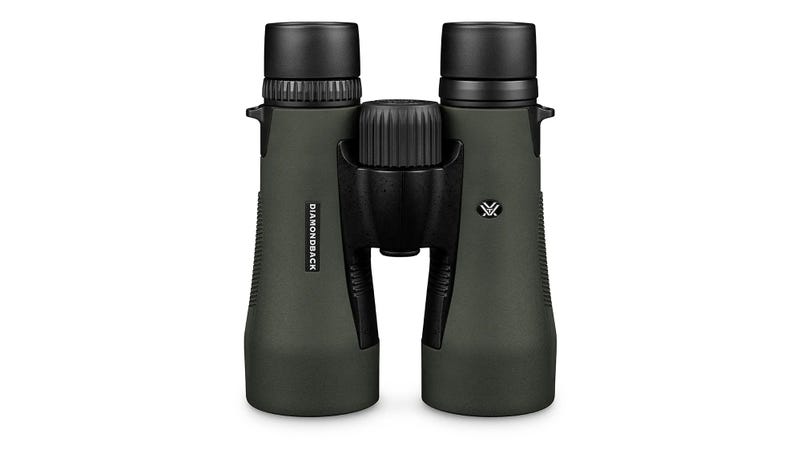
Image source and model notes
Choose it for reach, not for scanning a broad scene
The manufacturer lists fixed 12x magnification, 50 mm objectives, a 5.2-degree angular field and 271 feet across at 1,000 yards. Twelve power enlarges distant subjects, useful when you can settle your elbows or observe from a stationary position. It magnifies hand movement too. The 5.2-degree field is narrow beside many lower-power binoculars, making walking searches and moving birds harder to keep in view. That is a fit implication of the listed figures, not a field-test claim.
The 50 mm objectives do not prove a bright or steady view. Vortex lists a 4.1 mm exit pupil; it is geometric, not measured brightness. The page's low-light language is not a comparative test. The bare instrument weighs 28.7 ounces; case, strap and covers add kit weight. For long handheld sessions, set a realistic weight ceiling and try a steadier hold.
Eye fit, focusing and support
The page gives 14 mm eye relief, a 60–75 mm interpupillary range and seven-foot close focus. The manual says to twist eyecups up without glasses and down with glasses, then set IPD until the barrels form one unshaded image. Fourteen millimeters is only a screening figure; individual frames and facial fit vary. Seven feet is for relatively nearby viewing, not macro work.
This Diamondback has a center-focus wheel and right-eye diopter. The manual instructs users to focus the left eye on an object about 20 yards away, cover the left objective, then adjust the right diopter for the other eye. Once set for your vision, later focusing uses the center wheel. Record the diopter setting for repeat setup. This is model-linked setup guidance, not an ergonomic claim.
The manual diagram labels a tripod-adapter socket, so a tripod-supported viewing plan is supported with the appropriate adapter. The exact page’s in-box list does not include that adapter: it names a rainguard, tethered objective covers, comfort neck strap and deluxe padded carry case. Budget for a separate compatible adapter only if stationary support is important; do not mistake a socket for an included tripod or mount. The manual also explains protecting the lenses with the covers, storing the binocular in its case and clearing dust before wiping optics. Follow those directions rather than rubbing grit across a lens.
Keep the environmental claims narrow
The page calls the lenses fully multi-coated, says the binocular is nitrogen-gas purged, describes rubber armor and uses the terms dielectric and enhanced optical system. It does not identify ED glass, prism material, phase correction, waterproofing or a fogproof test specification. Nitrogen purging alone does not confirm weather sealing. If waterproofing, ED, phase coatings, stabilization or a specific rating is essential, the matcher should reject this reference profile rather than fill a missing field by assumption.
What to compare before considering an older pair
The separately assessed Diamondback HD 12x50 is a different SKU, DB-217, not a replacement identity for DB-207. Both pages list 271 feet per 1,000 yards and 14 mm eye relief; DB-207 is listed at 28.7 ounces and 6.7 by 5.5 inches, DB-217 at 28.9 ounces and 6.4 by 5.3 inches. These figures do not establish which view is sharper or more comfortable; the HD label is no side-by-side test. Read the separate Diamondback HD 12x50 review to compare that exact SKU.
Because DB-207 is inactive, this page does not establish a seller, in-stock offer, used-unit condition or warranty outcome for a particular pair. If you are examining one secondhand, verify the DB-207 code on the actual binocular, check that both barrels focus cleanly, inspect the glass for haze or damage, confirm covers and case against the listing, and ask about return terms. That is a prudent inspection checklist, not an assertion about any individual unit.
How the finder treats this model
Set “earlier models” to yes and choose 12x plus 50 mm to see DB-207 in a comparison. A maximum weight of 29 ounces accepts the published instrument weight; a stricter 28-ounce ceiling does not. A 14 mm minimum eye-relief screen accepts the listed figure, while 14.5 mm does not—and neither result guarantees eyeglass comfort. Its 5.2-degree real field fails the questionnaire’s six-degree broad-scene preference. A waterproof requirement, ED-glass requirement or phase-coating requirement must also exclude it because those details are unconfirmed. Confirmed tripod-adapter compatibility can pass a tripod-support choice, but “adapter included” must fail: no adapter appears in the box list. These distinctions keep a precise historical comparison useful without implying the product is available to buy.
Identity and specifications: Vortex Diamondback 12x50 (DB-207) U.S. product page and its linked Diamondback owner manual. Figures are manufacturer-listed, not independently measured.
Key specifications
Key details at a glance
| Magnification | 12× |
|---|---|
| Objective diameter | 50 mm |
| Real field of view | 5.2° |
| Eye relief | 14 mm |
| Exit pupil | 4.1 mm |
| Close focus distance | 7 ft |
More specifications and setup details
| Manufacturer-published weight | 28.7 oz |
|---|---|
| Lens and prism coatings | The exact page calls the lenses fully multi-coated and describes an enhanced, dielectric optical system; it does not identify prism material, ED glass or phase correction. |
| Water and fog protection | The page lists nitrogen gas purging and rubber armor but does not give a waterproof or fogproof rating; do not infer either. |
| Tripod use | The exact manual diagram labels a tripod-adapter socket. An adapter is not among the exact product page’s four named in-box items; specific adapter model remains unknown. |
| Published weight note | Exact U.S. page lists instrument weight as 28.7 oz; grams are not listed. |
| Integrated laser rangefinder | No |
| Onboard ballistic solution display | No |
| Tripod adapter in package | No |
Use the exact model’s instructions for operating limits, supplied equipment and version differences.
Sources for this review
Sources for this assessment
- Official Vortex U.S. Diamondback 12x50 product page, SKU DB-207, INACTIVE
- Official Vortex-linked Diamondback binocular owner manual, code #BIN-DBK-12A
- Official Vortex gallery image linked from exact DB-207 page
- Official Vortex inactive-binocular directory, page 3, card 12, observed Diamondback 12x50 / DB-207

Choose your optical trade-off first.
Choose viewing purpose first, then magnification, objective size, scene width and any fit, weather or mounting constraint. A direct-Sun requirement is separate: only exact manufacturer-confirmed solar binoculars can pass it.