
On this page
Your needs, this model
Does it fit your priorities?
Do you specifically want a 12x50 configuration?
The exact page and DB-217 XVIEW sheet identify fixed 12x50; the power is distinct from the 10x50 and 15x56 siblings.
Explore this need in the finder →Does a 29-ounce instrument limit work for you?
Vortex lists 28.9 oz. It meets 29 but not 28 oz; accessories add carry weight.
Explore this need in the finder →Do you need at least 14 mm stated eye relief?
The exact page gives 14.0 mm. The specification meets 14 but fails 14.5 mm; eyewear comfort is individual.
Explore this need in the finder →The Vortex Diamondback HD 12x50 (U.S. SKU DB-217) takes the family toward more distant detail without reaching the unusually high power of its 15x56 sibling. It combines 12x magnification with a 50 mm objective, a 271-foot field at 1,000 yards and a 28.9-ounce instrument weight. That combination is most useful when you accept a less forgiving view in exchange for more apparent reach.
What the step from 10x changes
Twelve power enlarges distant subjects more than the 10x50 DB-216, which can help when looking across an open field or picking details from a steady observation point. The corresponding field is narrower: Vortex lists 5.2 degrees (271 feet at 1,000 yards) rather than the 10x50’s 6 degrees (315 feet). A narrow field is not merely a specification-sheet penalty. It makes a fast-moving bird harder to acquire, leaves less surrounding context and asks more of the observer’s hand steadiness. If your usual activity involves searching, tracking or sharing a view with a new binocular user, an 8x or 10x model is likely easier to manage.
Its 50 mm objectives are larger than the 42 mm pair found on the DB-214 and DB-215, but that does not by itself establish low-light performance. The calculated exit pupil is about 4.2 mm (50 mm divided by 12x); it is a geometric size, not a measured brightness score. View stability, the actual light, your eye, the optical design and how comfortably you can position the eyecups all affect what you see. Carrying almost 29 ounces is part of the bargain, and the product page lists a body 6.4 by 5.3 inches.
Fit can be a limiting factor
Vortex lists just 14 mm of eye relief. Some glasses wearers can still obtain a usable view, but the number is short enough that a fit trial should be a priority, not a final detail. Lower the eyecups as instructed and check the whole circular field with your normal glasses. The eye-relief figure does not predict face shape or guarantee comfortable viewing. The interpupillary range is 60–75 mm; if your eyes cannot align within that adjustment, the model will not work well for you regardless of power. Its six-foot close focus is adequate for nearby outdoor subjects at a distance, but it is not the short-close-focus option in this family.
The 12x image also asks for a deliberate handhold. A brief glance may be fine for many people; a long scan can reveal shake that is easy to ignore at 8x. Vortex describes the model as tripod adaptable, yet the exact DB-217 box list contains a GlassPak binocular harness, comfort neck strap, tethered objective covers, rainguard and lens cloth—not a tripod adapter. If you require stable mounted viewing, verify the separately supplied adapter’s fit and budget for a suitable support.
Features and what they do not prove
The manufacturer lists a fixed-power optical system, center focus, adjustable eyecups, fully multi-coated lenses, dielectric prism coatings, phase correction and ArmorTek lens protection. It describes the binocular as waterproof, fogproof and shockproof, argon-purged and O-ring sealed. No IP code or immersion depth/time is published, so those claims should not be converted into an underwater rating. The exact page does not explicitly specify ED glass. If ED is an essential requirement, this evidence does not confirm it. There is no powered stabilization, electronic display or integrated laser rangefinder listed; the unit is a passive optical binocular with no instrument battery.
The package distinction is useful: the GlassPak harness keeps the binocular close at hand, but the box list does not name a tripod adapter. Check the supplied contents on the exact listing if you need a replacement or dealer bundle; a neighboring model’s kit is not proof of this SKU’s accessories. The manual gives the standard sequence: set interpupillary distance and eyecup position, focus the right barrel’s diopter for your vision, then use center focus for distance changes.
When the DB-217 is a sound fit
Consider it for a watcher who values 12x detail, can accommodate its weight and narrow field, and has tested the 14 mm eye relief. It can suit open-country observation or occasional supported viewing where a subject is distant and relatively stationary. The DB-216 10x50 is the better comparison if you prefer a broader view, a longer 17 mm listed eye relief and only a small weight change (30 ounces). The 10x42 DB-215 is 7.6 ounces lighter and wider at 6.3 degrees; it sacrifices 50 mm objectives but is easier to carry and scan with. The DB-218 15x56 is a step for deliberate long-range work and includes a tripod adapter, at a much higher weight.
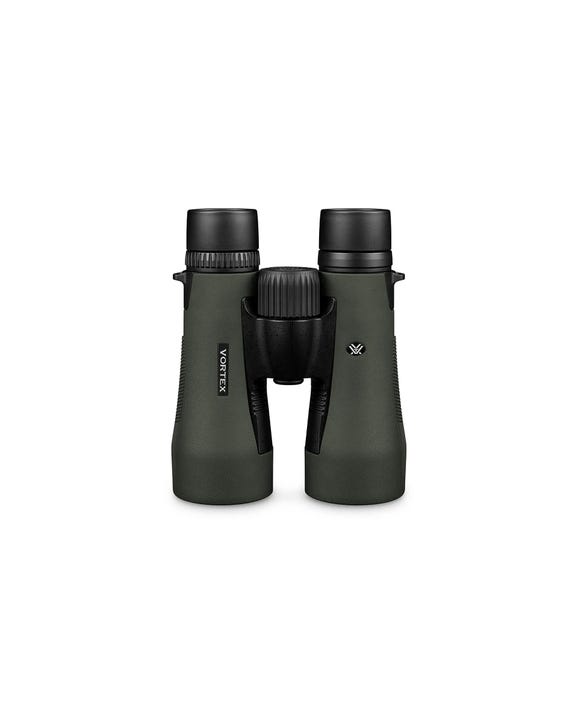
The DB-217 is not the safe default simply because its 12x magnification sounds like a compromise. Its 5.2-degree field and 14 mm eye relief create real constraints. Treat “Where to Buy” on Vortex’s page as a retail route, not proof of inventory. The product image does not identify power, and the company does not state photograph-versus-render status. Exact SKU and specifications are supported by the DB-217 page and parts sheet. The linked Diamondback HD manual warns not to view the Sun; never point this or any ordinary binocular at it.
Key specifications
Key details at a glance
| Magnification | 12× |
|---|---|
| Objective diameter | 50 mm |
| Real field of view | 5.2° |
| Eye relief | 14 mm |
| Exit pupil | 4.17 mm |
| Close focus distance | 6 ft |
More specifications and setup details
| Manufacturer-published weight | 28.9 oz |
|---|---|
| Phase coatings confirmed | Yes |
| Lens and prism coatings | Vortex lists fully multi-coated lenses, dielectric prism coatings, phase correction, ArmorTek exterior-lens protection and its HD Optical System. The exact page does not explicitly identify ED glass. |
| Water and fog protection | Vortex describes the exact HD model as waterproof, fogproof and shockproof, argon-purged and O-ring sealed. The page supplies no IP code, immersion depth or duration; underwater use is not established. |
| Tripod use | A tripod is not listed as included. Adapter availability is SKU-specific; exact DB-218 page/XVIEW list an adapter, other exact HD SKU box lists do not. |
| Published weight note | Manufacturer-listed instrument weight only; not independently measured and excludes carrying kit. |
| Manufacturer-rated waterproof | Yes |
| Built-in image stabilization confirmed | No |
| Integrated laser rangefinder | No |
| Onboard ballistic solution display | No |
| Tripod adapter in package | No |
Use the exact model’s instructions for operating limits, supplied equipment and version differences.
Sources for this review
Sources for this assessment
- Official Vortex U.S. exact product page, Vortex Diamondback HD 12x50, SKU DB-217
- Official Vortex SKU-specific DB-217 parts and in-box XVIEW sheet
- Official Vortex-linked Diamondback HD owner manual, page/in-box label M-00253-0; PDF footer M-00253-1
- Official Vortex gallery image linked from the exact DB-217 page; archived native product-image asset
- Official Vortex U.S. binocular category page 2, item 11; item manually matched to exact product page

Choose your optical trade-off first.
Choose viewing purpose first, then magnification, objective size, scene width and any fit, weather or mounting constraint. A direct-Sun requirement is separate: only exact manufacturer-confirmed solar binoculars can pass it.