
On this page
Your needs, this model
Does it fit your priorities?
Does the 8x42 keep the broadest field in this family?
The exact SI-SPH842 page and manual list 8x42 and 340 ft/1,000 yd; the 8x configuration is the broadest field among the four Pro Hunters.
Explore this need in the finder →Does the 19 mm eye-relief listing clear a 19 mm screening minimum?
Both exact-page and manual values are 19 mm; this is a screen only, not a guarantee of full-field eyeglass fit.
Explore this need in the finder →Can it use separately purchased tripod support, and is that adapter in the kit?
The manual confirms a hinge socket and compatible separate 90-degree adapter; adapter #161002CM is one example. The standard kit does not include the adapter.
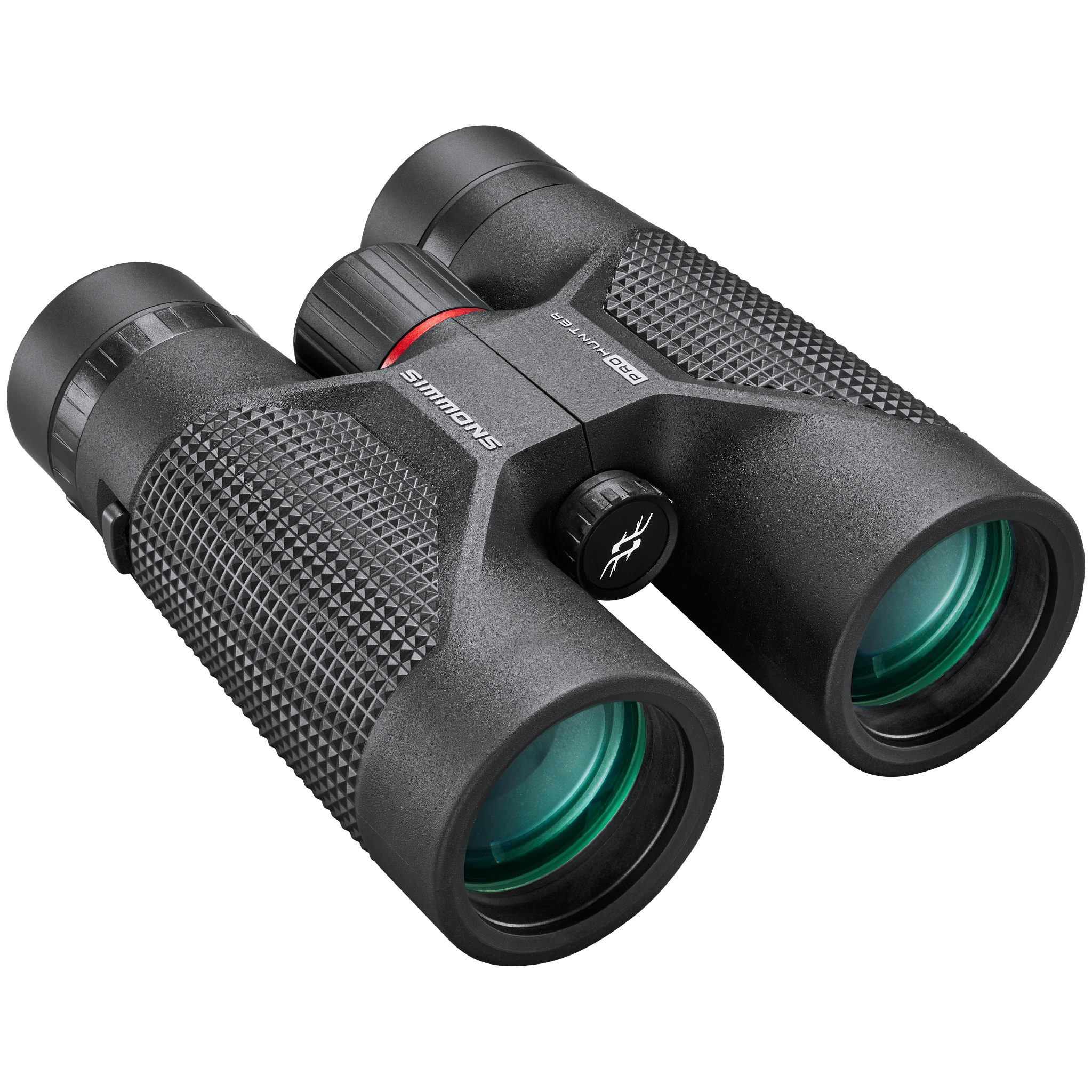
Explore this need in the finder →The Simmons Pro Hunter 8x42 is the broadest-field and lowest-power member of this four-configuration family. Bushnell identifies the U.S. variant as SKU SI-SPH842; its shared Pro Hunter owner guide lists 340 feet at 1,000 yards, 19 mm eye relief and 24.7 ounces. That makes it the most forgiving Pro Hunter for scanning and following movement, not a pocket binocular. This is a source-based assessment of manufacturer material, not a hands-on optical test.
Why choose 8x42 in this family?
Eight power gives up some apparent scale compared with the 10x42 and 12x50 versions, but it usually makes a handheld view easier to hold steady and gives you more scene around a moving subject. The manual's 340-foot field is the largest in the family. That difference is useful when sweeping a tree line or reacquiring a bird that moves between branches; it is not an optical-quality rating. For a stationary distant animal across open country, the 10x42 or 12x50 can show a larger image, provided you can manage the extra shake.
The 42 mm objectives make this a full-size design. Bushnell lists 24.7 ounces and a six-inch length, so it is a reasonable shoulder-carry size but not a substitute for compact 25–30 mm travel binoculars. The stated 5 mm exit pupil is the largest published in the Pro Hunter family. That can be a helpful geometric starting point when your eye is not fully constricted, but it does not guarantee a bright picture: optical transmission, your pupil, weather, focus and viewing conditions still matter. The claim that its fully coated glass gives sharp low-light views is the manufacturer's description, not an independent low-light measurement.
Field of view, focus and glasses
The guide gives this exact SKU a 21-foot close-focus distance, longer than the 18 feet listed for the three siblings. It is aimed at ordinary wildlife and hunting distances rather than close observation of insects, flowers or nearby detail. If close focus is an essential part of your use, compare a model with a shorter verified figure instead of treating all 8x42 binoculars as equivalent.
Its published 19 mm eye relief is the second longest in the family after the 10x50. That is a useful screening number for eyeglass wearers, not a promise that your particular frames will reveal the full circle. The manual says to roll the twist-up eyecups down for glasses, set the hinge to your interpupillary spacing until the two views merge, then focus one barrel and set the right-side diopter with the other covered. Try it with your own eyewear before deciding that a published relief figure guarantees fit; the manufacturer does not publish an IPD range for this model in the guide.
Weather claims and the mount are easy to misunderstand
Bushnell describes an all-glass, roof-prism system with BK-7 prism glass, fully coated lenses, a textured rubber exterior, IPX7 waterproofing and fogproof construction. These are useful construction claims for wet trails and hunting weather, but the documentation does not identify ED glass, phase correction, dielectric prism coatings or the purge gas. I would not buy this version to satisfy one of those exact optical requirements unless the manufacturer confirms it for SI-SPH842. IPX7 is a protection rating, not permission to use it underwater; keep the optics clean and dry them before storage.
A threaded socket is covered at the hinge. The manual says to use a compatible 90-degree binocular adapter (Bushnell gives #161002CM as an example) to mount the full-size Pro Hunter on a standard tripod or monopod. That adapter is separate. The box list covers the case, neck strap, rubber lens covers and cleaning cloth, not a tripod or adapter, and the guide does not specify the socket thread size. So this is tripod-adaptable, but it is not a mount-ready package.
Who should shortlist it?
Pick this configuration when a broad field and less demanding handheld magnification matter more than extra reach. Move to the 10x42 for a larger view in a similarly sized 42 mm package, accepting a narrower field and shorter eye relief. The 10x50 keeps 10x while using larger objectives and offers the family's longest stated eye relief, but weighs more and has a narrower view. The 12x50 prioritizes distant detail and benefits most from optional support. None of the four is the right answer if your essential need is a confirmed ED or phase-coated roof design.
Bushnell's U.S. page showed this 8x42 variant out of stock when checked. It remains a distinct current manufacturer-listed configuration, but that snapshot is not a promise that it can be bought now. Use the exact SKU in a retailer search and confirm the configuration before ordering. The included cleaning cloth and covers help with routine field care; the guide warns against rubbing dry grit into the lens or using household glass cleaner. As with all ordinary binoculars, never point it at the Sun.
Key specifications
Key details at a glance
| Magnification | 8× |
|---|---|
| Objective diameter | 42 mm |
| Eye relief | 19 mm |
| Exit pupil | 5 mm |
| Close focus distance | 21 ft |
| Manufacturer-published weight | 24.7 oz |
More specifications and setup details
| Water and fog protection | Manufacturer describes IPX7 waterproof and fogproof construction; no underwater use should be inferred. Exact instructions do not state immersion depth or duration. |
|---|---|
| Tripod use | Manual confirms a covered threaded socket at the center hinge and a compatible separate 90-degree binocular adapter for a standard tripod or monopod. It does not state a direct 1/4-20 thread size; no adapter or tripod is listed in the package. |
| Published weight note | Exact page and official guide list 24.7 oz / 700 g; this is a manufacturer-listed instrument weight, not a packed carry weight. |
| Manufacturer-rated waterproof | Yes |
| Built-in image stabilization confirmed | No |
| Integrated laser rangefinder | No |
| Onboard ballistic solution display | No |
| Tripod adapter in package | No |
Use the exact model’s instructions for operating limits, supplied equipment and version differences.
Sources for this review
Sources for this assessment
- Simmons Pro Hunter Binoculars | 8x42mm | Bushnell; SKU SI-SPH842
- Simmons Pro Hunter Binocular Owner Guide revision 04-24; exact model table includes four SKUs
- Official Shopify product JSON for four Simmons Pro Hunter variant IDs, SKUs, GTINs, availability and featured-image URLs
- Bushnell/Simmons official image URL linked to SI-SPH842 selected product variant
- Bushnell U.S. Hunt binoculars collection row; Simmons Pro Hunter family

Choose your optical trade-off first.
Choose viewing purpose first, then magnification, objective size, scene width and any fit, weather or mounting constraint. A direct-Sun requirement is separate: only exact manufacturer-confirmed solar binoculars can pass it.