
On this page
Your needs, this model
Does it fit your priorities?
What is the middle-power view in the Travelite VI 25 mm family?
The 10x25 lists 5.0° real field, 262 ft at 1,000 yards, a 2.5 mm exit pupil and 11.1 mm eye relief, between the 8x and 12x configurations on magnification and field width.
Explore this need in the finder →Can the Travelite 10x25 meet a 10 ft maximum close-focus requirement?
Yes. Nikon lists the closest-focus distance as 9.8 ft. That is still a near-focus specification, not a macro capability.
Explore this need in the finder →Does the Travelite 10x25 have a published waterproof rating?
No rating is established by Nikon's cited exact product and family specifications. If sealing is essential, select a different exact model with a stated rating.
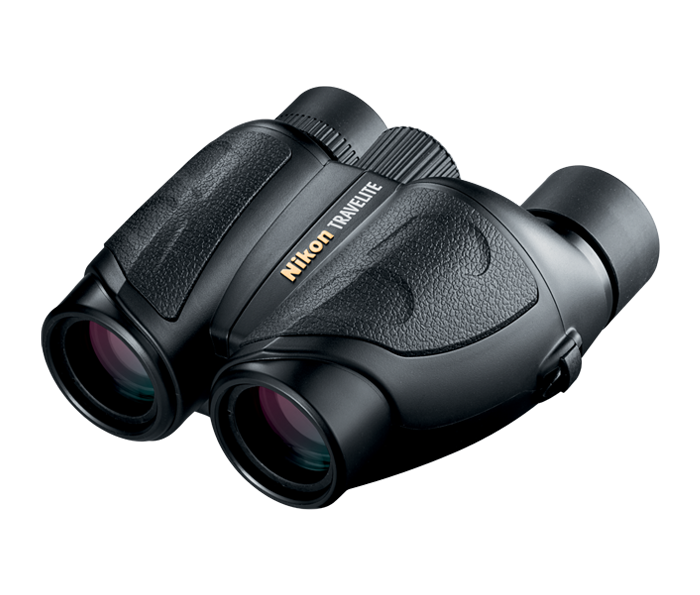
Explore this need in the finder →The Nikon TRAVELITE 10x25 sits between the 8x25 and 12x25 in magnification, field width and carrying weight. It weighs 9.5 oz, gives a published 5.0° real field (262 ft at 1,000 yards), and has a 2.5 mm exit pupil with 11.1 mm eye relief. It suits a traveler or spectator who wants a little more reach than 8x without choosing the narrowest, highest-power view. This is still a compact 25 mm instrument, and the cited Nikon specifications do not establish waterproofing.
A middle choice, not a universal compromise
The 10x25’s real field falls between its siblings: 5.0° / 262 ft, versus 5.6° / 293 ft for the 8x25 and 4.2° / 220 ft for the 12x25. In practical terms, the 8x begins with more of the scene around a target, while the 10x makes the subject appear larger than 8x does. The 12x has still more magnification, but it shows the narrowest real scene of these three. Nikon’s 47.2° apparent field for the 10x25 describes the eyepiece view; it is not a substitute for the 5.0° real field when comparing how much landscape or playing area you can see.
Its 2.5 mm exit pupil is smaller than the 8x25’s 3.1 mm and larger than the 12x25’s 2.1 mm. Nikon’s relative-brightness index is 6.3. Neither value is a field measurement of resolution or a promise that a compact binocular will perform like a larger objective model in low light. Choose this size for its balance of apparent reach and compact carrying, not on a claim of twilight performance.
Check eye fit before choosing the magnification
At 11.1 mm, listed eye relief is shorter than the 8x25’s 14 mm. Some glasses wearers may have trouble taking in the full field with the eyecups in their normal position. Nikon’s figure alone cannot confirm eyewear fit; use a returnable seller and check the whole circle of view with your glasses on if that is essential. The family’s interpupillary adjustment is 56–72 mm. Its central focus is familiar for changing between distant subjects, while the TRAVELITE VI family page describes a click-type diopter adjustment ring intended to resist unintended rotation.
The minimum focusing distance is 9.8 ft, matching the 8x25 and reaching nearer than the 12x25’s 13.1 ft. It can bring a nearby detail into focus at about that distance, but it is not a close-focus specialist. If nearby flowers or insects are a frequent target, treat the listed distance as a real constraint rather than assuming 10x implies close focus.
Lightweight, but not sealed by assumption
Nikon’s US page lists 9.5 oz and 4.3 × 4.6 in; its global family table gives 110 × 118 × 54 mm. It is a lightweight 25 mm pair in the context of larger 42 or 50 mm binoculars, although no reviewed fact establishes a particular pocket, case or strap fit. Check total carry space rather than buying from a “travel” name alone.
The exact US specifications do not publish waterproofing, fogproofing or nitrogen filling. Treat those capabilities as unknown. If waterproofing is a non-negotiable requirement for wet trails or marine use, the Travelite 10x25 should not pass that filter. Nikon describes the family’s lenses as aspherical and multilayer-coated and its body as incorporating carbon fibre with rubber armor. Those features do not amount to a water-sealing claim. ED glass, tripod compatibility and included accessories are also not established in the reviewed sources.
When a neighboring Nikon makes more sense
The Nikon TRAILBLAZER II 10x25 is the closer alternative if a 10x, 25 mm view and explicit weather rating matter more than this Travelite’s listed weight. Its published values include 6.5° / 342 ft at 1,000 yards, 10 mm eye relief, 11.5 ft close focus and 10.9 oz; Nikon describes that family as waterproof to 1 m for 10 minutes and says it is not intended for underwater use. The 10x25 Travelite is 1.4 oz lighter and lists 11.1 mm eye relief, but does not have a published water rating in the cited sources. Compare the TRAILBLAZER II 10x25 review if those requirements change your shortlist.
Within Travelite, choose the 8x25 if the wider real scene, 14 mm eye relief and 9.3 oz listed weight better fit your priorities. Choose the 12x25 only if extra subject scale is worth its 4.2° field, 2.1 mm exit pupil, 11.1 mm eye relief and 13.1 ft close focus. If you specifically need stabilized high-power viewing, the separate STABILIZED 10x25 S changes the design and operating requirements rather than simply improving a Travelite. Start with the Travelite size comparison if you are still weighing these three.
Check Nikon’s exact TRAVELITE 10x25 US product page and the global TRAVELITE VI specifications for the published values. This is a source-based comparison, not an independent sharpness or brightness test.
Key specifications
Key details at a glance
| Magnification | 10× |
|---|---|
| Objective diameter | 25 mm |
| Real field of view | 5° |
| Apparent field of view | 47.2° |
| Field width at 1,000 m | 87 m |
| Eye relief | 11.1 mm |
More specifications and setup details
| Exit pupil | 2.5 mm |
|---|---|
| Close focus distance | 9.8 ft |
| Manufacturer-published weight | 9.5 oz |
| Lens and prism coatings | Nikon's global TRAVELITE VI page describes multilayer-coated aspherical lenses. It does not establish ED glass, phase correction, dielectric mirror coating, all-surface prism coatings, or oil/water-repellent objective and eyepiece surfaces. |
| Water and fog protection | The inspected exact US page and global family page do not state waterproofing, nitrogen filling, fogproofing or a rated immersion depth. These capabilities remain unknown, not assumed absent or present. |
| Published weight note | Nikon lists 9.5 oz on the exact US page and 270 g on the global family page. The US page lists 4.3 × 4.6 in; the family page gives 110 × 118 × 54 mm. |
| Package contents | The cited product pages do not establish exact package contents. Do not infer a case, strap, lens covers or other supplied items from a product image; verify a seller's stated package if an accessory matters. |
Use the exact model’s instructions for operating limits, supplied equipment and version differences.
Sources for this review
Sources for this assessment
- Nikon USA current binocular directory; TRAVELITE series filter reports three configurations and a current 12x25 product tile
- Nikon USA exact TRAVELITE 10x25 product page, product 7278
- Nikon global TRAVELITE VI 25 mm family specifications and feature description
- Nikon Binocular General Instructions (Detailed), not a product-specific Travelite manual
- Dated CPSC exact-name query for Nikon Travelite 10x25
Choose your optical trade-off first.
Choose viewing purpose first, then magnification, objective size, scene width and any fit, weather or mounting constraint. A direct-Sun requirement is separate: only exact manufacturer-confirmed solar binoculars can pass it.