
On this page
A wider field in the 10x stabilized configuration
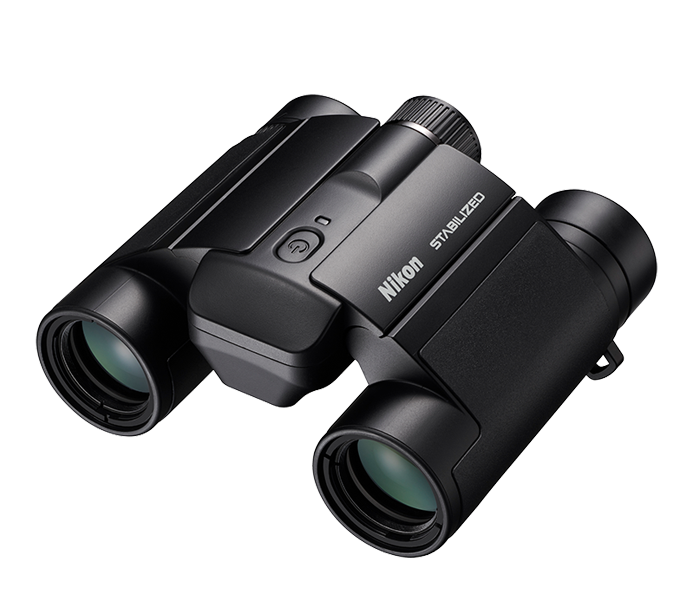
The STABILIZED 10x25 S publishes a 5.4° real field, 14 mm eye relief and 14.3 oz instrument mass before its two AA batteries. Nikon's manual describes optical lens-shift stabilization and an approximate 12-hour alkaline-cell estimate under stated conditions; this exact model is not waterproof.
Explore the needs this model fits
Your needs, this model
Does it fit your priorities?
For handheld 10x viewing, do you need built-in stabilization rather than a passive optical path?
Yes. The STABILIZED 10x25 S uses a powered optical lens-shift mechanism; Nikon reports about 80% shake reduction under its stated test standard. Two AA cells are required and the claim is not a guarantee of a perfectly still view.
Explore this need in the finder →Does the 10x25 S give a wider real scene and longer eye relief than the STABILIZED 12x25 S?
Yes. Nikon lists 5.4° real field and 14 mm eye relief for the 10x25 S, compared with 4.5° and 12.3 mm for the 12x25 S. That favors scanning and gives glasses users more stated relief, though it cannot promise frame fit.
Explore this need in the finder →Can this stabilized compact meet a waterproofing requirement?
No. The manual’s specification table says non-waterproof and instructs users to keep the binocular dry. Select a sealed weather-rated alternative if rain, spray or accidental wetting is essential to the plan.
Explore this need in the finder →The Nikon STABILIZED 10x25 S is a compact, battery-powered binocular for someone who wants a steadier handheld view without carrying a full-size instrument. Its stabilization uses optical lens shift, and Nikon says its sinusoidal hand-shake test shows about an 80% reduction in image shake. The 10x25 is the more forgiving of Nikon’s two current STABILIZED 25 mm models: it shows a wider real field, has a larger exit pupil and gives more eye relief than the 12x25.
What stabilization changes—and what it does not
At 10x, a small hand movement can make a distant subject wander across the view. The STABILIZED 10x25 S applies an optical lens-shift mechanism when its power button is pressed. Nikon’s manual describes an approximately 80% reduction in shake under its own sinusoidal-motion measurement standard, with a stated operating angle range of −80° to +80°. Treat that as Nikon’s specified effect under test conditions, not an independent test or a guarantee of a perfectly still view. You still need to locate the target and hold the binocular sensibly.
That powered operation sets it apart from a conventional compact. The manual specifies two AA batteries, either alkaline or rechargeable Ni-MH. Nikon rates alkaline operation at approximately 12 hours at 20°C, with actual life varying by conditions. The unit turns itself off after roughly 60 minutes. Supplied AA cells are for operation checks and may have shorter life, so carry replacements for an important outing.
The useful compromise between 10x and 12x
The 10x version has a published 5.4° real field, or 283 feet across at 1,000 yards, versus 4.5° and 236 feet for the 12x25. Both models have a 50.5° apparent field, so the higher-power model does not create a broader scene; it narrows the actual landscape you see. The 10x is a better starting point for scanning a shoreline, watching movement in a field or reacquiring a small subject after lowering the binocular. If the subject is usually distant and relatively still, 12x can make it appear larger, but its tighter real field asks you to point more accurately.
The same 25 mm objective gives the 10x25 a 2.5 mm exit pupil and a manufacturer relative-brightness index of 6.3. Nikon lists 2.1 mm and 4.4 for the 12x25. These are published optical ratios, not a low-light laboratory result. Stabilization reduces motion; it does not enlarge the objective or turn a compact binocular into a twilight instrument. For dusk wildlife, heavy shade or a view that needs a more generous eye position, compare a larger-objective model rather than assuming extra power or stabilization will help.
Fit, weight and day-to-day setup
Nikon lists 14 mm of eye relief for the 10x25, compared with 12.3 mm on the 12x25. The extra relief is meaningful if you wear glasses, but it cannot guarantee that every frame will show the whole field. The manual provides four eyecup positions: fully retract them for glasses, or extend them for bare eyes, with two intermediate click positions available to fine-tune placement. It also explains how to adjust interpupillary distance until the two circles merge, then focus the left eye with the center ring and the right eye with the separate diopter ring. These are useful setup steps, but face shape and glasses still matter; try the view if fit is essential.
The published instrument weight is 405 g (14.3 oz) without batteries. The 12x25 is slightly lighter at 395 g (13.9 oz), so choosing more power does not mean carrying a heavier bare instrument in this pair. Neither number includes the two AA cells. Nikon lists a 103 mm length, 117 mm width and 56 mm depth, along with a roof-prism, center-focus design and 56–75 mm interpupillary adjustment. The manual’s supplied-items list includes the binocular, eyepiece cap, strap, drawstring bag and two AA alkaline batteries. Nikon says those included batteries are for operation checks and can have shorter life.
The major boundary: keep it dry
Nikon’s manual is explicit that the body is non-waterproof and says to keep it dry. This is not the compact to choose for a rainy hike, spray on a boat or a place where accidental wetting is likely. Stabilization is not a weather rating. If water resistance is essential, a sealed passive binocular such as the Nikon TRAILBLAZER II 8x25 is a better direction, though it will not provide the same powered image-shift stabilization. The sources reviewed do not establish a fogproof rating for the STABILIZED 10x25 S, so do not assume one from its optical construction.
There is also no stated underwater rating or tripod-use plan in the sources reviewed. Keep the instrument handheld, use it in dry conditions, switch it off before opening the battery chamber, and remove the cells for long storage as the manual instructs. This is a specialized instrument for a particular combination—high-power pocket scale and powered stabilization—not a weather-sealed all-purpose pair.
Who should choose it?
Choose the STABILIZED 10x25 S if you want a compact 10x view and expect to watch distant, reasonably stationary subjects from a dry location. It makes more sense than the 12x25 when a wider real scene, larger exit pupil or longer eye relief matters. Choose the 12x25 only when its extra reach is the point and you are comfortable with its narrower field and shorter eye relief. If you prioritize weather protection, passive simplicity, dim-light use or an unconfirmed fogproof specification, compare a different model family instead.
This assessment uses Nikon’s published specifications and operating manual; it does not claim a hands-on shake test or measured image-quality ranking. See the Nikon STABILIZED 10x25 S product page and the STABILIZED 10x25 S / 12x25 S instruction manual for the full model details.
Key specifications
Key details at a glance
| Magnification | 10× |
|---|---|
| Objective diameter | 25 mm |
| Real field of view | 5.4° |
| Apparent field of view | 50.5° |
| Field width at 1,000 m | 94 m |
| Eye relief | 14 mm |
More specifications and setup details
| Exit pupil | 2.5 mm |
|---|---|
| Close focus distance | 9.8 ft |
| Manufacturer-published weight | 14.3 oz |
| Lens and prism coatings | The inspected sources do not confirm ED glass, phase correction, dielectric coating or multi-coating for this exact model; those details remain unknown. |
| Water and fog protection | Nikon’s model specifications say Non-waterproof and the manual says keep dry. A fogproof rating is not stated in the inspected sources; it remains unknown. |
| Published weight note | Nikon publishes 405 g / 14.3 oz without batteries. Two AA cells are required for stabilization, so this is not the complete powered carry weight. |
| Package contents | The manual lists the binocular, eyepiece cap, strap, drawstring bag and two AA alkaline batteries. Retailer-specific bundles are not established by this manufacturer manual; do not infer additional accessories from product photography. |
| Manufacturer-rated waterproof | No |
| Built-in image stabilization confirmed | Yes |
| Image-stabilization method | Optical lens shift |
| Power source | Two AA-size alkaline (LR6) or rechargeable Ni-MH cells |
| Approximate battery runtime | 12 h |
| Batteries required to power stabilization | Yes |
Use the exact model’s instructions for operating limits, supplied equipment and version differences.
Sources for this review
Sources for this assessment
- Nikon USA exact US STABILIZED 10x25 S product page, product 16782
- Nikon US binocular catalogue filtered to Stabilization; page displays the current 10x25 S and 12x25 S rows
- Nikon US STABILIZED series announcement and specifications
- Nikon global STABILIZED 10x25 S / 12x25 S family page
- Nikon STABILIZED 10x25 S / 12x25 S instruction manual (292-page multilingual PDF; English pp. 18–38)
- CPSC exact ProductName recall query for STABILIZED 10x25 S
Choose your optical trade-off first.
Choose viewing purpose first, then magnification, objective size, scene width and any fit, weather or mounting constraint. A direct-Sun requirement is separate: only exact manufacturer-confirmed solar binoculars can pass it.
Your needs, this model
Compact binoculars with image stabilization
Choose it when: Choose the 10x25 S if a broader scene and longer stated eye relief matter more than the additional magnification of the 12x model. Nikon confirms optical image stabilization for this exact configuration.
Compact binoculars with image stabilization →25 mm binoculars: compact 8x or stabilized 10x
Choose it when: This exact 10x25 offers the higher fixed power and confirms built-in stabilization, an unusual distinction among the 25 mm candidates.
25 mm binoculars: compact 8x or stabilized 10x →