
On this page
Pocket-weight end of the 7x choice
The MIKRON 7x15 is the pocket-weight anchor among the exact 7x candidates at 4.7 oz, with a 7.0° field. Nikon's exact page conflicts on closest focus, so use neither the tabular nor descriptive value as settled; the 10 mm eye relief and unconfirmed waterproof status also limit generalization.
Explore the needs this model fits
Your needs, this model
Does it fit your priorities?
Does the MIKRON 7x15 provide one more step of fixed magnification than the 6x15?
Yes. Nikon lists a fixed 7x for product 7392 and 6x for 7348. Higher power enlarges a distant subject somewhat more while the 7x page gives a narrower real field.
Explore this need in the finder →Can the published material confirm that the 7x15 focuses within five feet?
Not reliably. Nikon's exact page says 2 ft in its table but 6.5 ft in descriptive copy. Since the claims conflict, closest focus remains unknown and an essential five-foot requirement is not satisfied in matching.
Explore this need in the finder →Does the MIKRON 7x15 meet a ten-millimeter minimum published eye-relief threshold?
Nikon lists 10 mm. That meets a ten-millimeter specification threshold but does not guarantee a full view with any particular glasses.
Explore this need in the finder →The Nikon MIKRON 7x15 M CF is the higher-power member of the current two-model MIKRON listing. It weighs 4.7 ounces, uses a 15 mm objective and is described by Nikon as a compact black die-cast aluminum Porro binocular. It makes sense when a very small 7x view is more important than the broadest scene. One important detail needs verification before relying on close focus: Nikon's technical table says 2 feet, while nearby product copy says it can focus on objects as close as 6.5 feet. I treat that specification as unresolved rather than choosing the more attractive number.
More power, a tighter scene
Nikon lists the 7x15 at 7 degrees real field, 122 m at 1,000 m, and 46.4 degrees apparent field. The 6x15 M CF is wider at 8 degrees and 140 m per kilometre. The 7x gives a little more enlargement for a distant stage performer or a small fixed detail, but it narrows the actual scene and raises the chance of losing a moving subject while searching. That is a geometric trade-off, not a claim that 7x reveals more total information in every situation.
The published exit pupil is 2.1 mm, compared with 2.5 mm for the 6x15. Nikon's relative-brightness index falls from 6.3 on the 6x to 4.4 on the 7x. These values are specifications derived from the optical design, not independent tests of contrast or brightness. Both instruments have very small 15 mm objectives, so neither should be treated as a low-light wildlife pair, a substitute for an 8x42 after sunset or a serious astronomy instrument. If dusk viewing is a frequent need, begin with a larger objective rather than trying to solve it by choosing the more powerful MIKRON.
Light enough to take along, but not a universal outdoor pair
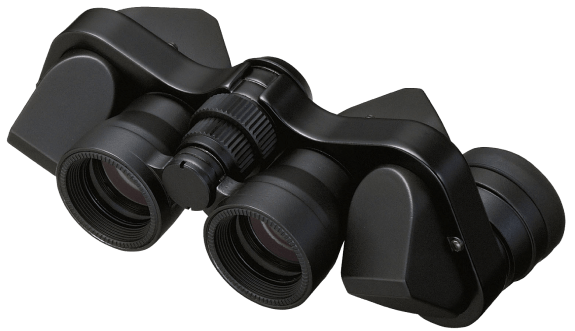
Nikon lists the 7x15 at 135 g (4.7 oz), 10 mm eye relief and a 56–72 mm interpupillary adjustment range. Its product copy describes a black aluminum body and a classic Porro-prism structure. The instrument is small by ordinary binocular standards, yet it still has two barrels and a center focus wheel; “pocket-sized” should not be mistaken for a flat or indestructible object. The exact product cutout shows the black two-barrel model, but Nikon does not disclose whether it is a photograph or render. Its image is not evidence of what is included in a particular box, and the exact US page does not list the case, caps, strap or other accessories.
Short eye relief deserves attention. Ten millimeters is a published distance, not a promise that eyeglasses will fit the full view. Anyone who needs glasses to observe comfortably should check the physical fit instead of relying on the compact exterior. The page does not describe adjustable eyecups, their positions, or whether the eye relief can be extended for a glasses wearer. A 56–72 mm interpupillary range provides a useful measurable fit boundary, but it does not settle eye-cup comfort.
Nor should the metal construction be confused with weather sealing. Nikon's exact page does not state a waterproof or fogproof rating. No such rating is confirmed in the source set, so this is not a safe choice where rain resistance is an essential requirement. The page also does not confirm image stabilization or a tripod socket. Its sensible use plan is a dry, handheld outing where 7x magnification, low weight and a small body are the important priorities.
Resolve the close-focus discrepancy first
Unlike many product pages where only one number is available, Nikon's 7x15 page publishes two different close-focus statements. The technical specification lists 2 feet. The descriptive section says it provides views of objects “as close as 6.5 feet away.” Those are materially different limits, and the manufacturer page does not explain whether one is a typo, a rounded marketing claim or a different measurement. The matching record therefore leaves close focus unknown. If near-field focusing is essential—for a close display or object on a museum wall—do not assume either number; ask Nikon or an exact seller for clarification.
That caution changes the comparison with the 6x15. The 6x model's exact technical specification lists 2 feet without the same conflicting statement, plus a wider scene and one-tenth ounce less weight. The 7x may still be the better choice for a viewer who puts more value on the extra fixed magnification. But its page does not let me make a confident close-focus advantage claim, even though the table alone would appear to do so.
Alternatives when the priorities change
If a wide, easier-to-find view matters more than 7x power, compare the MIKRON 6x15. If you expect longer outdoor walks, glasses use or variable light, Nikon's TRAVELITE 8x25 is a fuller instrument: it is 9.3 ounces, with 25 mm objectives and 14 mm of listed eye relief. The added weight is real, but so is the larger aperture and longer stated relief. A standard 8x30 or 8x42 provides still more objective area, at the cost of the very small package that makes the MIKRON distinctive.
Bottom line
The MIKRON 7x15 M CF is for someone who wants a very light, fixed 7x instrument for a dry, handheld outing and can accept narrow objectives, short eye relief and an unresolved close-focus claim. The extra power over the 6x model may be useful on static or more distant subjects, but it does not turn this into a better general-purpose pair. If your essential needs include verified close focus, all-weather use, glasses-friendly viewing or dim-light performance, this exact model has not cleared those requirements from Nikon's published material.
Exact US model and specifications: Nikon MIKRON 7x15 M CF. The other current Mikron size is Nikon MIKRON 6x15 M CF; general compact alternative: Nikon TRAVELITE 8x25.
Key specifications
Key details at a glance
| Magnification | 7× |
|---|---|
| Objective diameter | 15 mm |
| Real field of view | 7° |
| Apparent field of view | 46.4° |
| Field width at 1,000 m | 122 m |
| Eye relief | 10 mm |
More specifications and setup details
| Exit pupil | 2.1 mm |
|---|---|
| Manufacturer-published weight | 4.7 oz |
| ED glass confirmed for this exact model | No |
| Lens and prism coatings | Nikon describes high-contrast multilayer coating on the exact product page; coating on every optical surface and other coating types are not established. |
| Water and fog protection | No manufacturer waterproof or fogproof rating appears on the inspected exact model page; environmental protection remains unknown and does not meet a required waterproof filter. |
| Published weight note | Nikon publishes weight for the instrument; it is not the packed kit weight. |
| Package contents | The exact page and inspected official sources do not establish a complete retail-box contents list. Confirm accessories with the exact seller if essential. |
Use the exact model’s instructions for operating limits, supplied equipment and version differences.
Sources for this review
Sources for this assessment

Choose your optical trade-off first.
Choose viewing purpose first, then magnification, objective size, scene width and any fit, weather or mounting constraint. A direct-Sun requirement is separate: only exact manufacturer-confirmed solar binoculars can pass it.
Your needs, this model
15 mm binoculars: choose between MIKRON 6x and 7x
Choose it when: The 7x15 adds a step of fixed magnification while remaining almost the same weight; it is the choice only when 7x matters more than the MIKRON 6x's wider published field.
15 mm binoculars: choose between MIKRON 6x and 7x →Choosing a 7x binocular by viewing setup
Choose it when: The MIKRON is the compact extreme of the 7x candidates: Nikon lists a 4.7 oz instrument and a 7.0° real field. It fits a buyer who values minimal carry over a large objective or extensive feature set.
Choosing a 7x binocular by viewing setup →