
On this page
Your needs, this model
Does it fit your priorities?
Does the 10x50 keep ten-power magnification with a 50 mm objective?
Yes. Maven identifies SKU C31050 as the 10X option and lists a 50 mm objective.
Explore this need in the finder →Does its published 19.5 mm eye relief meet an 18 mm minimum?
Yes, 19.5 mm is above that published minimum; individual glasses fit still needs checking.
Explore this need in the finder →Can the 10x50 meet a six-degree real-field requirement?
No. Maven lists a 5° real field, so a mandatory six-degree broad-scene request should rule it out.
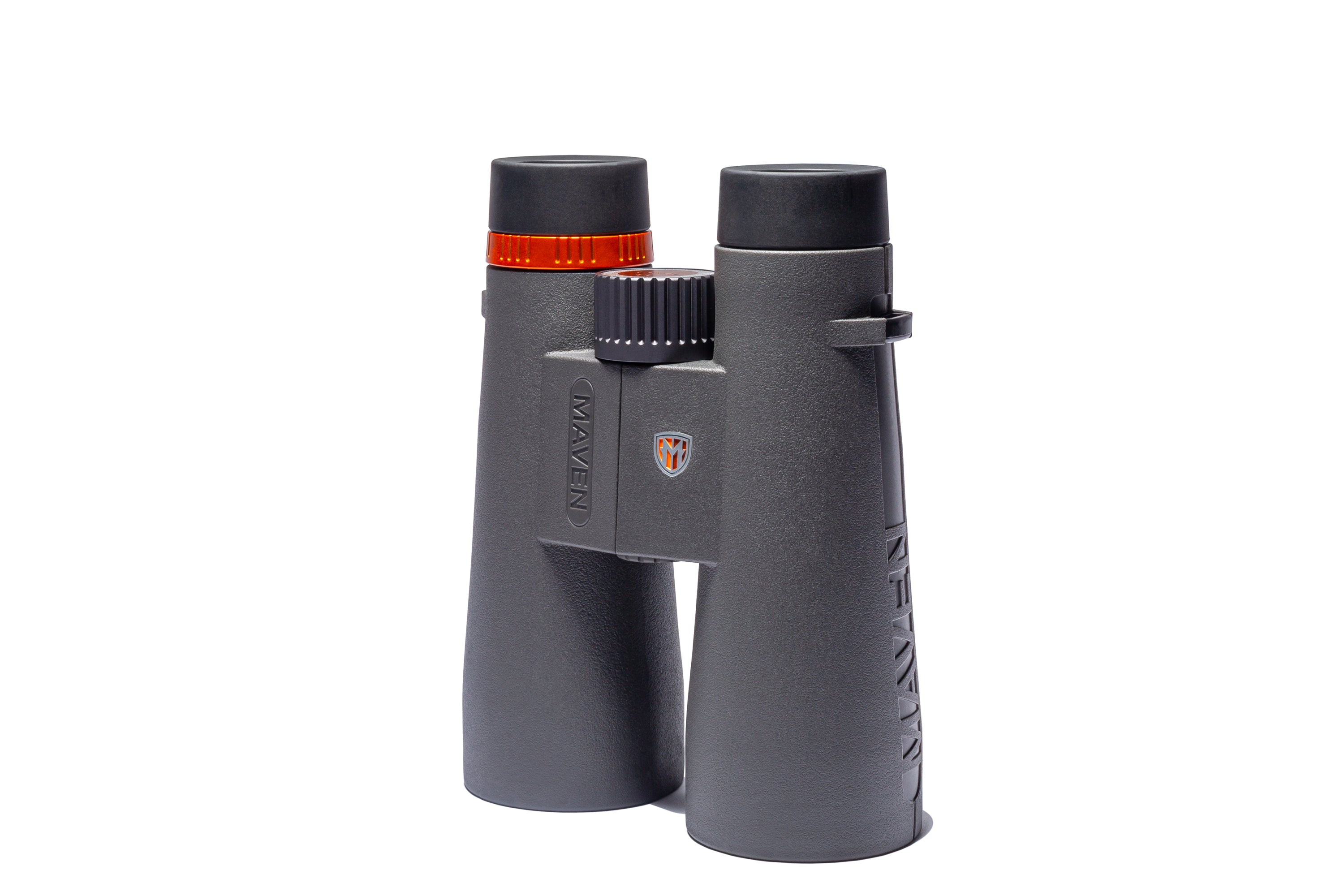
Explore this need in the finder →The Maven C.3 10x50 is the C-series option for someone who wants ten-power detail but a larger objective than the C.1 10x42. Maven lists a 5° real field (262 feet at 1,000 yards), a 5 mm exit pupil, 19.5 mm eye relief and 28-ounce instrument weight. That is a specific compromise, not a universal low-light upgrade: the larger pupil and longer eye relief are useful numbers to compare, while the narrower field, larger body and added weight matter just as much.
Ten power, with the roomier pupil of a 50 mm objective
The exact C.3 table gives this power a 50 mm objective, 5 mm exit pupil and 50° apparent field. The 12x50 sibling uses the same objective but its exit pupil is 4.2 mm and its apparent field is 57°. In the hand, ten power is generally the more forgiving of these two fixed magnifications for scanning or following movement; it does not remove hand shake, but it asks less of the viewer than twelve power. The wider pupil also gives the 10x50 more nominal pupil area than the 12x50. Neither figure is a promise of a particular dawn or dusk view, and neither substitutes for steadiness, eye fit or the light actually available.
Do not confuse the 50° apparent field with a broad real scene. Maven lists only 5° real field, or 262 feet at 1,000 yards. That does not meet the six-degree broad-scene choice used in this guide, and it is narrower than the C.1 10x42's published 6° / 314-foot view. Someone who needs to find a small moving bird quickly may prefer the C.1's greater scene width even though it has a 42 mm objective. If distant detail and the larger objective take priority over scene width, the C.3 10x50 is the better match of those two paper configurations.
Useful eye relief, but a full-size package
Maven lists 19.5 mm of eye relief for the 10x50 and 15 mm for the 12x50. That makes the 10x configuration the more promising starting point for glasses wearers, but a number alone cannot certify full-field comfort with every frame. The eyecups have multiple positions and should be set deliberately. The advertised 58–72 mm interpupillary range also deserves a check if several people will share the binocular. If either minimum eye relief or minimum IPD is an essential fit requirement, treat a missing or borderline specification as a reason to test before relying on the recommendation.
The C.3 measures 5.3 by 6.6 by 2.4 inches and weighs 28 ounces according to Maven. For comparison, the C.1 10x42 is listed at 24.5 ounces and 5 by 5.7 by 2.1 inches. The C.3 is consequently not a small upgrade to a pocket optic; it is a full-size instrument with more objective glass and a longer close-focus distance of 8.2 feet rather than the C.1's 5.9 feet. For long walks, travel or close subjects in a garden, a smaller 42 mm or compact model may be more useful than chasing the larger objective.
Outdoor protection and support are conditional details
The manufacturer describes the C.3 as waterproof and fog-proof; its specification page gives an IPX7 pressure-test result of one meter for 30 minutes and lists nitrogen purging. Those are construction claims, not an instruction to use the binocular underwater. Maven also lists ED objective glass, fully multi-coated lenses, phase correction, dielectric roof-prism coatings and scratch/oil-resistant lens coating. These identify the optical and coating package. They are not independent resolution, contrast or transmission tests; the published 90% transmission remains a manufacturer figure.
Both C.3 powers are tripod adaptable, but the C-series manual says the adapter is separate for models other than C.2. The 10x50 can therefore be considered for a supported setup, but do not count an adapter as included. The exact page lists a neoprene neck strap, lens caps and a double-layered microfiber storage bag. If a supplied support system is a hard requirement, this configuration does not meet it on the available package list; if you already own a compatible adapter or plan to buy one, the mounting capability is relevant.
Who should choose it?
Choose the C.3 10x50 when you want fixed ten-power magnification, a confirmed 50 mm objective, ED glass, weather protection and more eye-relief headroom than the C.3 12x50. It is especially worth comparing against the C.1 10x42 if your use includes longer sessions in dimmer outdoor light and you are willing to carry a larger, heavier body. Choose the C.1 instead if a wider real field, lighter carry or shorter close focus matters more. The C.3 12x50 is the alternative when stronger nominal magnification is the priority and you can accept its 15 mm eye relief and smaller exit pupil. In either case, evaluate eye placement, balance and steadiness in your own use; published values explain the tradeoffs but do not establish hands-on comfort.
Maven C.3 10x50 product option · Maven C.3 specifications · Maven C Series manual. Maven's linked family imagery does not identify this view by magnification; the model-specific numbers above come from the variant and specification table.
Key specifications
Key details at a glance
| Magnification | 10× |
|---|---|
| Objective diameter | 50 mm |
| Real field of view | 5° |
| Apparent field of view | 50° |
| Eye relief | 19.5 mm |
| Exit pupil | 5 mm |
More specifications and setup details
| Close focus distance | 8.2 ft |
|---|---|
| Manufacturer-published weight | 28 oz |
| ED glass confirmed for this exact model | Yes |
| Phase coatings confirmed | Yes |
| Lens and prism coatings | Maven lists ED objective elements, fully multi-coated lenses, phase correction, dielectric reflective coating on the roof prisms and scratch/oil-resistant lens coating. These are manufacturer specifications, not independent optical measurements. |
| Water and fog protection | Manufacturer waterproof/fog-proof description and IPX7 1 m / 30 min pressure-test specification; do not infer underwater suitability. |
| Tripod use | Manufacturer lists tripod adaptability. The linked C Series manual says the adapter is sold separately for models other than C.2; the C.3 standard included-items list does not include it. |
| Published weight note | Maven’s exact C.3 specification table lists 28 oz for this 50 mm power. This is the listed instrument weight, not an independent weighing or packed-system mass. |
| Manufacturer-rated waterproof | Yes |
| Tripod adapter in package | No |
Use the exact model’s instructions for operating limits, supplied equipment and version differences.
Sources for this review
Sources for this assessment

Choose your optical trade-off first.
Choose viewing purpose first, then magnification, objective size, scene width and any fit, weather or mounting constraint. A direct-Sun requirement is separate: only exact manufacturer-confirmed solar binoculars can pass it.