
On this page
Your needs, this model
Does it fit your priorities?
Do you want to look and range through the same 10x42 instrument?
The exact part 185699 page confirms a fixed 10x42 view and an integrated laser rangefinder. Its 12x50 sibling is a different, narrower-scene configuration.
Explore this need in the finder →Is the 17 mm stated eye-relief figure enough for your fit screen?
The exact page lists 17 mm. It satisfies a 17 mm published minimum, but not an 18 mm hard minimum and does not guarantee fit with any particular glasses frame.
Explore this need in the finder →Does the 10x42 adjustment start at a sufficiently narrow interpupillary setting?
The exact page lists 56 mm as its minimum interpupillary setting. That meets a limit of 56 mm; it does not meet a tighter 50 mm limit.
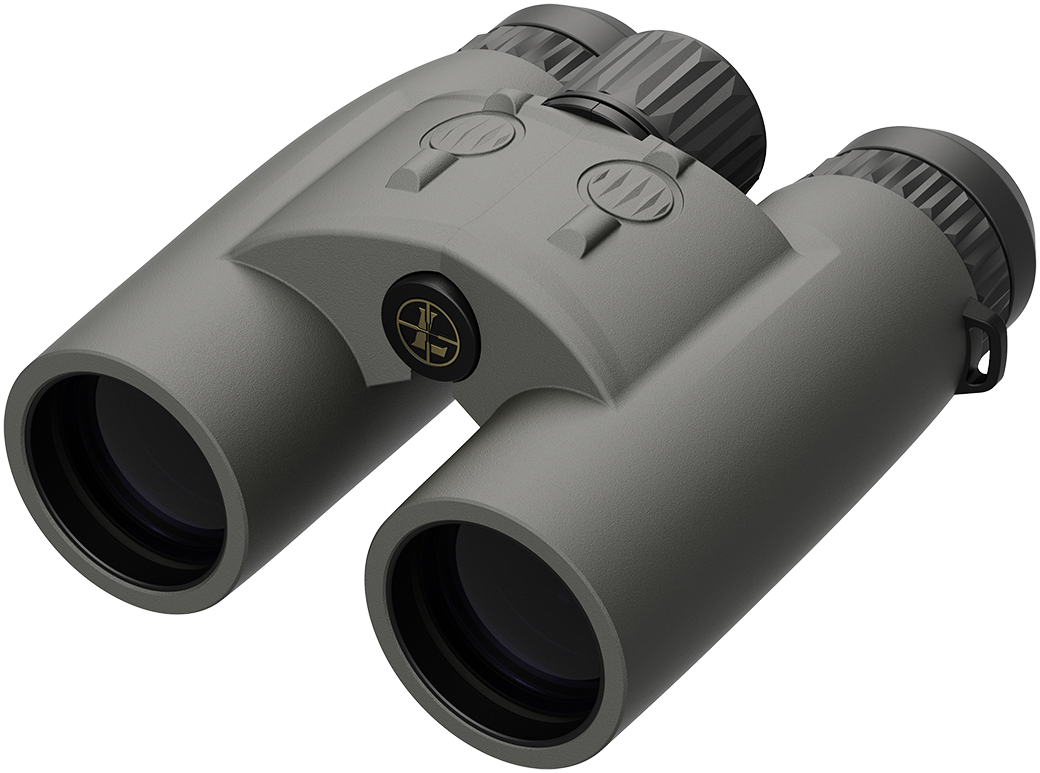
Explore this need in the finder →The Leupold BX-4 Range HD Gen 2 TBR/W 10x42 (part 185699) combines a conventional 10x42 view with an electronic laser rangefinder and on-unit distance/ballistic display. It makes most sense when ranging is a regular part of the same outing as glassing. If you mainly scan birds, wildlife or a distant shoreline, this is more instrument than you need: its battery, controls and uncertain carry weight are real ownership tradeoffs, not free extras.
One optical view, then a distance readout
The exact U.S. page identifies part 185699 as a 10x42 and lists a 6.2-degree real field, or 334 feet at 1,000 yards, 17 mm eye relief, a 4.2 mm exit pupil and a 13-foot close-focus distance. Those figures put it on the wider-view side of its 12x50 sibling: Leupold lists 279 feet and 5.2 degrees for the 12x50, with 14 mm eye relief. This is a direct specification comparison, not an optical test. Both are still 10x or 12x instruments rather than low-power wide-angle binoculars, and personal steadiness and fit are not captured by a field-of-view number.
The 10x42 objective is smaller than the 12x50’s, but both listings give a 4.2 mm exit pupil. A 50 mm front lens by itself therefore does not make the 12x50 the obvious low-light winner. Neither the name “HD” nor marketing claims about transmission substitute for a controlled side-by-side assessment, which I did not perform.
What the electronics actually add
Leupold’s manual identifies line-of-sight output, an inclinometer, scan mode, a red OLED readout, a last-target function and True Ballistic Range/Wind (TBR/W). The exact page also describes Bow Mode and Archer’s Advantage. Rifle output depends on choosing a suitable ballistic load group; the manual describes 25 selectable groups and explains that the display’s hold information is calculated from the range, angle and selected group. Treat that result as a configured aid, not a guarantee. The page’s wind feature uses a specified 10 mph wind from a 90-degree angle; it is not an onboard wind sensor that measures the actual conditions around you. Bow calculations likewise depend on the user’s setup. If you do not want to enter or verify those inputs, a plain line-of-sight range readout may be the more appropriate goal.
Manufacturer maximums are 4,000 yards on a reflective target, 2,000 on a tree and 1,300 on a deer-sized target. These are stated ceilings under favorable conditions, not ranges to expect from every target. Target size, reflectivity, surface, angle, steadiness and visibility all affect returns. A dark or small subject in poor weather can be much less cooperative than a large reflective surface. The 12x50’s page publishes a different deer figure from its own shared feature copy and from the linked manual, so its deer maximum is left unresolved in the companion assessment rather than promoted as a dependable advantage.
Battery, weight and fit are the decision points
The display and active ranging use a CR2 battery. The product specification table lists 3,000 actuations, while the linked operating manual says more than 4,000; neither establishes a field-tested runtime, so plan around carrying a spare rather than counting on a specific number of readings. The page lists the 10x42 at 37 ounces, but the manual gives 39 ounces with the battery installed. Because the two sources do not define the same weight basis, the assessment leaves weight unknown: a strict pack or neck-carry ceiling should not treat the lower page figure as verified. This is a substantial device compared with passive binoculars, even before a harness, adapter or other gear.
At 17 mm, the published eye relief is longer than the 12x50’s 14 mm, but it does not promise that every eyeglass frame will show the whole field. The manual describes three interchangeable Form-Fit eyecup sizes, including a low version intended for glasses; try the actual viewing position if glasses use is essential. The instrument adjusts from 56 to 76 mm interpupillary distance. Its specification page contains a malformed minimum-diopter entry, so the assessment does not guess the intended value or claim a complete adjustment range.
A built-in rotatable 1/4-20 tripod port is confirmed. That is useful when a supported view or steadier ranging matters, but the page does not establish that a separate adapter or tripod is included. It also describes the binocular as waterproof and fogproof without a numerical immersion rating; do not infer that it is intended for underwater use. The optical body is rubber-armored magnesium alloy, and the linked manual identifies extra-low-dispersion objective glass. The manual’s electronics-warranty section states two years; check Leupold’s current terms before purchase rather than assuming an electronics warranty matches a passive optic.
When to choose the 10x42—and when not to
Choose this size if you need an integrated laser and want the broader published scene of the pair, or if 12x magnification is more than you need. The 10x42’s 334-foot field and 17 mm stated eye relief are the practical distinctions from the sibling, not a proof that it is easier for every viewer. If your main routine is observation and you rarely need a measured distance, compare a passive 10x42 such as the BX-3 Alpine HD 10x42 review, or use a separate rangefinder when necessary. That route avoids making every viewing session depend on a combined electronic instrument.
Both versions are laser rangefinding products, not solar binoculars. The manual identifies a Class 1M laser and cautions against aiming the power button at a person’s eye, viewing the Sun through the binocular, or leaving it with small children. Read the linked manual’s setup and safety instructions before use. See Leupold’s exact 10x42 product page and the BX-4 Range HD Gen 2 manual for current specifications and operating detail.
Key specifications
Key details at a glance
| Magnification | 10× |
|---|---|
| Objective diameter | 42 mm |
| Real field of view | 6.2° |
| Eye relief | 17 mm |
| Exit pupil | 4.2 mm |
| Close focus distance | 13 ft |
More specifications and setup details
| ED glass confirmed for this exact model | Yes |
|---|---|
| Lens and prism coatings | The linked BX-4 Range HD Gen 2 manual identifies objective lenses with extra-low-dispersion glass. No source inspected here establishes a specific roof-prism phase or dielectric coating. |
| Water and fog protection | The manufacturer describes waterproof/fogproof construction without a stated immersion depth or IP rating. |
| Tripod use | The exact page confirms a built-in rotatable 1/4-20 tripod adapter port. It does not confirm a separate adapter or tripod in the standard package; adapter inclusion is unknown. |
| Published weight note | The exact product page lists 37 oz; the page-linked manual lists 39 oz with battery installed. These are not presented as the same measurement basis, and the exact operating weight remains unresolved. No independent weighing was performed. |
| Manufacturer-rated waterproof | Yes |
| Built-in image stabilization confirmed | No |
| Power source | CR2 |
| Integrated laser rangefinder | Yes |
| Onboard ballistic solution display | Yes |
| Maximum reflective-target range (manufacturer) | 4000 yd |
| Maximum tree range (manufacturer) | 2000 yd |
| Maximum deer range (manufacturer) | 1300 yd |
| Minimum range (manufacturer) | 12 yd |
Use the exact model’s instructions for operating limits, supplied equipment and version differences.
Sources for this review
Sources for this assessment
- Leupold exact BX-4 Range HD Gen 2 TBR/W 10x42 product page, part 185699
- Leupold BX-4 Range HD TBR/W Gen 2 operating manual (page-linked from both exact product pages; part 186606, artwork 186618)
- Leupold BX-4 Range HD Gen 2 Quick Reference Card, page-linked from exact product page
- Leupold official U.S. binocular directory, page 2, positions 4 and 5
- Official part-specific product image linked from the exact product page
- Dated narrow product-name SaferProducts.gov/CPSC query; empty response is not recall clearance

Choose your optical trade-off first.
Choose viewing purpose first, then magnification, objective size, scene width and any fit, weather or mounting constraint. A direct-Sun requirement is separate: only exact manufacturer-confirmed solar binoculars can pass it.