
On this page
Your needs, this model
Does it fit your priorities?
Is this exact fixed 10x50 configuration the power and objective you want for ordinary outdoor observation?
The exact page identifies fixed 10x50mm and lists 299 ft / 5.7° field at 1,000 yd. It matches the requested format; the field figure is a published specification, not a tracking test.
Explore this need in the finder →Will the 28.7-ounce body and 19 mm listed eye relief meet your numeric fit screen?
The exact specification table lists 28.7 oz, 19 mm eye relief and 56–74 mm interpupillary distance. These are screening figures, not a glasses-fit or comfort guarantee.
Explore this need in the finder →Do you require an exact-page-confirmed weather claim and standard tripod port?
Leupold describes this exact configuration as waterproof/fogproof and confirms a built-in rotatable 1/4-20 port. Adapter inclusion is not confirmed, so the port does not satisfy a need for an adapter in the box.
Explore this need in the finder →The Leupold BX-4 Pro Guide HD Gen 2 10x50mm (part 184762) keeps 10x magnification but enlarges the objectives to 50 mm. The manufacturer lists a 299-foot field at 1,000 yards, 19 mm eye relief, 5 mm exit pupil, 28.7-ounce instrument weight, and 6.8-inch length. Its role is a more light-admitting geometric configuration than the 10x42 on pupil size, while its larger housing makes it a less convenient walking companion.
Same power, different package
Because both 10x42 and 10x50 use ten-power magnification, their subject scale is the same in principle. The 50 mm objectives produce a listed 5 mm exit pupil, compared with 4.2 mm on the 10x42. A larger exit pupil can make eye placement more forgiving in some conditions, but it does not establish transmission efficiency or prove a brighter image. Lens coatings, observer pupil size, illumination and the alignment of the eyes also matter; no independent optical measurements were performed for this review.
The physical cost is concrete. The 10x50 weighs 28.7 ounces and measures 6.8 inches long, compared with 25 ounces and 5.7 inches for the 10x42. Its field is 299 rather than 314 feet at 1,000 yards. That makes the 50 mm size a reasonable consideration for a stationary observation point or a sit-and-glass outing, but less attractive if your priority is low pack weight or rapid scanning. A harness can help distribute a binocular on the body, but no harness fitting or long-duration carrying test was conducted.
Eyeglasses and close work
The product table lists 19 mm eye relief, two millimeters more than the 10x42. That figure makes the 10x50 worth trying for glasses users, not a guaranteed full-field match. Its minimum IPD is listed at 56 mm and maximum at 74 mm; compare your fit and the view with your regular glasses before making the choice. Leupold describes three interchangeable Form-Fit eyecup styles, including low eyecups for glasses, plus twist-up adjustment. Use whichever position gives a full image without pressure or blackouts.
Leupold lists a 9.3-foot close-focus distance. For very nearby subjects, that may be less useful than a dedicated close-focusing model. The model uses central focus and a locking diopter according to its exact page. The linked, two-page general manual covers hinge spacing, center focus, diopter setting and basic handling. It is not a model-specific resolution test, and no field tracking or low-light test is claimed here.
Features and boundaries
Leupold describes phase-coated roof prisms, fully multi-coated lenses, DiamondCoat 2 on exterior glass, and a Guard-Ion hydrophobic lens treatment. These are exact-page manufacturer claims. The product page does not identify ED glass or a full technical coating stack; neither the “HD” label nor the 50 mm objectives should substitute for evidence on those details.
The manufacturer describes the 10x50 as waterproof and fogproof, without an IP rating or immersion depth and duration on the page. Consider that a weather-sealing claim, not permission to submerge the optics. It also confirms a built-in, rotatable 1/4-20 tripod port. The page does not identify a standard adapter in the box, so budget for compatible mounting hardware only after confirming which adapter fits.
Shortlist judgment
Keep the 10x50 on the list if you want the stated 5 mm exit pupil and 19 mm eye relief while retaining 10x power, and if a heavier, longer instrument is acceptable. The 10x42 is the more carryable same-power alternative, while 8x42 gives the broadest view and 12x50 more magnification with a narrower scene. A 50 mm objective alone is not a recommendation for darkness; judge the complete optical system and your intended use.
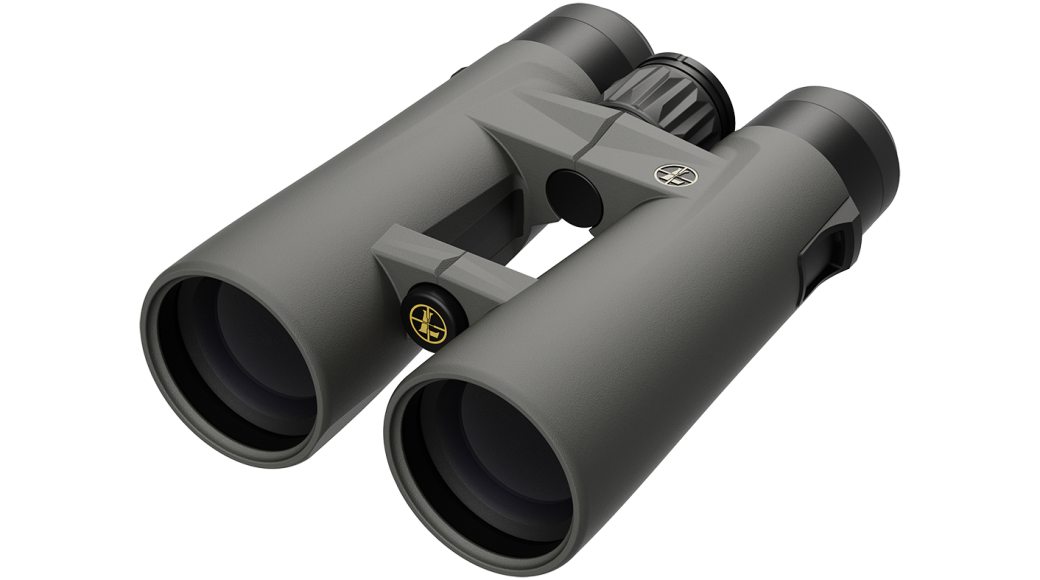
The exact page-linked image is a gray binocular product cutout; it does not show a legible 10x50 marking, and the image bytes are shared with the 12x50 exact page. The page URL, not visual differentiation, establishes which model it accompanies. Rendering method and reuse rights remain undisclosed. Retail stock, price and exact ASIN were not verified; search by the full model name and part 184762, then confirm the seller’s listing is the 10x50.
Manufacturer sources: 10x50mm part 184762 exact U.S. page and its linked general owner manual.
Key specifications
Key details at a glance
| Magnification | 10× |
|---|---|
| Objective diameter | 50 mm |
| Real field of view | 5.7° |
| Eye relief | 19 mm |
| Exit pupil | 5 mm |
| Close focus distance | 9.3 ft |
More specifications and setup details
| Manufacturer-published weight | 28.7 oz |
|---|---|
| Phase coatings confirmed | Yes |
| Locking diopter ring confirmed | Yes |
| Lens and prism coatings | Leupold lists phase-coated roof prisms and fully multi-coated lenses, DiamondCoat 2 exterior lens treatment, and Guard-Ion hydrophobic coating. The exact page does not identify ED glass or every technical detail of the coating stack; no independent transmission measurement is claimed. |
| Water and fog protection | Manufacturer waterproof/fogproof description; no numeric immersion/IP specification located. |
| Tripod use | The exact product page confirms a built-in rotatable 1/4-20 tripod port, but does not establish an adapter model or that an adapter is included. Confirm mounting hardware separately. |
| Published weight note | Exact manufacturer-listed binocular weight; any carry accessories add weight. No independent weighing was performed. |
| Manufacturer-rated waterproof | Yes |
| Built-in image stabilization confirmed | No |
| Integrated laser rangefinder | No |
| Onboard ballistic solution display | No |
| Direct 1/4-20 tripod thread confirmed | Yes |
Use the exact model’s instructions for operating limits, supplied equipment and version differences.
Sources for this review
Sources for this assessment
- Leupold exact U.S. product page, part 184762
- Leupold Binocular Owner’s Manual (2023 artwork 56116P), linked from exact product page; generic setup/care guidance, not SKU-specific optical evidence
- Exact manufacturer product-page-linked primary image URL for part 184762
- Previously archived Leupold U.S. binocular directory page 1, observed row 9
- Dated exact-name public CPSC recall search; a narrow empty result only

Choose your optical trade-off first.
Choose viewing purpose first, then magnification, objective size, scene width and any fit, weather or mounting constraint. A direct-Sun requirement is separate: only exact manufacturer-confirmed solar binoculars can pass it.