
On this page
Your needs, this model
Does it fit your priorities?
Does the fixed 10x50 provide the broad scene and larger objective you are looking for?
Celestron lists 10x, 50 mm objectives and a 6.8° real field; the 5 mm exit pupil and 27 oz weight explain why it is brighter in geometry than the 25 mm options but not especially compact.
Explore this need in the finder →Is waterproofing essential for this outing?
No: the exact item is rated water resistant, not waterproof, and is not nitrogen filled. If water exposure is an essential condition, select a model with an explicit waterproof rating.
Explore this need in the finder →Must a tripod adapter be included in the package?
This Porro body is tripod adaptable, but the separate adapter is not included. Treat it as a supported option only if purchasing the adapter separately is acceptable.
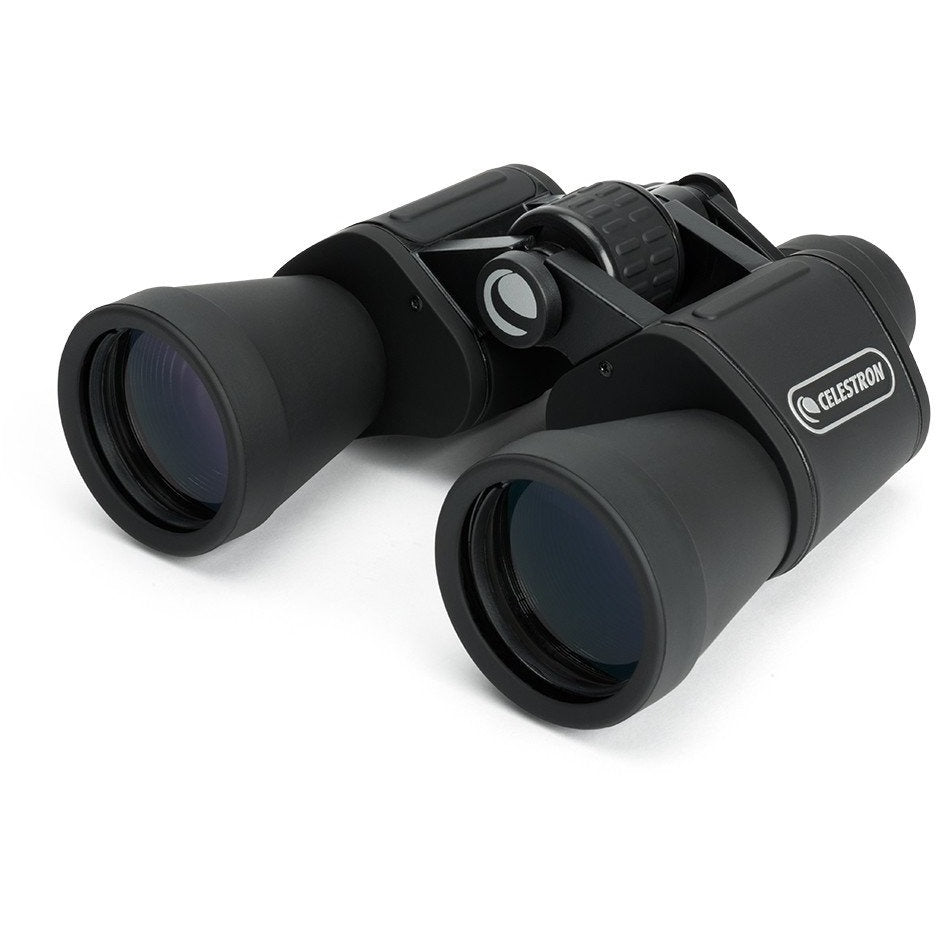
Explore this need in the finder →The Celestron UpClose G2 10x50 (item 71256) is the conventional large-objective member of this low-cost family: fixed 10x magnification, 50 mm objectives and a broad-shouldered Porro body. Its published 6.8° field (354 ft at 1,000 yd), 5 mm exit pupil and 27 oz weight put it between the easier-to-carry 8x40 and the much harder-to-steady 20x50. Celestron still lists the exact US item, although its own page showed it out of stock when checked on October 23, 2026. Stock status does not make the model a different binocular.
A full-size 10x view rather than a compact carry
Ten power gives a more enlarged view than the 7x and 8x UpClose G2 models, while a 50 mm objective retains a 5 mm exit pupil. The manufacturer lists a 6.8° angular field and 354 ft of scene width at 1,000 yards. That is a useful middle ground for someone who wants to inspect distant activity without narrowing the view as severely as the 20x50 does. The field is a published specification, not a personal observation of edge sharpness or optical resolution.
The 10x50 is roughly 7.3 inches long and weighs 27 oz before a case or other gear is added. That is a real distinction from the 11 oz 10x25 roof pair and the 8 oz 8x21 pocket model. Choose the 10x50 when a larger grip and aperture are worth carrying; choose one of those compacts when the binocular must disappear into a jacket pocket. The 8x40 is another sensible alternative if ease of subject-finding matters more than ten-power reach: its published field is 8.2° and it weighs 24 oz.
Published limits matter as much as aperture
Celestron gives this item 12 mm of eye relief, a 23 ft close-focus distance, and a -4 to +8 diopter adjustment range. The short stated eye relief may be restrictive for some eyeglass wearers; lowering a rubber eyecup is a setup step, not proof that the full field will remain visible through every frame. The 23 ft close-focus figure suits distant outdoor viewing, not close-focus study of nearby subjects. The 8x21 and 10x25 reach 10 and 15 ft respectively, while the 7x35 reaches 13 ft.
The 50 mm lenses do not certify low-light image quality. The page lists BK-7 Porro prisms and multi-coated optics, but does not claim phase coating, ED glass, nitrogen filling or a waterproof rating. Its environmental-protection entry says water resistant. Treat that as a limit against incidental moisture, not a promise for sustained rain, immersion, or fog-free operation. The black rubber-covered aluminum body is described as rugged; no drop test or independent durability measurement is available here.
Tripod support needs an extra part
The exact product page marks the Porro binocular as tripod adaptable. Celestron's manual explains that Porro models have a threaded fitting under a cap and that a separate binocular tripod adapter connects that fitting to a photographic tripod. The exact standard package lists a carrying case, objective and eyepiece covers, lens cloth and instruction manual; it does not list the adapter. The product description separately mentions a neck strap. A steady mounting option can be useful for prolonged viewing, but this is not a tripod-ready bundle in the sense of having the adapter in the box.
The manual's practical setup sequence is straightforward: first hinge the barrels until the two images merge, then focus the left eye with the center wheel, set the right-eye diopter independently, and use the center wheel for later distance changes. For glasses, fold the rubber eyecups down; otherwise keep them raised. Celestron advises keeping the optics clean, storing the binocular in its case, avoiding internal cleaning or disassembly, and never viewing or projecting the Sun through it.
How questionnaire choices change the fit
Selecting 10x and 50 mm objectives will retain this exact model and rule out the smaller 8x21, 10x25, 7x35 and 8x40 sizes, as well as the 20x50 and 10–30x50 alternatives. A waterproof requirement removes the entire UpClose G2 line because the manufacturer identifies it only as water resistant. A 13 mm minimum eye-relief choice also removes this 12 mm configuration, and a 24 oz weight ceiling excludes the 27 oz instrument. Requiring an adapter included in the package excludes it too: the adapter is separate.
Consider the 8x40 if you favor its wider 429 ft field, 5 mm exit pupil and 24 oz weight, accepting a larger body than a pocket binocular. Choose the 20x50 only for a supported high-power plan and its narrower 168 ft field. The 10–30x50 provides variable power, but trades a fixed view for a heavier zoom system and a much narrower field at maximum power. This 10x50 is the simpler full-size choice for daytime birding, outdoor events or general distance viewing when weight, glasses fit, and weather limits match your own priorities.
Key specifications
Key details at a glance
| Magnification | 10× |
|---|---|
| Objective diameter | 50 mm |
| Real field of view | 6.8° |
| Field width at 1,000 m | 118 m |
| Eye relief | 12 mm |
| Exit pupil | 5 mm |
More specifications and setup details
| Close focus distance | 23 ft |
|---|---|
| Manufacturer-published weight | 27 oz |
| ED glass confirmed for this exact model | No |
| Lens and prism coatings | Celestron lists multi-coated optics and BK7 prisms; the exact table lists prism coatings as N/A. Fully multi-coated or phase-coated performance is not asserted. |
| Water and fog protection | Water resistant; not listed as waterproof; nitrogen filling: no. |
| Tripod use | Tripod adaptable, but a compatible adapter is sold separately and not included. |
| Published weight note | Exact manufacturer listed instrument weight; no field measurement or accessory weight is implied. |
| Package contents | Carrying case, objective covers, eyepiece covers, lens cloth and instruction manual are itemized; product description also names a neck strap. |
| Manufacturer-rated waterproof | No |
| Tripod adapter in package | No |
Use the exact model’s instructions for operating limits, supplied equipment and version differences.
Sources for this review
Sources for this assessment
- Official Celestron US UpClose G2 binocular family collection (14 rows observed)
- Official Celestron Shopify product JSON for the UpClose G2 family snapshot
- UpClose G2 10x50mm Porro Binoculars
- Celestron UpClose G2 binoculars manual; English operating and care pages inspected
- Celestron UpClose G2 official specification and package-variant sheet
- Dated CPSC ProductName search for Celestron item 71256 (empty response on 2026-10-23)
- Celestron image linked from the exact item page

Choose your optical trade-off first.
Choose viewing purpose first, then magnification, objective size, scene width and any fit, weather or mounting constraint. A direct-Sun requirement is separate: only exact manufacturer-confirmed solar binoculars can pass it.