
On this page
Your needs, this model
Does it fit your priorities?
If 8x power is still right but a 42 mm objective is acceptable instead of the discontinued 56 mm DX, which current 8x42 options meet 18 mm eye relief and a 38 oz ceiling? Would 21 mm eye relief still leave one?
Celestron lists 18 mm eye relief for discontinued item 72022, but that does not make it a purchase suggestion. If you accept the smaller 42 mm class, the current Nikon MONARCH M5 8x42 (19.5 mm, 22.2 oz), PROSTAFF P3 8x42 (20.2 mm, 20.3 oz) and PROSTAFF P7 8x42 (20.2 mm, 20.8 oz) meet the 18 mm / 38 oz choices. None reaches a 21 mm eye-relief minimum. These compact roof-prism pairs are not equivalent to the DX's 56 mm Porro design.
Explore this need in the finder →If walking weight matters more than the 56 mm objective, do current 8x42 choices stay under 21 oz, and what happens at a 20 oz ceiling?
The P3 at 20.3 oz and P7 at 20.8 oz meet a 21 oz instrument limit; the M5 at 22.2 oz does not. A 20 oz cap leaves none of these three 8x42 alternatives. Their 42 mm objective is a genuine change from the reference-only 8x56, not the same large-objective configuration.
Explore this need in the finder →If a tripod adapter must be included, which current SkyMaster 15x70 fits a 50 oz ceiling, and what if the ceiling is 45 oz?
The current SkyMaster 15x70 item 71009 weighs 48 oz and its manufacturer package list includes a tripod adapter; it fits the 50 oz choice but not 45 oz. It is a higher-power, 70 mm support-oriented configuration, not a substitute for the discontinued DX 8x56. The DX package list itself omits the adapter.
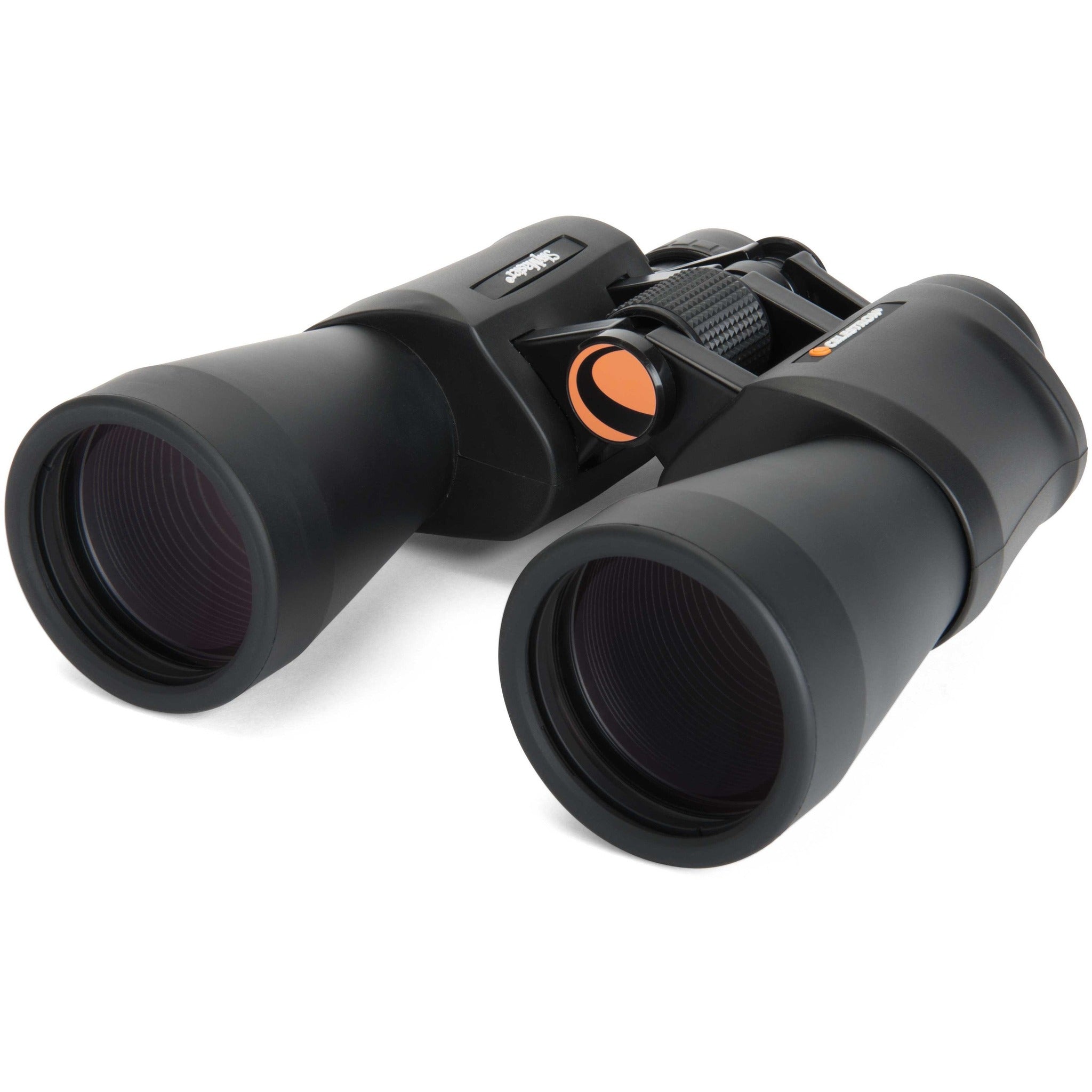
Explore this need in the finder →The Celestron SkyMaster DX 8x56 (item 72022) is a full-size Porro binocular built around an 8x view, wide stated field and waterproof body. Its 56 mm objectives yield a listed 7 mm exit pupil, but the instrument itself weighs 38 oz before a case or other accessories. Celestron’s collection identifies this item as discontinued, and its exact product page showed out of stock on October 23, 2026. This review is a reference for comparing the DX design, not a current purchase recommendation.
What the 8x56 combination changes
Eight-power magnification is a moderate choice for a large-aperture binocular. Relative to the 9x63 SkyMaster DX, this model gives up a little image scale in exchange for Celestron’s wider listed 5.8-degree field: 305 feet at 1,000 yards, or 102 metres at 1,000 metres. A wider real scene can make it easier to acquire a moving subject or sweep a broad landscape, although field width alone cannot promise a particular viewing experience. The exact product page positions the series for both terrestrial use and astronomy, so this is better understood as a long-view tool than a compact travel pair.
The 56 mm objective and 8x magnification produce a 7 mm exit pupil by division. Celestron also publishes a relative-brightness index of 49, but that figure is not a measurement of what every person will see. The eye limits the usable beam; an observer whose pupils open to less than 7 mm will not take in all of it. A large exit pupil is one design dimension, not a guarantee that the image will appear brighter in every setting. Light, focus, eye placement and the observer all matter.
Big body, real carrying cost
Celestron lists the binocular at 38 oz (1,077 g), with dimensions of 180 × 74 × 190 mm. Those are instrument figures, not a weighed package. At nearly two and a half pounds, it is much less convenient than the small 8x21 and 8x32 styles that are easier to keep in a day bag. The lower 8x power may be easier for some people to hold still than a 12x or 15x binocular, but no stabilization system is listed, and a large objective housing does not make a heavy pair disappear from the hands. For an extended fixed viewpoint, the page says tripod adaptable; its included-items list does not include a tripod or binocular adapter. The shared SkyMaster manual describes the separate threaded adapter procedure, so plan on confirming and obtaining the appropriate adapter if you want a tripod mount.
Fit and setup details worth checking
The page gives 18 mm eye relief, a 58–72 mm interpupillary range, and a ±4 diopter adjustment. It also describes multi-position twist-up eyecups, which can be folded down for glasses according to the manual. Eighteen millimetres is a useful starting specification for comparing fit, not a guarantee that a particular eyeglass frame sees the whole field; glasses users should check eye position and edge visibility if possible. The listed closest focus is 25 ft (7.6 m), so it is not intended for butterflies on nearby flowers, indoor exhibits or small objects across a room.
The exact item page calls this a BaK-4 Porro model, fully multi-coated, waterproof and nitrogen-purged, with twist-up eyecups and a center-focus knob. It publishes no immersion depth or duration, so waterproof is not permission to submerge it. The package list names objective caps, a rainguard, carrying case, neck strap, lens cloth and instruction manual; the tripod adapter is not listed. The linked five-language SkyMaster manual explains how to set interpupillary distance, focus the left barrel with the center wheel, set the right-eye diopter separately, then refocus with the center wheel. It also warns never to look at the Sun and says the instrument is intended for ages 14 and older.
Who should use this as a comparison point
For an old 8x56 sample or used-specification comparison, this DX is the wider-field and lighter member of its 8x56/9x63 pair. The 9x63 has more stated magnification and a larger objective, but it is heavier, narrower in field and has shorter eye relief. If your priority is carrying binoculars all day, the 38 oz figure argues for considering a different class rather than choosing between these two large formats. This exact item remains a reference, not a purchase suggestion: selecting earlier models does not reverse Celestron’s discontinued status. If 8x power matters more than 56 mm objectives, the current Nikon PROSTAFF P3 8x42 and PROSTAFF P7 8x42 are much lighter 42 mm roof-prism comparisons, not equivalent large-aperture replacements.
Key specifications
Key details at a glance
| Magnification | 8× |
|---|---|
| Objective diameter | 56 mm |
| Real field of view | 5.8° |
| Field width at 1,000 m | 102 m |
| Eye relief | 18 mm |
| Exit pupil | 7 mm |
More specifications and setup details
| Close focus distance | 25 ft |
|---|---|
| Manufacturer-published weight | 38 oz |
| Lens and prism coatings | Exact product table says Fully Multi-Coated optics and lists Prism Coatings N/A; no ED glass, phase coating or dielectric coating is established. |
| Tripod use | Exact page says Tripod Adaptable: Yes; the exact package list does not include an adapter. The linked general SkyMaster manual describes a separately threaded binocular adapter for models with the fitting. No tripod or adapter is claimed included. |
| Published weight note | Exact manufacturer page weight is instrument-only, not weighed or inclusive of accessories. |
| Package contents | Manufacturer product type is Discontinued and the exact page showed Out of stock on the 2026-10-23 check. Archived collection item data also tags discontinued-out-of-stock. Retain as reference-only; do not add a buying link. |
| Manufacturer-rated waterproof | Yes |
| Tripod adapter in package | No |
Use the exact model’s instructions for operating limits, supplied equipment and version differences.
Sources for this review
Sources for this assessment
- Official Celestron US SkyMaster collection object for item 72022
- SkyMaster DX 8x56mm Porro Binoculars (item 72022)
- Celestron SkyMaster Series five-language manual (shared manual linked from exact product page)
- Celestron exact-page-linked original image for item 72022
- Official CPSC exact-number ProductName recall query for item 72022

Choose your optical trade-off first.
Choose viewing purpose first, then magnification, objective size, scene width and any fit, weather or mounting constraint. A direct-Sun requirement is separate: only exact manufacturer-confirmed solar binoculars can pass it.