
On this page
Your needs, this model
Does it fit your priorities?
Does the 71348 combine 10x power with 50 mm objectives and a 5.6° field?
Yes. The exact page lists 10x, 50 mm and 5.6° angular field.
Explore this need in the finder →Does it meet a 17 mm eye-relief minimum at a 27-ounce weight ceiling?
The page lists 17.4 mm and 27 oz; actual glasses fit and handheld comfort remain personal checks.
Explore this need in the finder →Does the 10x50’s listed close focus fit a nine-foot maximum?
Yes. Celestron lists 8.2 ft (2.5 m), the shortest close-focus figure in this five-model black group.
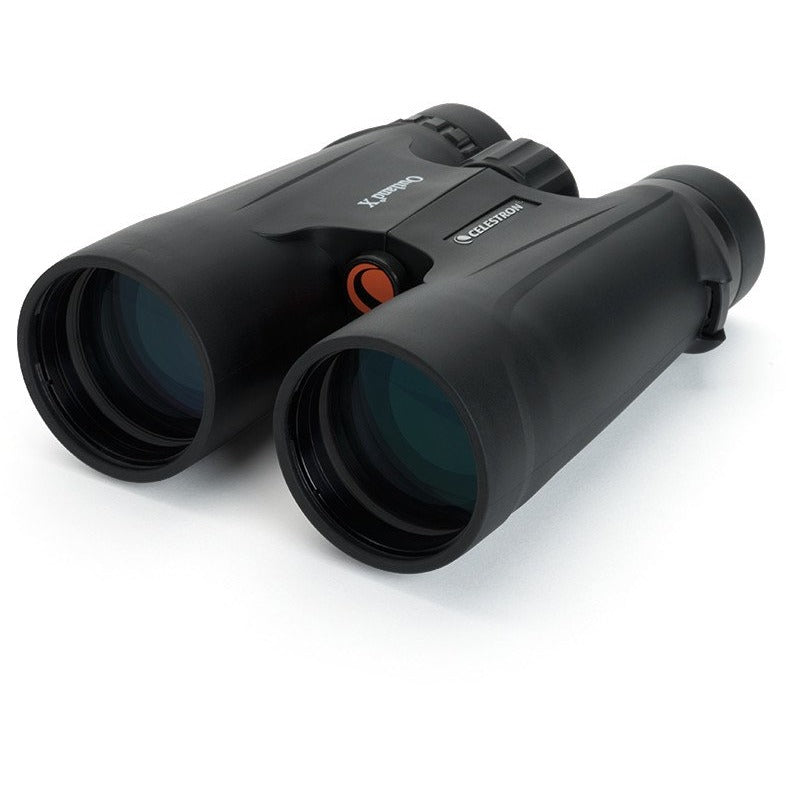
Explore this need in the finder →The Celestron Outland X 10x50 (item 71348) keeps 10x power but moves to the largest objective in this black five-model group. Celestron lists a 5.6° field, 4.8 mm exit pupil, 17.4 mm eye relief and 27 oz (765 g) weight. It suits stationary or supported viewing when a larger 50 mm package and the listed close focus of 8.2 ft are relevant. For someone who carries binoculars all day, its additional size and mass over the 10x42 should be treated as the central cost, not a footnote.
A 50 mm option with a close-focus distinction
At 10x, the 71348 has a listed 294.2 ft field at 1,000 yards (98.1 m at 1,000 m), or 5.6°. That is almost the same real field as the 10x42’s 5.5° and only modestly different by the stated figures. Its objective diameter increases from 42 to 50 mm, the listed exit pupil increases from 4.2 to 4.8 mm, and the weight rises by 95 g (about 3.4 oz). Exit pupil is a geometric specification, not evidence that the binocular delivers a particular measured amount of light or an independently verified low-light advantage.
One specific number separates the 10x50 from the 10x42: the product page lists close focus at 8.2 ft (2.5 m), versus 13.1 ft (4 m) on the 10x42. If you frequently observe nearby subjects, that published minimum may be useful. For distant birds, sports or scenery, the shorter close-focus number may not justify extra mass. The 8x42 weighs less and is listed with a wider 7° field; the 10x42 keeps the same magnification and almost the same field while saving weight. All three are tripod adaptable, but the adapter is a separate purchase.
Handheld comfort, glasses and support
Twenty-seven ounces is a substantial handheld instrument compared with the 11–12 oz compact pairs and the 23.6 oz 42 mm models. The manufacturer’s page lists tripod adaptability, and the Outland X manual identifies the 50 mm body as threaded beneath the removable logo plate. A separate binocular tripod adapter is needed to attach the instrument to a photographic tripod; it is not in the included-items list. A stable setup is a realistic operating plan for long observation sessions. If you intend to handhold for hours, decide whether the 50 mm aperture and 8.2 ft close focus are worth the extra burden before considering magnification alone.
Eye relief is listed at 17.4 mm and the product uses twist-up eyecups. This is a helpful number for an eyeglass-wearing buyer to compare, but it does not certify full-field comfort for every prescription or frame. Celestron’s manual recommends setting the eyecups down for glasses and adjusting IPD, center focus and right-eye diopter in order. The stated interpupillary range is 56–74 mm, and the diopter range is ±3. If either range is an essential fit constraint, test the exact eyepieces and body position rather than relying on a broad “eyeglass friendly” label.
Outdoor construction without an underwater promise
Celestron lists waterproof construction and nitrogen filling and describes the series as fogproof. The exact product page does not state a depth or duration for immersion. Treat it as weather-oriented construction, not a device to submerge. The listed optical description is multi-coated optics and BaK-4 prisms; the manufacturer material reviewed here does not report a measured transmission value or independent sharpness result. The product page names objective caps, rainguard, neck strap, cloth case, lens cloth and manual as standard items.
Care is straightforward: use caps between sessions, remove dust before wiping, and store the binocular cool and dry. The manual warns against hot-car storage, impact and looking at the Sun. It describes a limited lifetime warranty for the original owner in the United States or Canada; warranty eligibility is not a reason to assume a used, resold or modified unit is covered.
How to decide if 10x50 is the right size
The 71348 is a reasonable choice when 10x matters, 50 mm objectives are specifically wanted, the shorter close-focus specification is useful, and tripod support or brief handheld sessions fit the way you observe. For travel and walking, the 10x25 is 446 g (15.7 oz) lighter and 25 mm shorter across the objective class, though it has a 2.5 mm exit pupil, 9.1 mm eye relief and a narrower 6.2° field. For a balanced full-size 10x pair, the 10x42 is lighter and has slightly longer stated eye relief; the 10x50 adds aperture but should not be assumed to add the same amount of real-world image performance. The exact page-linked manufacturer product image is used for identity; Celestron does not disclose photo-versus-render status. This is a source-led comparison, not a lab test or ownership report.
Key specifications
Key details at a glance
| Magnification | 10× |
|---|---|
| Objective diameter | 50 mm |
| Real field of view | 5.6° |
| Field width at 1,000 m | 98.1 m |
| Eye relief | 17.4 mm |
| Exit pupil | 4.8 mm |
More specifications and setup details
| Close focus distance | 8.2 ft |
|---|---|
| Manufacturer-published weight | 27 oz |
| ED glass confirmed for this exact model | No |
| Lens and prism coatings | Celestron describes multi-coated optics and BaK-4 prisms. Prism coatings are listed as N/A; fully multi-coated or phase-coated performance is not asserted. |
| Water and fog protection | Celestron lists waterproof construction and nitrogen filling and describes the series as fogproof; no exact depth or duration limit is published. Do not infer underwater use. |
| Tripod use | Celestron lists the 42/50 mm model as tripod adaptable. The manual requires a separate binocular tripod adapter; the standard page package does not list one. |
| Published weight note | Celestron lists 27 oz (765 g) for the exact item. No independent scale measurement is claimed. |
| Manufacturer-rated waterproof | Yes |
| Tripod adapter in package | No |
Use the exact model’s instructions for operating limits, supplied equipment and version differences.
Sources for this review
Sources for this assessment
- Official Celestron US Outland X collection and product enumeration
- Official collection products JSON, archived catalogue enumeration
- Celestron exact US product page, item 71348
- Celestron Outland X series manual; English setup, eyecups, support, safety and care inspected
- CPSC exact item-number ProductName recall query for 71348; empty array on 2026-10-23
Choose your optical trade-off first.
Choose viewing purpose first, then magnification, objective size, scene width and any fit, weather or mounting constraint. A direct-Sun requirement is separate: only exact manufacturer-confirmed solar binoculars can pass it.