
On this page
Your needs, this model
Does it fit your priorities?
Does the ED 10x50 satisfy a required ED-glass choice with at least 17 mm listed eye relief?
Yes. Celestron identifies ED objective lenses and lists 17.8 mm eye relief for item 72335.
Explore this need in the finder →Does the ED 10x50 meet a 29 oz carry limit but miss a stricter 27 oz cap?
Yes. The manufacturer publishes 28.4 oz: below 29, above 27.
Explore this need in the finder →Does the ED 10x50 meet a close-focus maximum of nine feet when waterproofing is required?
Yes. Its exact page lists 8.2 ft close focus and waterproof construction.
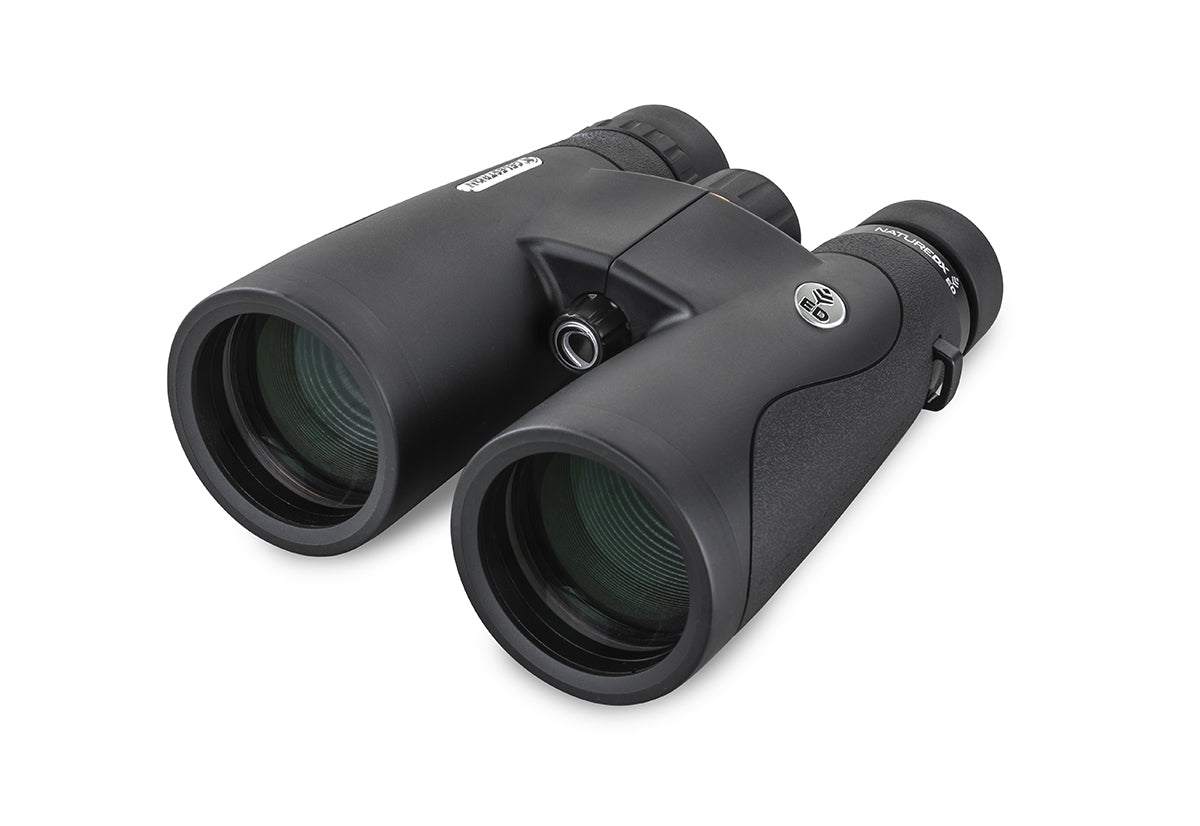
Explore this need in the finder →Celestron’s Nature DX ED 10x50, item 72335, is a full-size roof binocular for someone who wants the 10x/50 mm combination and considers ED glass an important optical specification. It is not an ultralight choice: Celestron lists it at 28.4 oz (806 g), the same weight as its standard 10x50 and 12x50 siblings. Its published 5.9° field and 17.8 mm eye relief are the most generous figures among the four 50 mm models in this comparison, but that does not make it a wide-field binocular or guarantee glasses fit for every face.
What the ED designation confirms
The exact page identifies ED objective lenses, fully multi-coated optics and phase-coated BaK-4 prisms. Celestron says extra-low-dispersion glass reduces color fringing and promotes contrast; those are manufacturer claims, not results from an independent bench test in this review. ED glass is a concrete design distinction from standard item 72325, which is not labeled ED, but the source material does not support a numerical ranking of contrast or a guarantee that every user will prefer it. If ED glass is a must-have answer, item 72335 satisfies it; if your choices do not require ED, compare cost and handling as well rather than treating the label alone as a verdict.
At 10x, the stated exit pupil is 5 mm. The exact product page lists a 5.9° angular field and a linear field of 309 ft at 1,000 yd / 103 m at 1,000 m. This is a little wider on the published numbers than standard 72325’s 5.8° and 304 ft; the 10x magnification is still narrower than most 8x42 viewing. The 8.2 ft close-focus figure is the same as the other 50 mm Nature DX versions, so choosing this model does not make it a dedicated close-range instrument.
Size, eye position and support
The published body dimensions are 163 × 135 × 61 mm and the weight is 28.4 oz. That bulk matters more on a walking route than the ED letters: for a compact travel pair, compare smaller objectives; for long hikes or a child’s small hands, consider whether an 8x42 or 8x32 is easier to hold. A 10x image magnifies both the subject and movement of the binocular, so the larger aperture does not eliminate the usual steadiness trade-off. Celestron says it can be used without a tripod, but the manual provides for a separate binocular adapter when a stable extended session is preferable. The adapter is sold separately and is not listed in the included items.
The 17.8 mm stated eye relief gives this model a modest edge on paper over the standard 10x50’s 17.5 mm and the 12x50 siblings’ 14–14.3 mm. The twist-up eyecups have multiple stops. If you wear glasses, start with the cups lowered and verify a full circular field at your normal eye position; a published eye-relief number cannot predict your individual frames or bridge shape. The stated interpupillary span is 63–74 mm, and the ED model’s diopter range is ±3. The ED manual instructs the user to set the hinge to eye spacing, focus one side with the center wheel, and then set the separate right-side diopter for the other eye.
Outdoor protection and maintenance
Celestron lists waterproofing and dry-nitrogen filling, but its specification table gives no immersion depth or duration. Take that as a protection claim for outdoor conditions, not an underwater rating. The exact page lists a neck strap, objective caps, rainguard, padded nylon case, cloth and instruction manual. The ED manual advises replacing caps when not viewing, storing the binocular cool and dry, avoiding impact or force on moving controls, and removing dust before cleaning glass. It also covers the use of the eyecups and tripod socket. The manual is a five-language series guide; it is useful for operating this ED family, while item-specific optical and package facts are from the 72335 page.
Keep the Sun out of the field. Celestron’s manual and product page warn that viewing the Sun can permanently damage eyes and that projecting sunlight through the binocular can damage the instrument. This is not a solar filter or a safe way to view an eclipse.
Selection logic and alternatives
In the finder, a 10x/50 mm selection with waterproof required keeps 72335 in the candidate set. An eye-relief minimum of 17 mm accepts the published 17.8 mm; an 18 mm minimum does not. A 29 oz weight maximum includes the model, while a 27 oz limit excludes it. A 9 ft close-focus maximum accepts 8.2 ft; a 7 ft requirement does not. It satisfies an ED-glass requirement but fails an adapter-in-box requirement and a 6° minimum-real-field requirement. Each answer screens for a particular need; none is a rating of general image quality.
For a standard non-ED version at the same power and aperture, compare 72325. Its manufacturer-listed field is 5.8° and relief 17.5 mm, with the same stated weight and body dimensions. The small field/relief differences should not be mistaken for a universal optical victory. If you need more reach, the 12x50 ED 72336 has a narrower 4.8° field and 14.3 mm relief; if you need scene width or a steadier handheld view, an 8x42 is a better direction. For long mounted sessions, budget for the actual adapter and tripod rather than relying on the optional accessory being included.
Exact item 72335 specifications: Celestron Nature DX ED 10x50 product page. ED operation, care and safety: Celestron Nature DX ED series manual.
Key specifications
Key details at a glance
| Magnification | 10× |
|---|---|
| Objective diameter | 50 mm |
| Real field of view | 5.9° |
| Field width at 1,000 m | 103 m |
| Eye relief | 17.8 mm |
| Exit pupil | 5 mm |
More specifications and setup details
| Close focus distance | 8.2 ft |
|---|---|
| Manufacturer-published weight | 28.4 oz |
| ED glass confirmed for this exact model | Yes |
| Phase coatings confirmed | Yes |
| Lens and prism coatings | Celestron lists ED objective lenses, fully multi-coated optics and phase-coated BaK-4 prisms on the exact ED page. ED is a manufacturer-described glass configuration, not a measured performance result. |
| Water and fog protection | Celestron lists waterproof construction and nitrogen fill. Exact page gives no depth/duration for submersion; do not treat the rating as an underwater-use specification. The relevant series manual advises dry storage and lens protection. |
| Tripod use | The exact page lists tripod adaptability and states the binocular adapter is sold separately. The series manual illustrates attaching an adapter to a photo tripod. The standard included-items list does not name the adapter. |
| Published weight note | Celestron publishes 28.4 oz (806 g) and dimensions [163, 135, 61] mm. The dimensions are an unlabeled tuple; no measurement axes or packed-weight adjustment are inferred. |
| Manufacturer-rated waterproof | Yes |
| Tripod adapter in package | No |
Use the exact model’s instructions for operating limits, supplied equipment and version differences.
Sources for this review
Sources for this assessment
Choose your optical trade-off first.
Choose viewing purpose first, then magnification, objective size, scene width and any fit, weather or mounting constraint. A direct-Sun requirement is separate: only exact manufacturer-confirmed solar binoculars can pass it.