
On this page
Your needs, this model
Does it fit your priorities?
Does the ED 10x42 fit 10x, 42 mm, ED and a 25 oz maximum?
Yes. The exact page identifies 10x42 ED and lists 24.9 oz.
Explore this need in the finder →Does ED 10x42 meet a 15 mm eye-relief minimum?
No. The listed value is 14.3 mm.
Explore this need in the finder →Does this model meet a 7 ft close-focus and waterproof requirement?
Yes. Its exact page lists 6.5 ft and waterproof construction; depth/duration are not given.
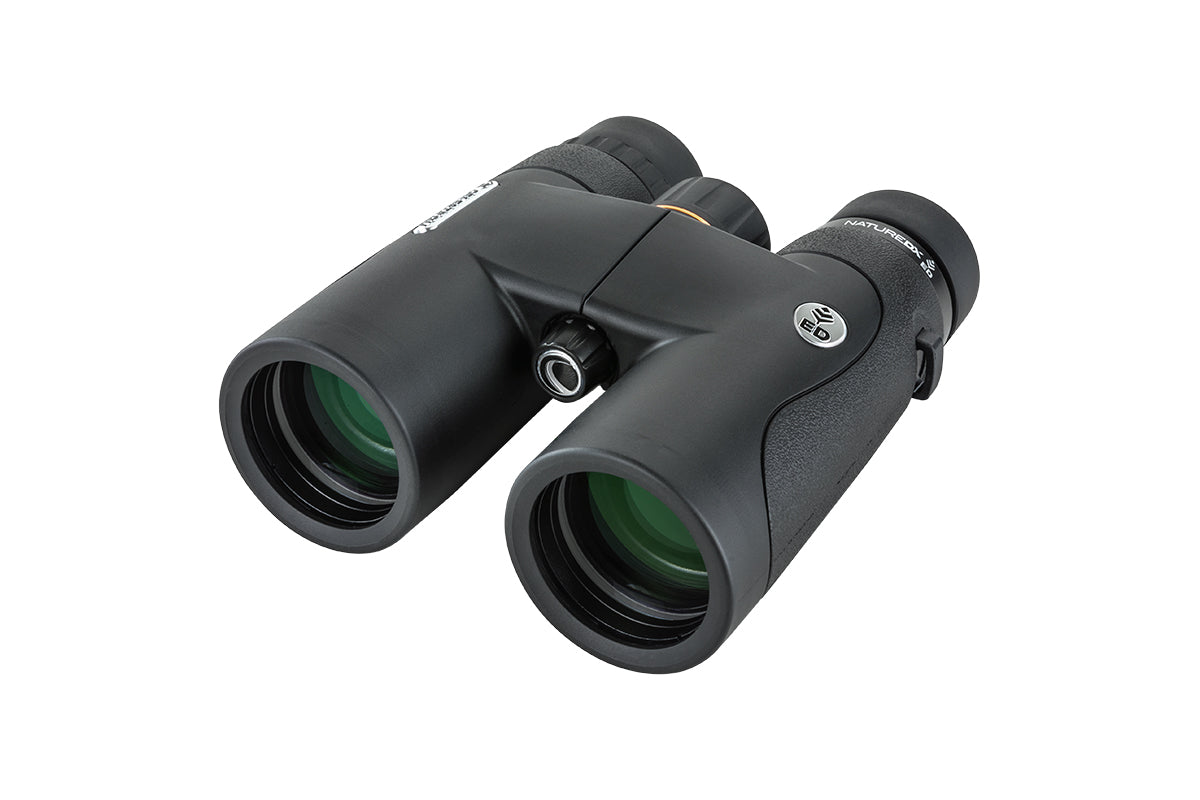
Explore this need in the finder →Nature DX ED 10x42 item 72333 is Celestron’s ten-power ED roof binocular in the 42 mm size. The exact page lists a 5.9° real field, 4.1 mm exit pupil, 14.3 mm eye relief, 6.5 ft close focus and 24.9 oz weight. It suits someone who wants fixed 10x magnification and confirmed ED glass in a weather-rated full-size pair, and who accepts a narrower frame and shorter stated relief than the 8x42 ED model.
Ten-power reach comes with a narrower frame
The manufacturer reports 309 ft at 1,000 yards and 103 m at 1,000 m, which are consistent after normalizing the distance. The 5.9° real field is clearly narrower than the ED 8x42’s 7.5°. That is the practical difference when you are searching a canopy or following birds that move across the view: the ten-power version shows a larger subject at a given distance, but locating it takes more deliberate pointing. Ten power also makes hand movement more visible. Celestron lists no image stabilization for this model, so do not buy it expecting an electronic or optical stabilizer.
Its 4.1 mm exit pupil is the source-listed value for 10x42. That is smaller than the ED 8x42’s 5.25 mm, but it is not a controlled brightness comparison. The final view depends on transmission, eye placement, the observer’s pupil, focus and light. The ED label is more specific: Celestron identifies Extra-Low Dispersion objective glass and says it is intended to reduce chromatic aberration, including color fringing. The claim is useful for deciding whether the material feature is essential, but it is not a lab test or guarantee of a visible difference to every observer.
Eye relief and operation deserve a check
The exact table gives 14.3 mm eye relief, shorter than the ED 8x42’s 17.8 mm. Celestron describes the eyecups as twist-up with multiple stops and calls the model eyeglass-friendly. A glasses wearer should still lower the cups and test whether the whole field appears without pressing the frames into the barrels. Model-to-model numbers are a screening aid, not a guarantee that a particular face and frame will work comfortably. The page also lists a 56–74 mm interpupillary range and ±3 diopter adjustment.
The ED family manual explains how to avoid mistaking a diopter mismatch for a defective view: first set interpupillary spacing until the images merge; then focus a distant object with the center wheel while the right objective is covered; last, use the right-eye diopter on the same target. Once the diopter is set, use the center control for normal focus. The 6.5 ft close-focus spec makes flowers or nearby insects possible, but it is not a substitute for a dedicated macro instrument.
Weather, support and contents
Celestron lists waterproof construction, nitrogen fill and a tripod-adaptable body. The exact page does not give an immersion depth or duration, so “waterproof” is a weather feature, not a diving specification. A separate binocular adapter is required for a conventional tripod, and the included-items list does not name one. A 24.9 oz body is manageable for many hand-held sessions, but extended observation at 10x can benefit from support. If a supplied adapter is an essential requirement, this exact model does not pass the evidence.
Published package contents are a neck strap, objective caps, rainguard, padded nylon canvas case, lens cloth and instruction manual. Retailer additions or a used-outlet unit should not be assumed identical. Follow the family manual to keep the lenses capped, dry the body before storage and remove loose dirt before wiping the optical surfaces. Never look at the Sun through the instrument or use it to project sunlight; Celestron warns that irreversible eye injury can result.
Questionnaire fit and alternatives
Answers selecting 10x, 42 mm and ED keep 72333. A 6° real-field minimum excludes it because its listed angle is 5.9°. A weight ceiling of 25 oz accepts the 24.9 oz listing; 24 oz does not. A 14 mm eye-relief minimum is met by the listed 14.3 mm, while 15 mm is not. A 7 ft close-focus maximum accepts 6.5 ft. Waterproofing and nitrogen fill are documented; an in-box adapter, lockable diopter and underwater rating are not. A hard requirement needs a positive exact fact, not an inference from the ED or Nature DX family name.
Compare the ED 8x42 item 72332 if a broader frame, more stated eye relief and lower hand-shake sensitivity matter more than ten-power reach. A standard Nature DX 10x42 may be lighter or otherwise different by item number; check its own exact values and do not assume ED is a universal improvement. The 10x32 item 71331 keeps ten-power magnification at 18 oz but uses a smaller objective, a narrower 14 mm eye-relief figure and lacks confirmed ED glass. This ED 10x42 is the choice for the specific combination of ten power, 42 mm glass and a confirmed ED objective, not a guarantee that any tradeoff disappears.
Exact identity and specifications: Celestron Nature DX ED 10x42 item 72333. Setup, care and safety: Celestron Nature DX ED binoculars series manual.
Key specifications
Key details at a glance
| Magnification | 10× |
|---|---|
| Objective diameter | 42 mm |
| Real field of view | 5.9° |
| Field width at 1,000 m | 103 m |
| Eye relief | 14.3 mm |
| Exit pupil | 4.1 mm |
More specifications and setup details
| Close focus distance | 6.5 ft |
|---|---|
| Manufacturer-published weight | 24.9 oz |
| ED glass confirmed for this exact model | Yes |
| Phase coatings confirmed | Yes |
| Lens and prism coatings | Celestron identifies ED objective lenses, fully multi-coated optics and phase-coated BaK-4 roof prisms. ED is a manufacturer-described design intended to reduce chromatic aberration; no independent performance measurement is inferred. |
| Water and fog protection | Celestron lists waterproof construction and nitrogen fill. The exact page gives no depth or duration for submersion; do not treat this as an underwater-use specification. Keep caps on and store the instrument dry per the series manual. |
| Tripod use | The exact product page calls the model tripod adaptable; the family manual shows an adapter between the binocular thread and a photographic tripod. The adapter is required and not in the manufacturer-listed package contents. |
| Published weight note | Celestron publishes 24.9 oz (705 g). Dimensions are the published numeric tuple; where the imperial tuple conflicts, the dossier records the conflict and leaves interpreted inches unknown. These are manufacturer values, not independent packed-weight measures. |
| Manufacturer-rated waterproof | Yes |
| Tripod adapter in package | No |
Use the exact model’s instructions for operating limits, supplied equipment and version differences.
Sources for this review
Sources for this assessment
Choose your optical trade-off first.
Choose viewing purpose first, then magnification, objective size, scene width and any fit, weather or mounting constraint. A direct-Sun requirement is separate: only exact manufacturer-confirmed solar binoculars can pass it.