
On this page
A larger-objective 12x with adapter-based support
The Nature DX 12x56 publishes a 5.5° real field and weighs 36.2 oz, making it a larger alternative to the stabilized 12x25. Celestron calls it waterproof but gives no immersion depth or duration; its confirmed tripod route needs a separately purchased adapter.
Explore the needs this model fits
Your needs, this model
Does it fit your priorities?
Does the 12x56 fit a 37 oz carry ceiling at fixed 12x?
Yes. Item 71336 is listed at 36.2 oz and 12x56.
Explore this need in the finder →Does item 71336 meet a 16 mm relief and 10 ft close-focus maximum?
Celestron lists 16 mm eye relief and 9.8 ft close focus.
Explore this need in the finder →Is its binocular tripod adapter in the standard box?
No adapter appears in the included-items list; a separate adapter is needed for tripod use.
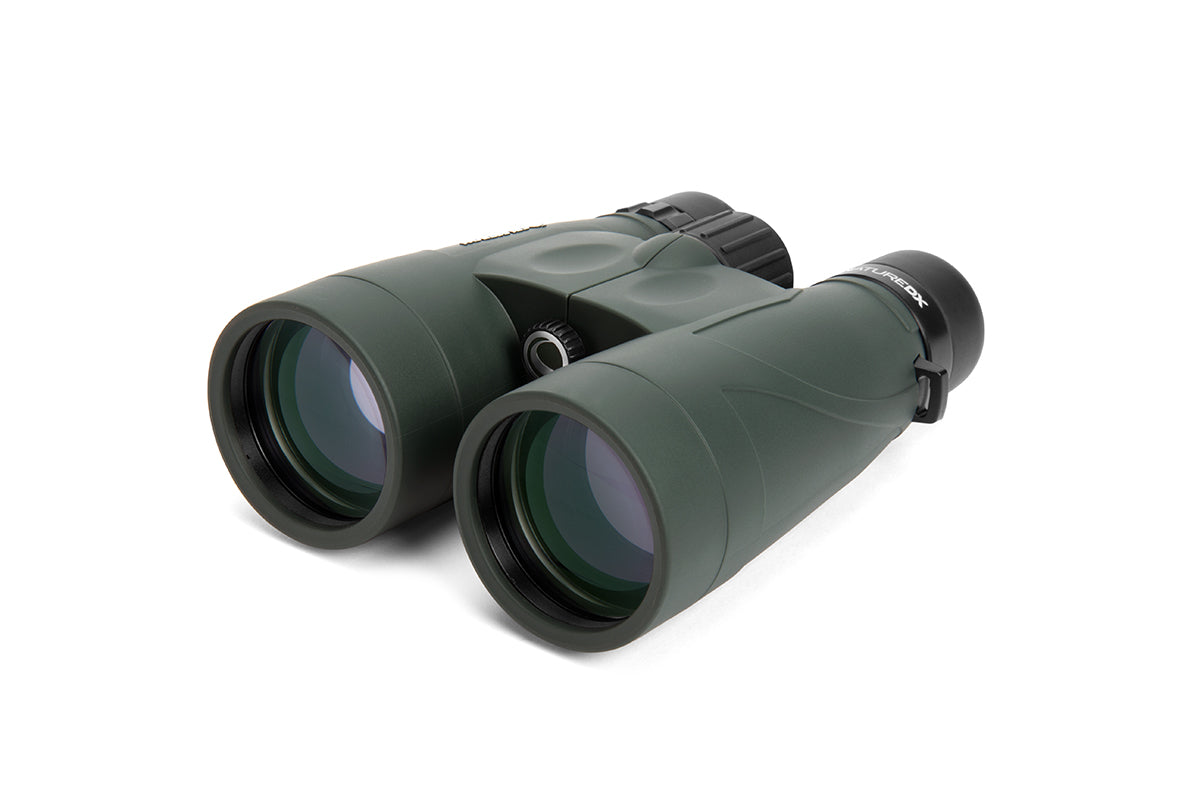
Explore this need in the finder →Celestron Nature DX 12x56 item 71336 is the highest-magnification and largest-objective standard Nature DX model documented in this group. It combines fixed 12x magnification, a 56 mm objective, a 5.5° real field and a 36.2 oz listed weight. That makes it a deliberate long-viewing instrument rather than a light trail companion: the added reach and large objective come with a substantial carry burden and a stronger need to manage hand movement.
A large objective is not a free brightness guarantee
The published exit pupil is 4.6 mm (56 mm divided by 12x), and the angular field is 5.5°. Celestron pairs 289 ft at 1,000 yards with 96 m at 1,000 m, which is a reasonable rounded normalized match. The stated 16 mm eye relief is moderate; the multiple-position twist eyecups are intended for different eye positions, but glasses users should test the full field. The close-focus figure is 9.8 ft, less convenient for nearby subjects than this family’s 6.5 ft 32 and 42 mm models.
A 56 mm objective can gather more light than a smaller one when the rest of the optical system and conditions permit, but the result at the eye is shaped by transmission, exit pupil, the observer’s pupil, focus and steadiness. The 4.6 mm exit pupil is smaller than the 5.25 mm figure on the 8x42 models. Neither measurement predicts an individual’s dusk view, and no independent optical test is available here. Compare the 56 mm choice when the intended viewing window and carry plan justify it, not because “larger objective” is treated as a universal promise.
Reach, field and support plan
At 12x, distant details occupy more of the view than they do at 8x, but locating a small bird in a wider scene can be harder. The 5.5° real field confirms that this is narrower than the Nature DX 8x32’s 7.4° and 8x42 ED’s 7.5°. If you mostly scan or follow quick movement, lower power is the safer starting point. If you watch stationary subjects, water or the night sky from a fixed location, 12x may suit the goal, but plan for steadiness. The 36.2 oz body weighs more than two pounds before strap or case, and a handheld 12x image will not be as forgiving as a lower-power view.
Celestron calls this model tripod-adaptable; an adapter is necessary, and the standard included-items list does not list one. A stable support plus the separate binocular adapter is the practical plan for long fixed observation. A hard filter requiring a built-in or supplied adapter should exclude the model. A softer preference for tripod capability can retain it, with the extra part included in the eventual setup. No stabilizer is listed in the exact product specs.
Construction and care
The standard 12x56 page lists fully multi-coated optics, phase-coated BaK-4 prisms, waterproof construction, nitrogen fill and rubber armor. It does not identify ED glass, so do not attribute ED correction to the model from its Nature DX series name. “Waterproof” is not accompanied by an immersion depth or duration, so regard it as weather protection and avoid underwater use. The ballistically styled nylon case with clasp, strap, objective caps, rainguard, cloth and manual are named in the manufacturer’s included-items list; a retailer bundle or used-outlet carton can differ.
Use the shared Nature DX manual’s ordinary sequence: align interpupillary distance first, focus the left eye with the center wheel, and adjust the right-eye diopter separately for the same distant target. After setting the diopter, use the focus wheel for normal observation. Keep the lens caps available and clear loose dust before wiping. Celestron warns never to look at the Sun through the binocular or project its image; this is a serious safety limit, not a viewing suggestion.
When questionnaire answers change the choice
A 12x and 56 mm preference keeps 71336; 50 mm or 42 mm requirements do not. The 36.2 oz weight fails a 33-ounce cap, though it fits a 37-ounce ceiling. A 5.5° scene fails a 6° minimum. An eye-relief floor of 16 mm is met at the published figure; 17 mm is not. A close-focus ceiling of 10 ft is met by 9.8 ft, but a 9 ft ceiling excludes it. A requirement for waterproof construction fits the page’s label; a requirement for ED glass, stabilization, or an adapter in the box does not have supporting evidence. These are hard gates, not assumptions about the picture quality.
For a lighter 12x choice, compare the standard and ED Nature DX 12x50 items 72326 and 72336; their 50 mm objectives and item-specific weights, eye relief and fields should be checked separately. If steadiness and broader scanning matter more than fixed 12x reach, try a Nature DX 8x32 or 8x42. Item 71336 is for a prepared support-and-carry plan, not someone hoping a bigger front lens will overcome all low-light or handholding limits.
Used Outlet listing 557133655 is a condition variant
Celestron’s Nature DX collection also exposed the exact manufacturer listing Used Nature DX 12x56 listing 557133655. Its item number 557133655 links back to this same optical configuration, so it is covered here as a used-condition listing rather than a different magnification or a separate recommendation profile. The archived page showed out of stock on 2026-10-24. Its general Used Outlet text describes the maker’s inspection and warranty policy, not a unit-specific optics, alignment, accessory or condition report; do not assume a particular used specimen is available or in a stated condition.
Exact identity and specifications: Celestron Nature DX 12x56 item 71336. Setup, support, care and safety: Celestron Nature DX binoculars series manual.
Key specifications
Key details at a glance
| Magnification | 12× |
|---|---|
| Objective diameter | 56 mm |
| Real field of view | 5.5° |
| Field width at 1,000 m | 96 m |
| Eye relief | 16 mm |
| Exit pupil | 4.6 mm |
More specifications and setup details
| Close focus distance | 9.8 ft |
|---|---|
| Manufacturer-published weight | 36.2 oz |
| ED glass confirmed for this exact model | No |
| Phase coatings confirmed | Yes |
| Lens and prism coatings | Celestron lists fully multi-coated optics and phase-coated BaK-4 roof prisms. This exact model is not identified as ED; no comparative optical measurement is inferred. |
| Water and fog protection | Celestron lists waterproof construction and nitrogen fill. The exact page gives no depth or duration for submersion; do not treat this as an underwater-use specification. Keep caps on and store the instrument dry per the series manual. |
| Tripod use | The exact product page calls the model tripod adaptable; the family manual shows an adapter between the binocular thread and a photographic tripod. The adapter is required and not in the manufacturer-listed package contents. |
| Published weight note | Celestron publishes 36.2 oz (1028 g). Dimensions are the published numeric tuple; where the imperial tuple conflicts, the dossier records the conflict and leaves interpreted inches unknown. These are manufacturer values, not independent packed-weight measures. |
| Manufacturer-rated waterproof | Yes |
| Tripod adapter in package | No |
Use the exact model’s instructions for operating limits, supplied equipment and version differences.
Sources for this review
Sources for this assessment
- Celestron Nature DX US collection page 1; exact linked model row observed
- Celestron exact Nature DX US product page, item 71336
- Celestron Nature DX standard five-language manual; English setup and care inspected
- Celestron Nature DX QSG; English IPD/center-focus/right-eye-diopter instructions inspected
- CPSC exact item-number ProductName query for 71336; empty array on 2026-10-23
- Used - Nature DX 12x56mm Roof Binoculars exact Celestron Used Outlet listing
Choose your optical trade-off first.
Choose viewing purpose first, then magnification, objective size, scene width and any fit, weather or mounting constraint. A direct-Sun requirement is separate: only exact manufacturer-confirmed solar binoculars can pass it.
Your needs, this model
Choosing 12x binoculars: stabilization or a larger objective
Choose it when: This is the larger-objective 12x alternative when field width, a manufacturer waterproof claim and support compatibility matter more than minimal carry. Celestron publishes 5.5° real field and confirms tripod adaptability for this exact model.
Choosing 12x binoculars: stabilization or a larger objective →