
On this page
Your needs, this model
Does it fit your priorities?
Does the standard Nature DX 10x50 have a waterproof rating and an 8.2-foot close-focus distance?
Yes. Item 72325 is listed as waterproof and the page gives an 8.2 ft closest focus.
Explore this need in the finder →Does item 72325 meet a 17 mm eye-relief minimum while staying under a 29 oz carry limit?
Celestron lists 17.5 mm and 28.4 oz for this exact standard 10x50.
Explore this need in the finder →Does the 10x50 meet a 27 oz limit if tripod mounting is optional?
No. Celestron lists the binocular at 28.4 oz; an optional adapter does not change its carry weight.
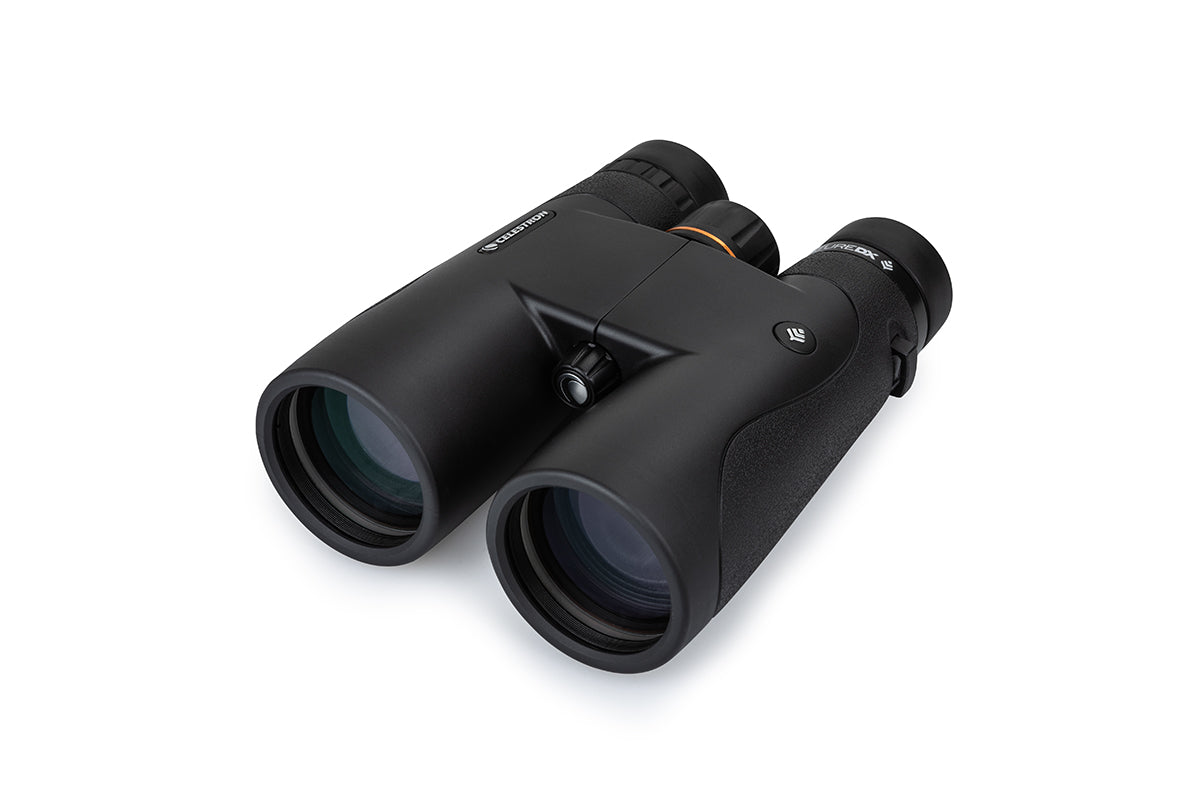
Explore this need in the finder →Celestron’s Nature DX 10x50 item 72325 is the standard, non-ED roof-prism version of a bright-aperture, ten-power binocular. It suits someone who wants more objective diameter than a 42 mm binocular, expects to use it at dusk or for long-distance observation, and is willing to carry a substantial 28.4 oz body. It is not a light travel pair, and the 10x view is less forgiving of hand movement than 8x.
What the 50 mm objective changes—and what it does not
Celestron lists 10x magnification, 50 mm objectives, a 5.8° angular field and a 5 mm exit pupil. That 5 mm exit pupil follows the published 50 mm aperture and 10x magnification. The stated eye relief is 17.5 mm, and the close-focus distance is 8.2 ft. Compared with a 10x42, the larger objective can present a larger exit pupil at the same magnification, but it does not turn twilight into daylight or guarantee a brighter image: transmission, the observer’s pupil, focus, steadiness and viewing conditions all matter. No independent optical testing is available here.
The exact page pairs a linear field of 304 ft at 1,000 yd with “92.66 m” for 1,000 m. Those two labels do not reconcile: 304 ft per 1,000 yd converts to roughly 101 m per 1,000 m, not 92.66 m. I preserve Celestron’s printed pair and do not turn it into a normalized metric-width claim. Its 5.8° field is the safer cross-model comparison. That view is appreciably broader than the 4.7° standard 12x50, so this 10x is easier to sweep across a moving subject, though it still cannot match the wide scene of a typical 8x42.
Handling, fit and support
The published 28.4 oz (806 g) and 163 × 135 × 61 mm dimensions make this a big handheld pair. Celestron calls it light enough to use without a tripod, but that is not the same as saying every person will find 10x steady during a long watch. If you plan to search a broad landscape or follow quick birds, compare a lower-power 8x42. If you need steady, extended views, the manual describes using a separate binocular adapter through the body’s tripod socket; Celestron says the adapter is optional and does not list it among the included items. A questionnaire that makes an adapter-in-the-box essential should therefore reject this configuration.
The 17.5 mm stated eye relief is longer than the standard 12x50’s 14 mm and may make this model more accommodating for glasses, but a number cannot guarantee the full field through every frame. Twist-up eyecups have intermediate positions; lower them for glasses and check for a complete circular image. Celestron lists a 63–74 mm interpupillary range and ±4 diopter adjustment. The manual’s setup sequence is practical: first set the barrels to your eye spacing, then focus the left eye with the center wheel, and finally use the right-eye diopter for the difference between eyes.
Standard Nature DX versus the ED 10x50
Item 72325 is not labeled ED. Its page specifies fully multi-coated optics and phase-coated BaK-4 prisms, plus waterproof construction and nitrogen fill. The 10x50 ED item 72335 has a separately documented ED objective, a 5.9° field, 17.8 mm eye relief and a ±3 diopter range. Both have the same listed 28.4 oz weight and body dimensions, and both require a separately purchased tripod adapter. The ED designation is a real configuration distinction, but Celestron’s statements about contrast and color correction are manufacturer claims rather than a measured guarantee that every observer will see a dramatic difference. If ED glass is an essential filter, choose the ED version; if it is not, do not assume the standard version is defective or that a product label proves a performance ranking.
Outdoor use, care and safety
Celestron lists this model as waterproof and nitrogen-filled, but gives no depth or immersion duration. Treat that as weather protection, not a diving rating. The standard Nature DX manual covers this family’s center focus, right-eye diopter, twist eyecups and tripod attachment. It recommends using the caps when idle, storing the binocular somewhere cool and dry, and removing loose dust before wiping lenses with a clean lens cloth. Do not force the hinge or moving controls. Most importantly, the product page warns never to view the Sun through this optic or to use it to project sunlight; serious eye damage can result.
The included-items list names a neck strap, objective caps, rainguard, padded nylon case, lens cloth and instruction manual. The actual carton is not independently inspected, and a retailer bundle or used listing can differ. A compact case or harness should be checked against the manufacturer’s dimensions rather than assumed from the 10x42 shape.
How questionnaire answers change the fit
Selecting 10x and 50 mm keeps 72325 in the candidate group. A waterproof requirement is met by Celestron’s listed construction. A close-focus maximum of 9 ft accepts its 8.2 ft specification; a 7 ft maximum does not. A 17 mm eye-relief minimum accepts it, while an 18 mm minimum does not. A 29 oz ceiling leaves it in; a 27 oz ceiling rules it out. A requirement for ED glass rules it out, while an adapter-in-box requirement also rules it out because the adapter is separate. If broad scanning is your priority, its 5.8° field may be adequate but a wider 8x model remains the better comparison. For a ten-power 50 mm pair with explicit ED glass and slightly longer stated relief, compare item 72335; for maximum reach in this family, compare the narrower 12x models and accept the additional steadiness tradeoff.
Exact identity and specifications: Celestron Nature DX 10x50 item 72325 product page. Setup and care: Celestron Nature DX series manual.
Key specifications
Key details at a glance
| Magnification | 10× |
|---|---|
| Objective diameter | 50 mm |
| Real field of view | 5.8° |
| Eye relief | 17.5 mm |
| Exit pupil | 5 mm |
| Close focus distance | 8.2 ft |
More specifications and setup details
| Manufacturer-published weight | 28.4 oz |
|---|---|
| ED glass confirmed for this exact model | No |
| Phase coatings confirmed | Yes |
| Lens and prism coatings | Celestron lists fully multi-coated optics and phase-coated BaK-4 prisms on the exact standard Nature DX page. This item is not labeled ED; no comparative optical measurement is inferred. |
| Water and fog protection | Celestron lists waterproof construction and nitrogen fill. Exact page gives no depth/duration for submersion; do not treat the rating as an underwater-use specification. The relevant series manual advises dry storage and lens protection. |
| Tripod use | The exact page lists tripod adaptability and states the binocular adapter is sold separately. The series manual illustrates attaching an adapter to a photo tripod. The standard included-items list does not name the adapter. |
| Published weight note | Celestron publishes 28.4 oz (806 g) and dimensions [163, 135, 61] mm. The dimensions are an unlabeled tuple; no measurement axes or packed-weight adjustment are inferred. |
| Manufacturer-rated waterproof | Yes |
| Tripod adapter in package | No |
Use the exact model’s instructions for operating limits, supplied equipment and version differences.
Sources for this review
Sources for this assessment
- Celestron Nature DX US collection page 1; exact linked product row observed
- Celestron US exact Nature DX product page, item 72325
- Celestron Nature DX five-language manual; English operations and care pages personally inspected
- CPSC exact item-number ProductName query; empty JSON array on 2026-10-23
- Celestron Nature DX QSG; English IPD/center focus/right-eye diopter section personally inspected
Choose your optical trade-off first.
Choose viewing purpose first, then magnification, objective size, scene width and any fit, weather or mounting constraint. A direct-Sun requirement is separate: only exact manufacturer-confirmed solar binoculars can pass it.