
On this page
More fixed magnification, narrower field and greater mass
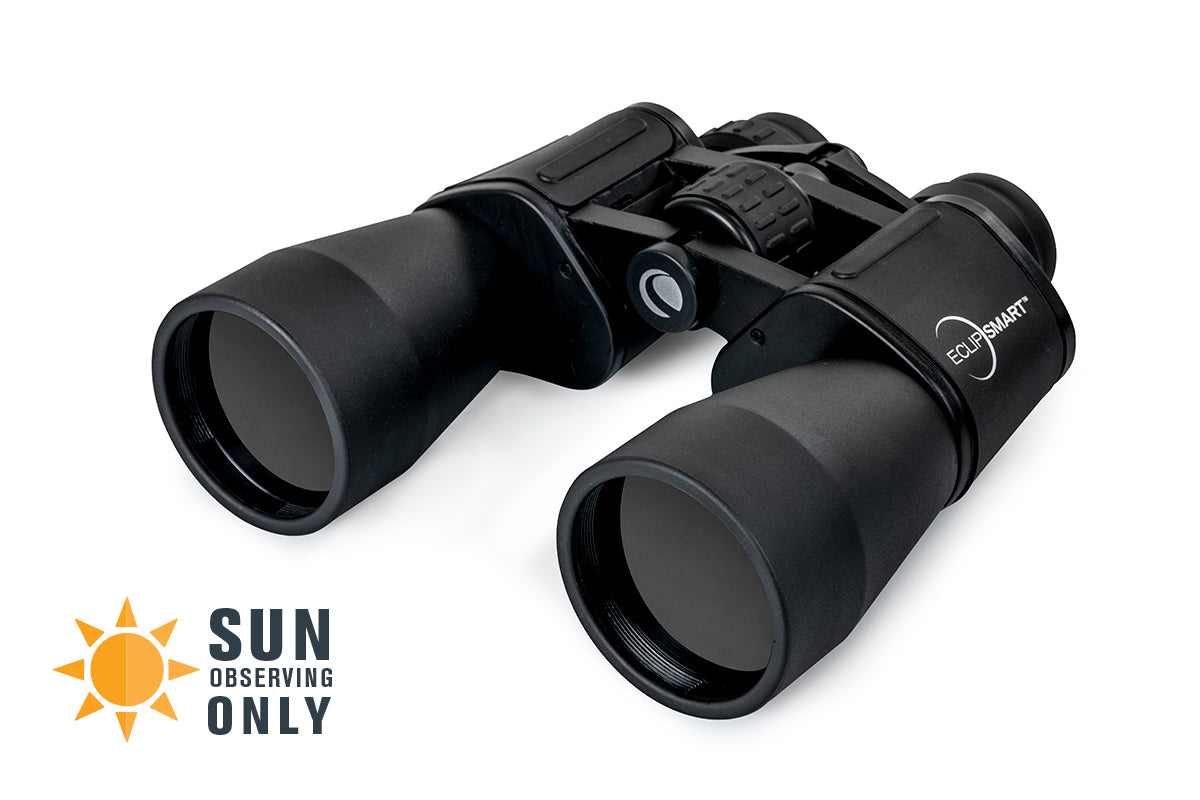
The EclipSmart 12x50 is the highest-power model in the solar comparison, but its published 5.0° field is the narrowest and its listed 31.5 oz weight is the greatest. Its non-removable objective filters keep it for solar observation rather than ordinary or night-sky use.
Explore the needs this model fits
Your needs, this model
Does it fit your priorities?
Does the 12x50 item 71239 combine a larger objective with a direct-solar filter?
Yes. Celestron identifies 12x50 Porro optics and a permanent built-in Solar Safe filter; it is much heavier than the 10x42.
Explore this need in the finder →Does its 12 mm stated eye relief meet a 12 mm minimum?
It meets the number exactly; this is not a guarantee of comfortable glasses fit. Celestron lists 31.5 oz instrument weight.
Explore this need in the finder →Is this 12x50 listed as tripod adaptable?
Yes. Celestron says Tripod Adaptable: Yes; however, the exact included-items list does not list an adapter, so an adapter-in-box requirement remains unsupported.
Explore this need in the finder →The EclipSmart 12x50 item 71239 is Celestron’s larger, higher-magnification Porro choice for direct solar viewing. The permanent objective filters are the feature that defines it, not an optional add-on. Its 12x view, 50 mm objectives and 5° listed field come with a substantial 31.5 oz mass. Celestron marks it tripod adaptable, but no adapter appears in its included-items list.
Why choose 12x50 over the 10x42?
Both models are built for solar use, but their trade-offs are real. Item 71239 increases power from 10x to 12x and objective size from 42 to 50 mm; the listed field narrows from 6° to 5°, weight rises from 24 to 31.5 oz, and the body becomes tripod adaptable. That combination may suit a stationary setup where extra apparent scale matters more than light carry or wide acquisition. It does not establish an independent detail advantage or a measured improvement; the comparison is strictly about manufacturer-listed configurations.
Celestron publishes 261 ft at 1,000 yards (87 m at 1,000 m), 3.3 mm exit pupil and 12 mm eye relief. The product page says the entire solar disk fits in the field. If glasses are essential, the eye-relief number meets a 12 mm minimum exactly, but actual fit still depends on eyecup position, face shape and eyewear. Celestron tells glasses wearers to fold down the eyecups. If your requirement is 13 mm or more, the 12x50 fails it; the 10x42’s listed 12.7 mm also falls short, leaving no current EclipSmart here at that threshold.
At 31.5 oz, this is not a lightweight carry choice. The heavier 20x50 has the same published weight but is discontinued and has only 8 mm eye relief and a 3.4° field. Do not use its historical listing as a shortcut to a current high-power recommendation. The 12x50 is still the most magnified current EclipSmart in the documented family.
Tripod adaptable does not mean adapter included
Celestron lists Tripod Adaptable: Yes. That confirms a mounting option, but the exact included-items list names a soft carry case, strap, eyepiece covers, objective covers, lens cloth and quick setup guide—not a tripod adapter. The shared manual focuses on safe positioning, IPD, focus and diopter adjustment; it does not identify a required tripod adapter model or explain this model’s mount interface. If your essential shopping condition is an adapter in the box, the 71239 cannot satisfy it from these sources. If you already have a binocular support adapter, verify compatibility with the exact body before relying on it.
The 71239 is water resistant, not waterproof, and Celestron lists no nitrogen fill. The product page does not state an immersion depth or duration, nor a fogproof rating. Use the published weather description rather than the rubber-armored aluminum construction to decide whether a damp outing is acceptable. This solar model is not an outdoor birding alternative: its dark, fixed objective filters are meant for the Sun, and Celestron says normal scenes should not be visible.
Filter statements and safe operating limits
Celestron describes its built-in filters as permanently attached, says the Solar Safe technology meets transmission requirements it associates with ISO 12312-2, and states that the technology was tested by SAI Global. The AAS explains that ISO 12312-2 formally covers non-magnifying handheld solar viewers rather than binocular filters. The manufacturer statement and the standard’s scope should not be collapsed into an independent certification claim. NASA’s binocular guidance requires purpose-made solar filtering at the front of magnifying optics. Use the manufacturer’s dedicated instructions and do not substitute ordinary eclipse glasses over your eyes while looking through unfiltered binoculars.
Inspect both objective filters every time before observing. Celestron warns against use if a filter is damaged, altered or detached from its frame. Its manual advises setting the hinge and diopter before pointing toward the Sun, getting both eyes behind the eyecups before raising the binocular, and never taking the instrument away from your eyes while still looking toward the Sun. If any scene other than the Sun is visible, stop and contact Celestron. Do not remove or modify the filters to turn this into a night or terrestrial pair.
The filters are not removable. AAS notes that built-in non-removable filters cannot be used to view totality, so the 12x50 is not an all-stages eclipse tool. It remains a dedicated direct-solar instrument for the phases and observations described by its manual, with adult supervision recommended around children.
What a careful shortlist should say
The manufacturer product page showed item 71239 out of stock when checked, but the exact item and specifications remain useful and current out-of-stock models should not disappear from a library. This is not evidence that the model is discontinued; the family collection identifies it as an EclipSmart product, unlike the discontinued 20x50 item 71240. Retail availability can change, so do not read the page’s stock status as an optical attribute.
Choose the finder’s direct-solar filter requirement before selecting 12x and 50 mm. That prevents an ordinary binocular without a confirmed solar filter from being treated as an alternative for looking at the Sun. The 12x50 then appears when its exact magnification and objectives are selected. A 31.5 oz ceiling lower than its listed mass, a 13 mm eye-relief minimum, or a requirement for a tripod adapter in the box should exclude it. If those limits matter more than 12x, compare the 10x42 for a wider field and lower carry weight; choose the 10x25 when compactness matters most and tripod use is not part of the plan.
Use a stable stance, adjust to one merged image, and set the right-eye diopter as the manual describes. Keep the front filters intact, store the instrument in its case, remove dust before cleaning glass, and never open the body. The 71239’s strongest case is straightforward: a current, full-size 12x solar binocular with a tripod-adaptable body, for users who accept its mass and the unresolved adapter-in-box question.
Model-specific details: Celestron item 71239 and the EclipSmart manual. Solar guidance: NASA and the American Astronomical Society.
Key specifications
Key details at a glance
| Magnification | 12× |
|---|---|
| Objective diameter | 50 mm |
| Real field of view | 5° |
| Field width at 1,000 m | 87 m |
| Eye relief | 12 mm |
| Exit pupil | 3.3 mm |
More specifications and setup details
| Manufacturer-published weight | 31.5 oz |
|---|---|
| Lens and prism coatings | Celestron lists multi-coated optics and BK7 prisms; prism coatings are N/A. No ED or phase-coating claim is imported from another model. |
| Tripod use | Celestron exact page marks tripod adaptability Yes. For Yes, no tripod adapter is listed in the package and the manual does not identify a required adapter model/interface. |
| Published weight note | Exact manufacturer-listed instrument mass only; no independent measurement and no accessory-weight estimate. |
| Manufacturer-rated waterproof | No |
| Tripod adapter in package | No |
Use the exact model’s instructions for operating limits, supplied equipment and version differences.
Sources for this review
Sources for this assessment
- Celestron US EclipSmart solar binocular collection: seven rows observed; one page
- Celestron US Shopify collection JSON: four optical configurations and three Used Outlet rows
- EclipSmart 12X50mm Porro Solar Binoculars; Celestron item 71239
- Celestron EclipSmart solar binocular manual; English pages 1–12 personally read: exact SKU index; safety; IPD, focus, diopter, eyecups and Sun-pointing steps; damaged-filter warning; care. Shared manual includes this exact SKU.
- NASA eclipse eye-safety guidance for binoculars and other magnifying optics
- American Astronomical Society guidance for solar filters on binoculars and telescopes
- Dated exact-item CPSC ProductName query (empty array; not a comprehensive recall guarantee)
- Official Celestron image URL enumerated from the exact item page/collection JSON

Choose your optical trade-off first.
Choose viewing purpose first, then magnification, objective size, scene width and any fit, weather or mounting constraint. A direct-Sun requirement is separate: only exact manufacturer-confirmed solar binoculars can pass it.
Your needs, this model
Direct-Sun binoculars: choose a purpose-built solar model
Choose it when: This 12x50 gives the highest fixed magnification and the largest objective among the qualifying EclipSmart choices. Choose it only if the larger apparent solar framing is worth its narrower 5.0° published field and higher listed mass.
Direct-Sun binoculars: choose a purpose-built solar model →