Binoculars · Choose by your needs
Direct-Sun binoculars: choose a purpose-built solar model
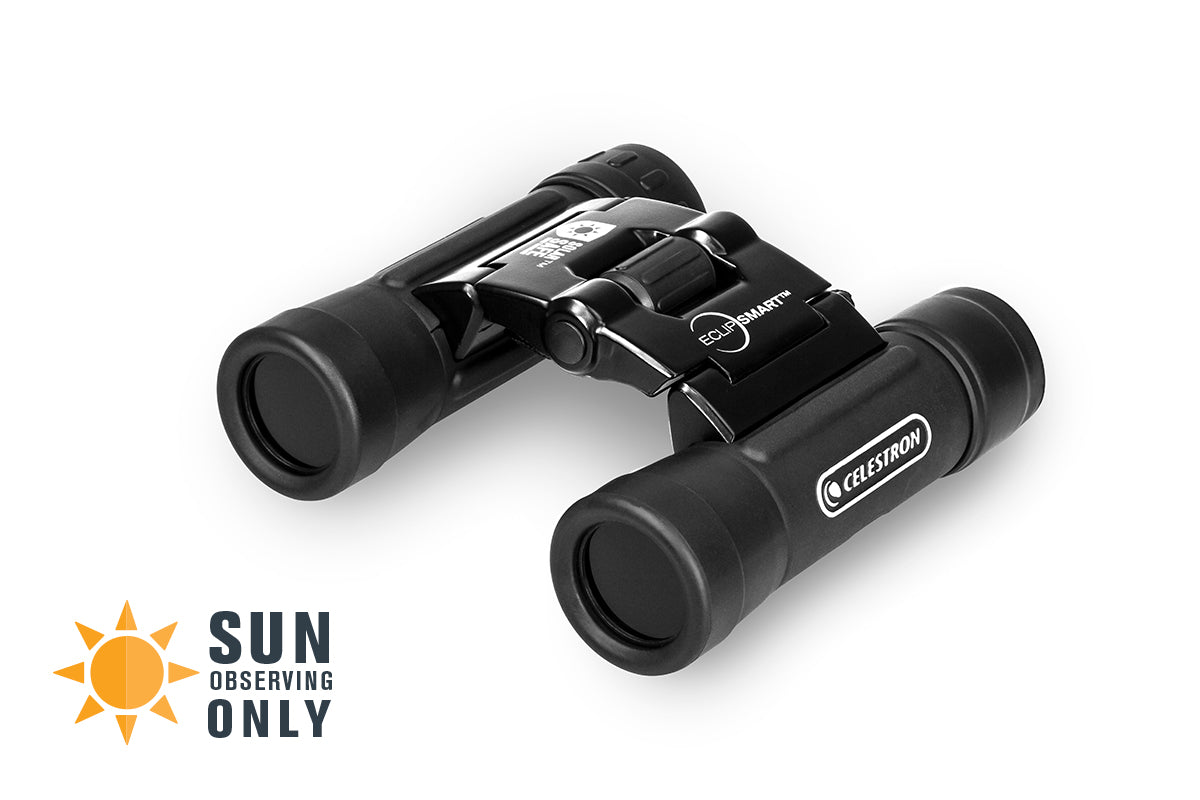
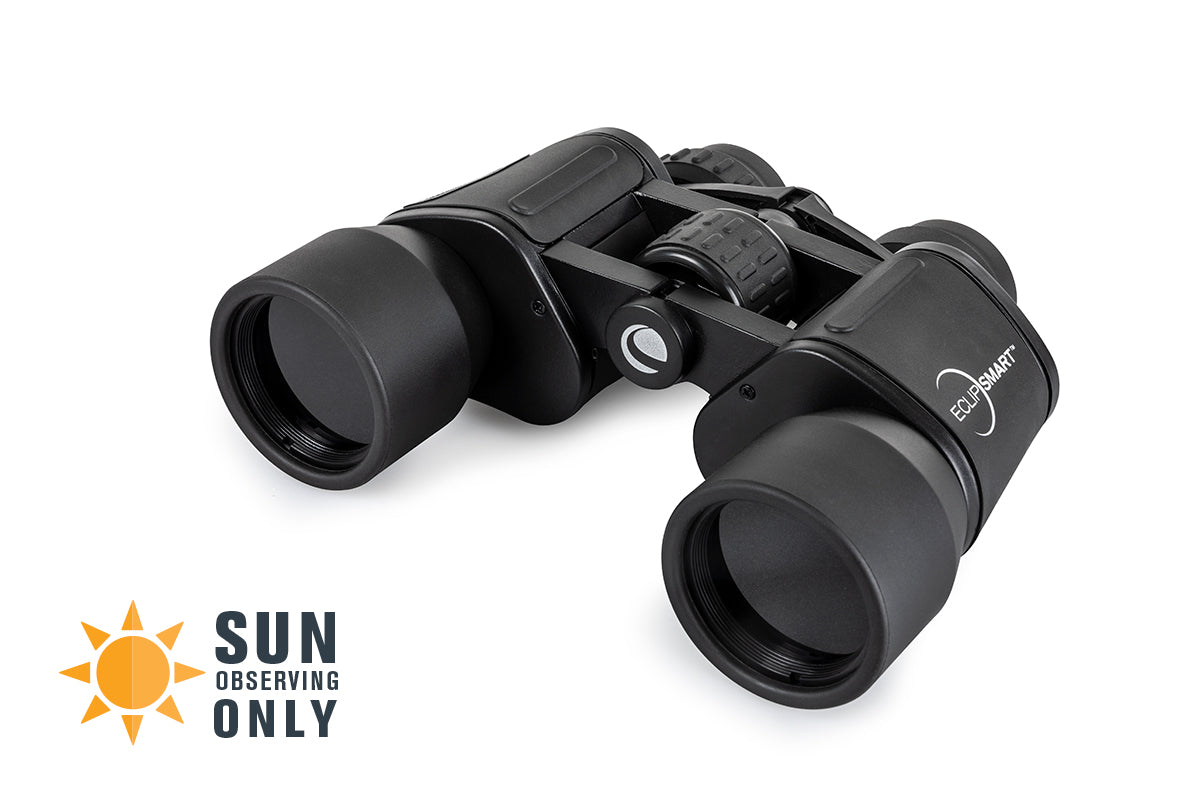
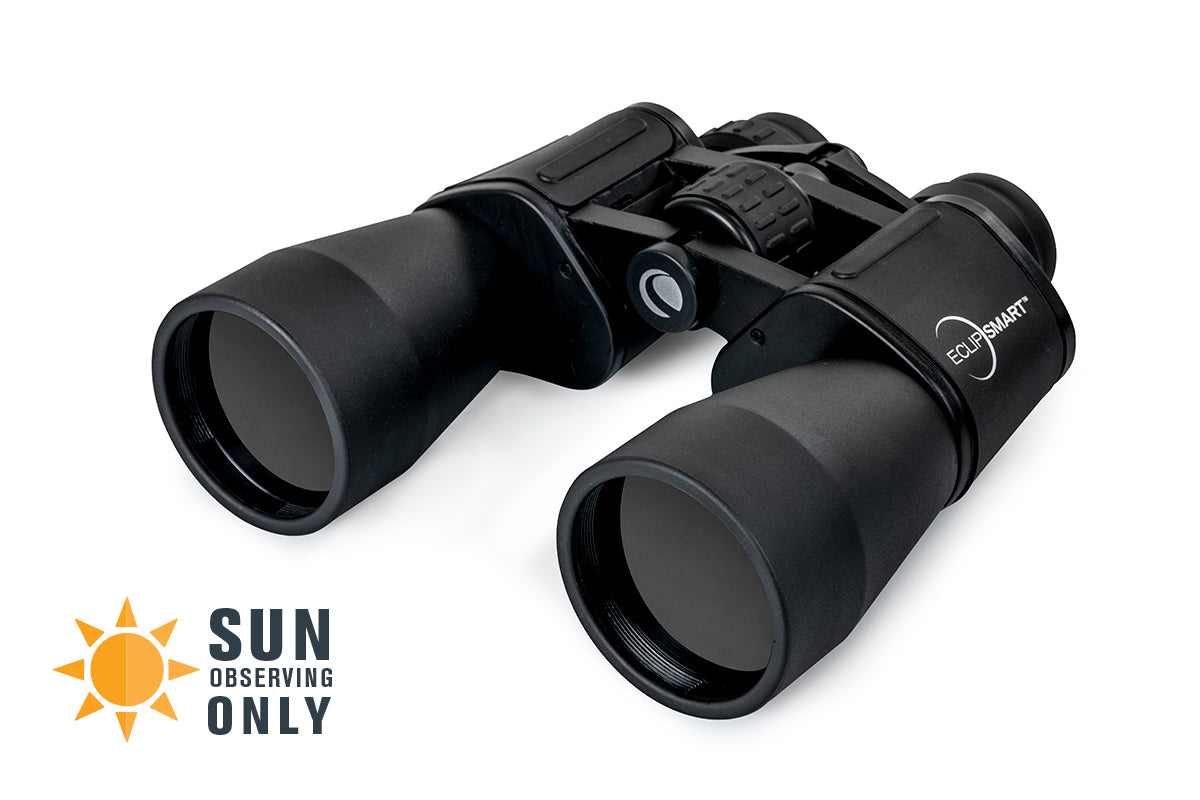
For direct-Sun observing, choose one of the three Celestron EclipSmart models listed here—not an ordinary binocular: all three have purpose-built, permanently attached objective solar filters. Pick the 10x25 for the lowest listed instrument weight (11.46 oz), the 10x42 for the widest published field (6.0°; 315 ft at 1,000 yd), or the 12x50 for 12x framing if you accept its narrower 5.0° field and 31.5 oz weight. These are Sun-only instruments, not general binoculars; the non-removable filters also make them unsuitable for totality or night-sky viewing.
- Use only for the Sun. Each qualifying EclipSmart has solar filters permanently attached in the objective lenses, so the same instrument is not a normal daylight, lunar or night-sky binocular.
- Inspect the front filter surfaces before each session and do not use a model if a filter is damaged, separated or tampered with.
- For partial or annular solar phases, use an exact-purpose solar instrument with its filters secured at the objectives; never view the Sun through an ordinary, unfiltered binocular, including while wearing eclipse glasses behind the eyepieces.
- The EclipSmart filters are not removable. The American Astronomical Society says binoculars with permanent solar filters are not useful during totality or for night-sky objects; use a different, appropriate instrument for those phases and targets.
Comparison updated 29 October 2026.
Solar viewing is a separate instrument decision
A magnification or a dark-looking image alone does not make an ordinary binocular safe for the Sun. NASA says magnifying optics such as binoculars need a special-purpose solar filter secured over the front; eclipse glasses worn behind unfiltered binoculars do not protect your eyes. The three EclipSmart models have built-in filters at their objective lenses, and their manufacturer facts say those filters are permanently attached and only the Sun is visible through them. A Celestron Nature DX 10x42 is a concrete example that does not meet this solar requirement: it is an ordinary binocular, not solar-only, and its exact sources do not confirm a direct-Sun filter. Do not point that or any other ordinary binocular at the Sun.
The optical trade is framing versus carry weight
All three EclipSmart models use permanent solar filters; the useful choice is among their published powers, scene fields and instrument masses. At the same 10x, the 42 mm EclipSmart publishes a wider field than the 25 mm version but weighs 24 oz rather than 11.46 oz. The 12x50 increases fixed magnification and objective diameter, while its published field is narrower and listed mass rises to 31.5 oz. These figures do not establish which view is sharper or brighter.
Do not plan to remove the filter for totality
The solar filters on these exact models are non-removable. The American Astronomical Society explains that binoculars with permanent solar filters are not useful during totality and are also unsuitable for viewing celestial objects at night. If your eclipse plan includes totality, choose separate, appropriate equipment and follow reputable eclipse-safety guidance for each phase; do not try to modify or defeat the built-in filter.
When to choose something else
- Celestron Nature DX 10x42 (item 71333): The Celestron Nature DX 10x42 is a conventional daytime binocular rather than a dedicated solar-only model, and its exact sources do not confirm a purpose-built direct-Sun filter. It fails this solar requirement; do not use it to view the Sun.
Questions that change the choice
Can one of these binoculars be used for ordinary birding after the eclipse?
No. The filters on all three EclipSmart models compared here are permanently attached; the exact model records classify them as solar-only and say only the Sun is visible through the filters. Choose a separate ordinary binocular for wildlife, daytime scenery, the Moon or night-sky targets.
Can I watch totality with an EclipSmart solar binocular?
No: its filter cannot be removed, and the American Astronomical Society says optics with permanent solar filters are not useful during totality. Make a separate viewing plan for totality and verify safe use with authoritative eclipse guidance.
Is the built-in-filter claim a guarantee that the instrument is safe if damaged?
No. Celestron's manual instructs users to inspect the filters before each use and not use the binocular if a filter is damaged, separated or tampered with. Stop using it if the objective filter is compromised.
Sources for the comparison
- EclipSmart 10X25mm Roof Solar Binoculars; Celestron item 71237
- Celestron EclipSmart solar binocular manual; English pages 1–12 personally read: exact SKU index; safety; IPD, focus, diopter, eyecups and Sun-pointing steps; damaged-filter warning; care. Shared manual includes this exact SKU.
- NASA eclipse eye-safety guidance for binoculars and other magnifying optics
- American Astronomical Society guidance for solar filters on binoculars and telescopes
- EclipSmart 10X42mm Porro Solar Binoculars; Celestron item 71238
- Celestron EclipSmart solar binocular manual; English pages 1–12 personally read: exact SKU index; safety; IPD, focus, diopter, eyecups and Sun-pointing steps; damaged-filter warning; care. Shared manual includes this exact SKU.
- EclipSmart 12X50mm Porro Solar Binoculars; Celestron item 71239
- Celestron EclipSmart solar binocular manual; English pages 1–12 personally read: exact SKU index; safety; IPD, focus, diopter, eyecups and Sun-pointing steps; damaged-filter warning; care. Shared manual includes this exact SKU.
- Celestron US Nature DX 10x42 exact product page, item 71333
- Celestron Nature DX five-language manual, English setup, eyecups, tripod, protection, care and safety section