
On this page
The wider-field 10x solar configuration
Among the three EclipSmart choices, this 10x42 has the widest published field at 6.0° (315 ft at 1,000 yd); its 24 oz listed weight is substantially higher than the 10x25. Its objective filters remain permanent, so it qualifies only for the direct-Sun need.
Explore the needs this model fits
Your needs, this model
Does it fit your priorities?
Does the 10x42 item 71238 give the widest published field among these four solar configurations?
Celestron lists 6° and 315 ft at 1,000 yd; this is broader than 5° for 12x50 and 3.4° for the discontinued 20x50.
Explore this need in the finder →Does the 12.7 mm eye-relief figure meet 12 mm while staying below 24 ounces?
Yes, on Celestron’s published figures: 12.7 mm and 24 oz. Individual glasses fit still depends on eye position and frame.
Explore this need in the finder →Does item 71238 satisfy an essential in-box tripod adapter need?
No. Its page says Tripod Adaptable: No, and the standard included-items list has no adapter.
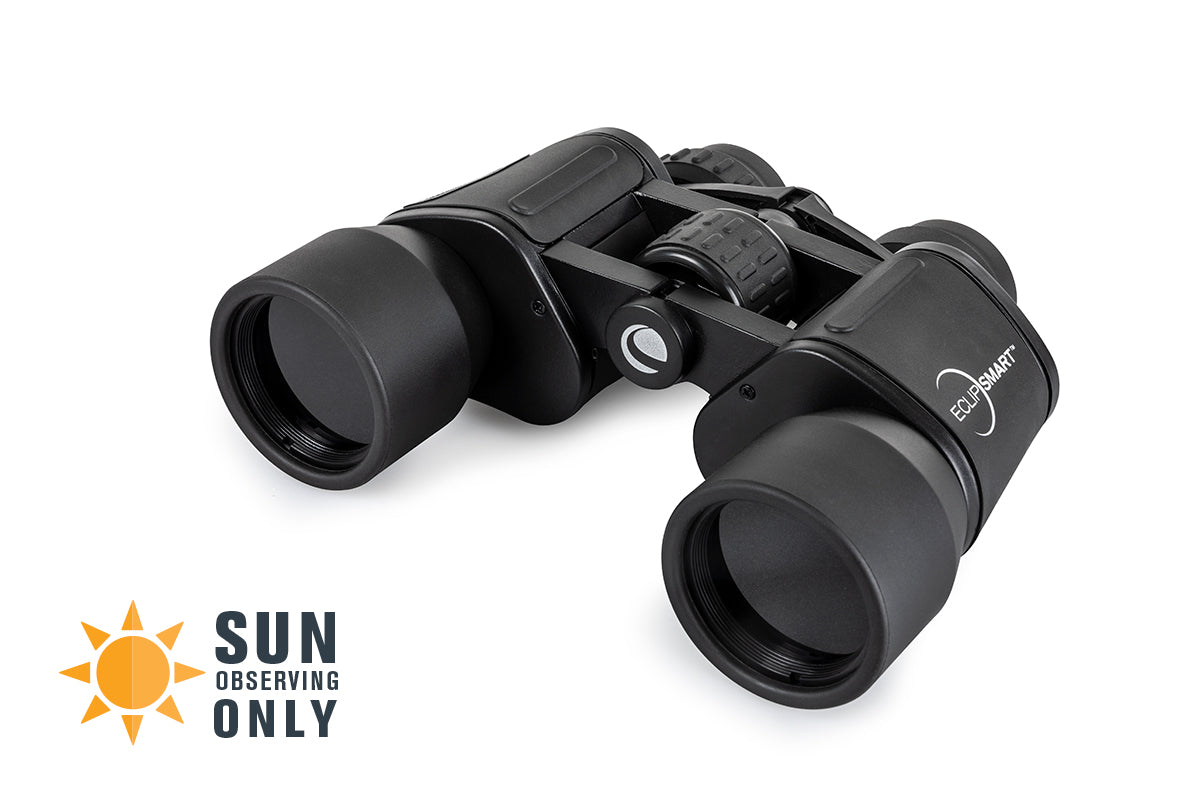
Explore this need in the finder →Celestron’s EclipSmart 10x42 item 71238 is a full-size Porro binocular with an objective filter permanently fitted to each barrel. Its 10x42 configuration, 6° stated field and 12.7 mm eye relief put it between the pocket 10x25 and the heavier 12x50 solar model. It is dedicated to looking at the Sun; the built-in filters are not removable for normal daytime scenes or night-sky observing.
A full-size solar setup with a broad published field
The 71238 is the widest-field EclipSmart among the four observed models at 6°, with a published linear field of 315 ft at 1,000 yards (105 m at 1,000 m). Celestron says the entire solar disk fits in the field. The 10x magnification keeps the view larger than the compact 10x25 only by its objective class, not its power; both are 10x. Their handling differs: item 71238 is 24 oz (680 g), roughly double the pocket model’s listed 11.46 oz. If a session involves carrying the binocular for a long walk before observing, that weight belongs in the decision even though it is not a large astronomy instrument.
The larger published exit pupil is 4.2 mm, and stated eye relief is 12.7 mm. That is more breathing room than the 10x25’s 10.5 mm, but it is not a promise of full-field viewing through every prescription-glasses frame. Celestron instructs eyeglass wearers to fold down the eyecups. Try the fit if possible; choose an essential 13 mm minimum only if you are willing to rule this model out. The 12.7 mm specification is close to that boundary, not a vague claim of universal glasses comfort.
The tripod answer is no
The exact page lists tripod adaptability as No. That is a meaningful distinction from both 50 mm Porro EclipSmart models, which say Yes. The standard package also lists no tripod adapter, but here the mounting limitation is broader: Celestron does not document this 10x42 as tripod adaptable. A stable stance and two-handed hold are the supported plan. For a requirement to mount a dedicated solar pair, consider a Celestron model explicitly marked adaptable, and separately verify the mount interface and adapter purchase; do not infer a tripod fitting from the Porro shape.
The housing is rubber-armored aluminum, protection is listed as water resistant, and nitrogen filling is No. There is no waterproof depth, immersion duration or fogproof rating in the exact specifications. This is not the pair for a marine or all-weather role, and the product page’s solar design purpose should not be confused with weather sealing. Celestron lists a soft case, strap, eyepiece and objective covers, lens cloth and quick setup guide.
Keep the purpose narrow and the filter intact
The defining feature is not a coating upgrade for general viewing; it is the front-mounted filter built permanently into each objective. Celestron says the Solar Safe filter technology meets the transmission requirements it associates with ISO 12312-2 and says the technology was independently tested. The AAS clarifies that ISO 12312-2 is not formally a standard for solar filters on magnifying optics. That nuance matters: a manufacturer statement should not be rewritten as my own certification of a binocular solar filter. NASA’s guidance for binoculars calls for purpose-made solar filtering at the front. Use the exact instructions, not improvised combinations of filters or eclipse glasses behind the eyepiece.
Inspect the objective filters before every use. If a filter is scratched, separated from its frame or otherwise damaged, do not observe the Sun with it. Celestron says not to modify or remove the permanent filters and warns that a view of anything other than the Sun means use should stop. The shared manual asks the observer to align the binocular first, place both eyecups completely in front of the eyes before raising the view, and keep the instrument before the eyes while turning toward the Sun. Do not lower the binocular while looking toward the Sun. Adults should supervise younger observers; the manual states a minimum intended age of 14.
Because the filters stay in place, this is not a single pair for ordinary landscape or night use plus an eclipse. AAS notes that built-in non-removable filters are not useful for viewing totality. Use this EclipSmart for the partial phases and other direct solar work only as its instructions allow; switch to an appropriate method during totality.
How the choices change its fit
In the finder, a direct-solar filter requirement is the first meaningful choice. An ordinary binocular with no documented solar filter must not appear as a Sun-viewing substitute. Choosing 10x and 42 mm then identifies the 71238; selecting 24 ounces as a ceiling preserves it, while the 12x50 is heavier. A 12 mm eye-relief floor lets it remain, but a 13 mm floor rejects it. A request for tripod adaptability also excludes it, regardless of its larger objective.
Choose the 10x25 if carrying weight and compact dimensions dominate and a handheld setup is acceptable. Choose the 12x50 if you prefer more magnification or need a tripod-adaptable body, accepting its 31.5 oz mass, narrower 5° field and the fact that the package does not list a tripod adapter. The 10x42 makes sense when a full-size 42 mm pair with a broad stated field is the desired direct-solar arrangement and when handheld use, 24 oz and the published eye relief all fit your plan.
Model-specific details: Celestron item 71238 and the EclipSmart manual. Solar guidance: NASA and the American Astronomical Society.
Key specifications
Key details at a glance
| Magnification | 10× |
|---|---|
| Objective diameter | 42 mm |
| Real field of view | 6° |
| Field width at 1,000 m | 105 m |
| Eye relief | 12.7 mm |
| Exit pupil | 4.2 mm |
More specifications and setup details
| Manufacturer-published weight | 24 oz |
|---|---|
| Lens and prism coatings | Celestron lists multi-coated optics and BK7 prisms; prism coatings are N/A. No ED or phase-coating claim is imported from another model. |
| Tripod use | Celestron exact page marks tripod adaptability No. For Yes, no tripod adapter is listed in the package and the manual does not identify a required adapter model/interface. |
| Published weight note | Exact manufacturer-listed instrument mass only; no independent measurement and no accessory-weight estimate. |
| Manufacturer-rated waterproof | No |
| Tripod adapter in package | No |
Use the exact model’s instructions for operating limits, supplied equipment and version differences.
Sources for this review
Sources for this assessment
- Celestron US EclipSmart solar binocular collection: seven rows observed; one page
- Celestron US Shopify collection JSON: four optical configurations and three Used Outlet rows
- EclipSmart 10X42mm Porro Solar Binoculars; Celestron item 71238
- Celestron EclipSmart solar binocular manual; English pages 1–12 personally read: exact SKU index; safety; IPD, focus, diopter, eyecups and Sun-pointing steps; damaged-filter warning; care. Shared manual includes this exact SKU.
- NASA eclipse eye-safety guidance for binoculars and other magnifying optics
- American Astronomical Society guidance for solar filters on binoculars and telescopes
- Dated exact-item CPSC ProductName query (empty array; not a comprehensive recall guarantee)
- Official Celestron image URL enumerated from the exact item page/collection JSON

Choose your optical trade-off first.
Choose viewing purpose first, then magnification, objective size, scene width and any fit, weather or mounting constraint. A direct-Sun requirement is separate: only exact manufacturer-confirmed solar binoculars can pass it.
Your needs, this model
Direct-Sun binoculars: choose a purpose-built solar model
Choose it when: At 10x, this 42 mm configuration has the widest published scene of these three at 6.0° (315 ft per 1,000 yd). It is the field-first choice if that wider framing is more useful than the 10x25's lower listed weight.
Direct-Sun binoculars: choose a purpose-built solar model →