
On this page
Choosing the lightest of the documented solar-only sizes
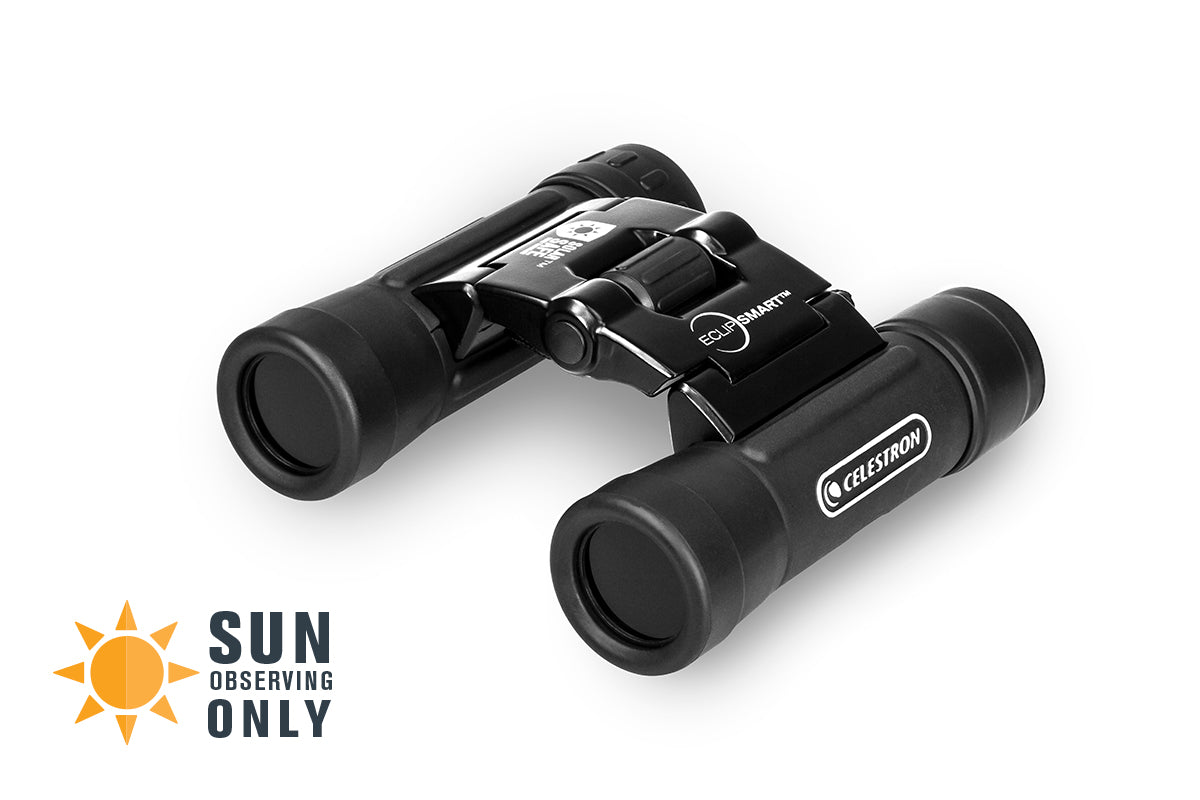
The exact EclipSmart 10x25 is the lightest of the three solar models compared here at 11.46 oz, with a published 5.7° field. Its permanently attached objective filters make it a Sun-only instrument, not a general 10x25 for wildlife or night-sky use.
Explore the needs this model fits
Your needs, this model
Does it fit your priorities?
Does item 71237 offer the smallest, lightest roof-format EclipSmart for direct solar viewing?
The exact Celestron page identifies a 10x25 roof configuration at 11.46 oz with a built-in, permanently attached filter; the listed tripod field is No.
Explore this need in the finder →Does its 10.5 mm eye relief meet a 12 mm minimum?
No. The manufacturer lists 10.5 mm. Folding the eyecups down is the manual’s glasses instruction, not a promise that every frame will show the full field.
Explore this need in the finder →Can item 71237 satisfy an essential adapter-in-box tripod request?
No. Its exact page says not tripod adaptable and the included-items list contains no adapter.
Explore this need in the finder →The Celestron EclipSmart 10x25 item 71237 is a compact roof-prism binocular built around one job: viewing the Sun through permanently installed objective filters. It weighs 11.46 oz, has a 5.7° stated field and is not tripod adaptable. This is not an ordinary travel binocular with a filter accessory; its fixed solar filters mean you should expect to see only the Sun through it.
Portable solar observing, not a pocket general-purpose pair
The 10x25 is the smallest body in the four-model EclipSmart solar set. Celestron gives its ordered dimensions as 76 × 51 × 114 mm and lists it at 325 g (11.46 oz). Those dimensions and mass make it the obvious option when a larger 42 or 50 mm body is more equipment than you want to carry to a short observing session. The roof layout is also more compact than the Porro-prism EclipSmart models. The exact product title identifies item 71237 as a roof binocular; a confusing “Porro” word in one image filename does not override that item-specific identity.
Compact does not mean versatile here. The filters are part of the objectives and cannot be removed for ordinary landscape, wildlife, sports or night-sky viewing. Celestron’s manual explains that users should not be able to see anything other than the Sun through the binoculars; if another scene is visible, stop use and contact the manufacturer. A standard 10x25 binocular is a better fit if you want daytime subjects as well as travel convenience. Choose this EclipSmart only when the dedicated solar view itself is the reason to carry it.
Read the field, eye relief and support limits together
Celestron publishes 10x magnification, 25 mm objectives, a 5.7° angular field, 288 ft at 1,000 yards, a 2.5 mm exit pupil and 10.5 mm eye relief. The field gives a generous aiming window for a small Sun disk, but magnification still matters: an unsteady hold is visible, and the 25 mm body has no tripod-adaptation support. If you specifically need a supported stationary view, compare the 12x50 or 20x50 product pages, which say they are tripod adaptable. Their package lists do not include a tripod adapter, so a requirement that an adapter come in the box is not established for those models either.
The 10.5 mm eye-relief figure is short. Celestron says to fold down the rubber eyecups when wearing glasses, but the number does not promise that every frame can reach the full field comfortably. A 12 mm minimum-eye-relief requirement correctly rules this pair out. It is also a very small exit pupil compared with the 10x42’s published 4.2 mm; that is a geometric specification, not a lab measurement or a brightness guarantee. The solar filter, rather than a conventional low-light objective, defines the entire use case.
Protection is water-resistant, not waterproof. Celestron lists no nitrogen fill and no tripod adaptability. Do not translate rubber armor into an immersion rating, or treat this model as a rain-safe outdoor observation pair when waterproofing is essential.
Solar safety is the first buying criterion
Celestron describes the built-in filter as permanently attached and says its Solar Safe technology meets the transmission requirements it associates with ISO 12312-2. The American Astronomical Society notes that ISO 12312-2 formally addresses handheld, non-magnifying solar viewers rather than filters for binoculars. I therefore treat the ISO sentence as Celestron’s claim, not as independent certification of this specific optical filter. NASA’s advice for binoculars is clear: direct solar viewing requires a purpose-built filter at the front of the optics. Follow the model manual and do not improvise with ordinary eclipse glasses placed behind unfiltered binoculars.
Before every use, inspect both objective filters. Celestron says not to use the instrument if a filter is damaged, altered or separated from its frame; keep the built-in filters in place. The manual’s safe aiming sequence is important: align the barrels and set focus before observing, place both eyes behind the eyecups first, then raise the binocular toward the Sun while keeping it in front of your eyes. Do not remove the binocular from your face while your gaze remains toward the Sun. These are not optional conveniences; the risk is eye injury, not simply a poor view.
The filters are fixed, so this pair is not a solution for viewing the brief total phase of a total eclipse. AAS guidance says built-in non-removable solar filters are not useful during totality. Keep to the manufacturer’s use instructions and change to an appropriate viewing method for totality.
What changes when you use the finder
Select the dedicated direct-Sun filter requirement to keep ordinary binoculars, whose solar filtering is unconfirmed, out of that result. Selecting 10x and 25 mm further isolates item 71237. A 12 mm minimum eye-relief choice or an essential tripod adapter-in-box choice should reject it. If neither the special solar purpose nor compact size is essential, compare general-use binoculars instead; this model does not replace them.
The manufacturer’s listed package includes a soft carrying case, strap, lens cloth and quick setup guide. Objective and eyepiece covers are not in the exact item’s included-items list, so I do not assume they are supplied. Store it protected, keep fingers and dust off optical surfaces, and use the manual’s gentle cleaning advice rather than opening the body. For someone whose plan is supervised partial-phase eclipse or sunspot viewing with a dedicated optic, item 71237 offers the easiest carry in this family. Its compactness is useful precisely because the job is narrow; outside that job, it is the wrong pair.
Model-specific details: Celestron item 71237 and the EclipSmart manual. Solar guidance: NASA and the American Astronomical Society.
Key specifications
Key details at a glance
| Magnification | 10× |
|---|---|
| Objective diameter | 25 mm |
| Real field of view | 5.7° |
| Field width at 1,000 m | 96 m |
| Eye relief | 10.5 mm |
| Exit pupil | 2.5 mm |
More specifications and setup details
| Manufacturer-published weight | 11.46 oz |
|---|---|
| Lens and prism coatings | Celestron lists multi-coated optics and BK7 prisms; prism coatings are N/A. No ED or phase-coating claim is imported from another model. |
| Tripod use | Celestron exact page marks tripod adaptability No. For Yes, no tripod adapter is listed in the package and the manual does not identify a required adapter model/interface. |
| Published weight note | Exact manufacturer-listed instrument mass only; no independent measurement and no accessory-weight estimate. |
| Manufacturer-rated waterproof | No |
| Tripod adapter in package | No |
Use the exact model’s instructions for operating limits, supplied equipment and version differences.
Sources for this review
Sources for this assessment
- Celestron US EclipSmart solar binocular collection: seven rows observed; one page
- Celestron US Shopify collection JSON: four optical configurations and three Used Outlet rows
- EclipSmart 10X25mm Roof Solar Binoculars; Celestron item 71237
- Celestron EclipSmart solar binocular manual; English pages 1–12 personally read: exact SKU index; safety; IPD, focus, diopter, eyecups and Sun-pointing steps; damaged-filter warning; care. Shared manual includes this exact SKU.
- NASA eclipse eye-safety guidance for binoculars and other magnifying optics
- American Astronomical Society guidance for solar filters on binoculars and telescopes
- Dated exact-item CPSC ProductName query (empty array; not a comprehensive recall guarantee)
- Official Celestron image URL enumerated from the exact item page/collection JSON

Choose your optical trade-off first.
Choose viewing purpose first, then magnification, objective size, scene width and any fit, weather or mounting constraint. A direct-Sun requirement is separate: only exact manufacturer-confirmed solar binoculars can pass it.
Your needs, this model
Direct-Sun binoculars: choose a purpose-built solar model
Choose it when: This exact 10x25 EclipSmart is the lowest-mass of the three qualifying configurations at 11.46 oz. Its published 5.7° field is narrower than the 10x42's 6.0° field, so choose it for the lighter listed instrument rather than for a wider surrounding scene.
Direct-Sun binoculars: choose a purpose-built solar model →