
On this page
Your needs, this model
Does it fit your priorities?
Does the 7x50 meet a 28-ounce cap and 12 mm listed eye-relief floor?
Yes by Celestron’s 27.3 oz and 13 mm figures, though 13 mm can be limiting for glasses.
Explore this need in the finder →Can it fit a 7x50 brief that requires waterproof construction?
No. Celestron says water resistant, not waterproof, and says nitrogen fill is No.
Explore this need in the finder →Does the published 26.2-foot closest focus meet a 30-foot ceiling?
Yes; the published closest-focus number is inside 30 feet, but not suited to very close objects.
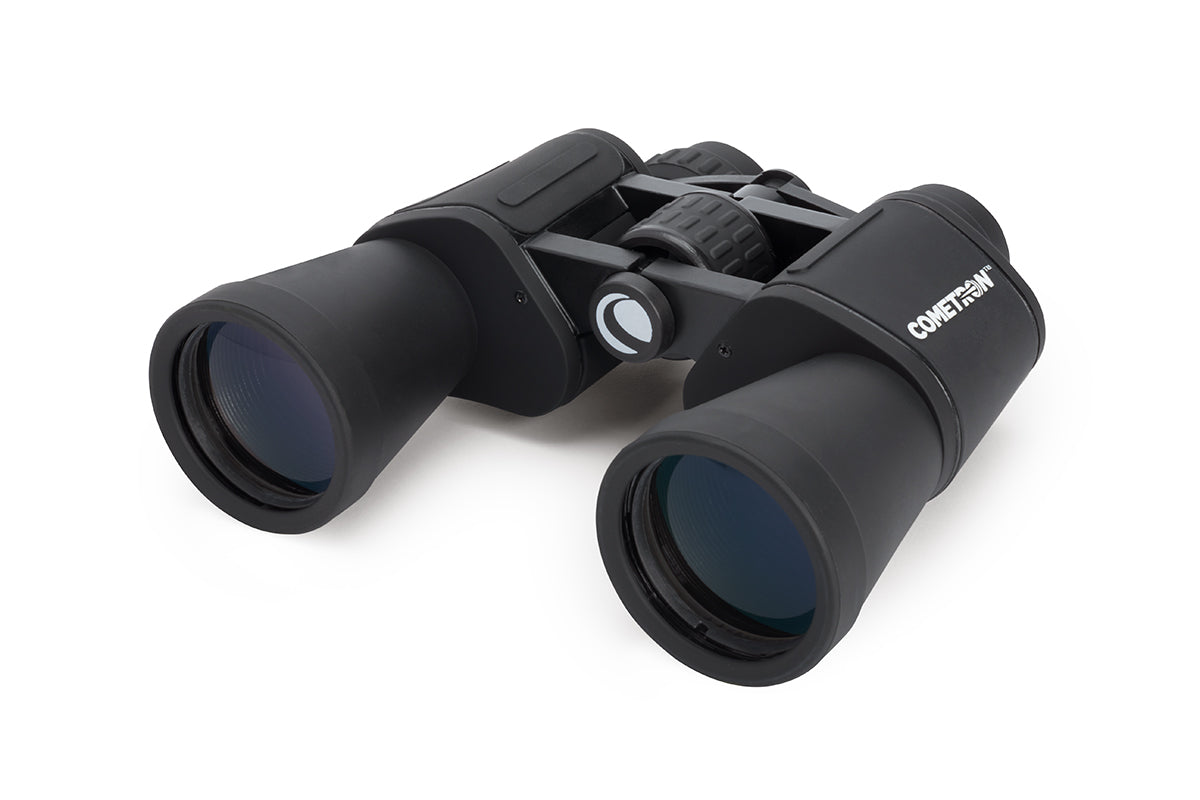
Explore this need in the finder →The Celestron Cometron 7x50 item 71198 is a traditional Porro-prism binocular: seven-power magnification, 50 mm objectives and a listed weight of 27.3 oz (774 g). The manufacturer describes it as water resistant and nitrogen filled “No”; do not treat it as waterproof or fogproof. The exact page and collection snapshot identified this standard U.S. item as available on 2026-10-24. Its distinguishing appeal is a broad, low-power view and a 7.1 mm nominal exit pupil, not compact size or all-weather protection.
A large exit pupil is a geometry, not a brightness score
Celestron publishes a 6.6° angular field and a linear field of 344 ft (105 m) at the stated distance row, with 13 mm eye relief and 26.2 ft close focus. The field and focus figures make it a different tool from an 8x42 roof model. Seven power makes a broad area easier to scan and has less apparent hand shake than higher magnification as a general optical trade-off. The 50 mm objectives divided by seven produce the listed 7.1 mm exit pupil. That can be helpful when a viewer’s pupil expands in low light, but an observer’s pupil size changes with age and illumination, and the number does not guarantee a bright or sharp view. It is not a promise that the full beam reaches every eye.
The 27.3 oz mass is a useful correction to any assumption that a lower magnification automatically means a lightweight instrument. The 50 mm Porro body is full-sized, and its listed weight is close to the two Regal ED 42 mm roof models. It may suit a stable viewing point or a roomy bag better than a long walk where size and weather sealing matter. The 26.2-foot closest focus is not suited to nearby subjects such as a feeder a few yards away. If close-range wildlife is a central use, look for an exact model with a much shorter published focus distance.
Simple coatings and the package boundary
The exact page lists multi-coated optics and BK7 prisms. It does not list ED objectives, phase correction, or the dielectric mirror coating claimed for Regal ED roof binoculars. That difference is a source-supported design distinction, not a claim that the Cometron has been tested and proven inferior. Compare the full model design and intended use instead of reading one prism label as a quality score. The package list includes a neck strap, woven nylon carrying case, objective caps, eyepiece caps, lens cloth and manual. A tripod connection is available, but the Cometron family manual says the adapter is supplied with item 71199 only, not this 71198 configuration. The separate adapter is not in the exact item’s included list.
That adapter distinction matters if you plan prolonged astronomy or stationary viewing. A tripod can reduce movement of the entire binocular, but it adds a component and does not eliminate the need for a correctly adjusted eye position. The Cometron manual describes the central focusing wheel and right-eye diopter sequence, foldable eyecups and the tripod threads beneath the logo plate. First align the barrels at your interpupillary distance; focus the left eye with the center wheel, then set the right-eye ring once. The manual’s fitting steps are more useful than treating the large exit pupil as a shortcut to comfort.
Weather protection and basic care
Celestron explicitly marks the Cometron water resistant, but not waterproof; it is not nitrogen filled. Do not use it in sustained rain or on a boat on the assumption that the word “resistant” gives a certified submersion limit. Neither a water depth nor a duration is published. A waterproof 42 mm model such as the Regal ED may be a better fit when exposure is likely, although no Celestron product page should be read as a promise of underwater operation. After outdoor use, keep the caps on, wipe the body dry and store the optics away from heat and moisture. The manual recommends removing dust before wiping glass, and its Sun warning is absolute: never point ordinary binoculars at the Sun.
Which answers fit, and which do not
Choose this exact Cometron if seven power, a nominal 7.1 mm exit pupil and a Porro layout are useful, and if you accept a full-size 50 mm body, shorter 13 mm eye relief and distant close-focus limit. A 7x/50 mm questionnaire choice with a 28 oz ceiling can fit the listed 27.3 oz weight. Requiring waterproofing must rule it out. A 20-foot maximum close-focus limit should also exclude it because the manufacturer lists 26.2 ft. Requiring a tripod adapter in the carton should reject item 71198, even though an adapter can be separately acquired.
The 8x42 Regal ED is a better comparison for weather and glasses priorities: its 22.5 mm relief and waterproof/nitrogen-filled claims are stronger on paper, with a wider 8.0° field but smaller objective and a higher price category not assessed here. An 8x50 or 10x50 is another option if more reach is wanted, but its field, eye relief and protection must be checked model by model. The Cometron is not automatically a night-sky instrument simply because it has 50 mm objectives; viewing comfort, sky brightness, steadiness and the observer’s eye all matter.
This assessment uses manufacturer specifications and one shared Cometron family manual; it includes no independent optical test. For a used unit, inspect alignment, focus, diopter, hinge friction, glass condition and included caps. The exact SKU is important: 71199 is a separately listed configuration with the adapter, and the standard item’s source list does not justify borrowing that package feature.
Exact identity/specifications: Celestron Cometron 7x50 item 71198. Operation and package distinction: Cometron binocular manual.
Key specifications
Key details at a glance
| Magnification | 7× |
|---|---|
| Objective diameter | 50 mm |
| Real field of view | 6.6° |
| Field width at 1,000 m | 105 m |
| Eye relief | 13 mm |
| Exit pupil | 7.1 mm |
More specifications and setup details
| Close focus distance | 26.2 ft |
|---|---|
| Manufacturer-published weight | 27.3 oz |
| ED glass confirmed for this exact model | No |
| Lens and prism coatings | Celestron lists multi-coated optics and BK7 prisms. The page does not confirm ED glass, fully multi-coated optics or roof-prism coatings. |
| Water and fog protection | Celestron labels the item water resistant, not waterproof, and lists nitrogen filling as No. No rated water depth/duration is published. |
| Tripod use | Celestron marks this model tripod-adaptable. The family manual requires a separate binocular adapter; it is not in the exact model’s package list. |
| Published weight note | Celestron lists 27.3 oz (774 g) instrument weight; no independent scale measurement is claimed. |
| Manufacturer-rated waterproof | No |
| Tripod adapter in package | No |
Use the exact model’s instructions for operating limits, supplied equipment and version differences.
Sources for this review
Sources for this assessment
Choose your optical trade-off first.
Choose viewing purpose first, then magnification, objective size, scene width and any fit, weather or mounting constraint. A direct-Sun requirement is separate: only exact manufacturer-confirmed solar binoculars can pass it.