
On this page
Your needs, this model
Does it fit your priorities?
Does the 14 x 32 show a wide real scene comparable to the 10 x 32 sibling?
No. Canon lists 4.3° real field for the 14x32 and 6.0° for the 10x32. The 14x gives greater image scale but a tighter scene and is harder to scan.
Explore this need in the finder →Can the exact 14 x 32 satisfy an essential waterproof requirement?
No waterproof rating is listed on its exact U.S. page, and the shared family manual cautions against immersion and strong rain or splash. Unknown protection cannot meet an essential condition.
Explore this need in the finder →Does its 55.5° apparent field make the real scene broad?
No. Canon separately lists a 4.3° real field; the 55.5° apparent value follows Canon’s ISO calculation note and does not replace the real-scene figure.
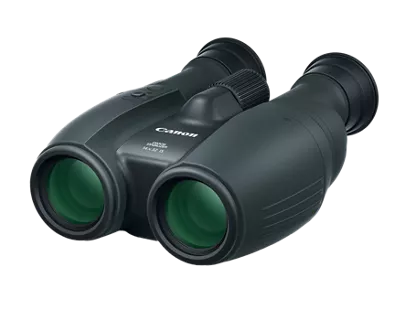
Explore this need in the finder →The discontinued Canon 14 x 32 IS is a high-magnification binocular built around lens-shift Image Stabilization and Canon’s Powered IS mode. Its 14x view is the reach-oriented end of Canon’s documented 32 mm IS family, but it is not a broad-scene or lightweight choice. Canon marks the exact U.S. model discontinued and no longer available, so this page is for identification and comparison rather than a current purchase recommendation.
More reach, a tighter real scene
Canon lists 14x magnification, 32 mm objectives, a 4.3-degree real field and a 2.3 mm exit pupil. Compare those figures with the 10 x 32 IS: it gives up four powers of magnification but opens the real field to 6 degrees and has a 3.2 mm exit pupil. The existing 12 x 32 sits between them at 5 degrees and 2.7 mm. This is a useful way to think about the family: 14x enlarges a distant detail more, while the lower-power siblings make it easier to find and follow that detail and show more surrounding context.
Canon’s listed apparent field is 55.5 degrees under its stated ISO 14132-1:2002 method. That does not mean the binocular shows a wide real scene: its 4.3-degree real field is the narrower figure that matters when tracking a moving subject. The high power is better suited to deliberate observation of a distant, relatively stationary target than to quick scanning. Stabilization can reduce hand shake; it cannot stop the target itself from moving.
At 14x, the 2.3 mm exit pupil is a substantial practical constraint. A 32 mm objective does not create a large viewing pupil at this magnification, and the specification is not a promise of a bright low-light image. The 14.5 mm eye-relief figure is also modest enough that glasses wearers should not assume they will see the full field. Try the actual eyecup and eye position if fit is important; a millimeter number cannot predict every face or spectacle frame.
Powered viewing requires a battery routine
The exact Canon page names Lens Shift Image Stabilization and a Powered IS mode controlled by microcomputer. Canon specifies a correction angle of plus or minus one degree. The shared 10x32/12x32/14x32 manual describes a press-and-release activation lasting roughly five minutes and a separate hold-to-operate option. Those are useful operating details, not independent measurements of stabilization quality. A careful hold can help when studying a distant stationary point, but the higher power still makes aiming and subject tracking more exacting than with 10x.
Canon specifies two AA batteries, while its U.S. package list names an alkaline battery without stating a quantity. The box list therefore does not prove that the full two-cell requirement is supplied. The shared Japanese family manual allows AA alkaline or Ni-MH cells and gives approximate battery-life estimates of ten hours at 23°C and two hours at minus 10°C under its conditions; temperature and use can change runtime. It also states that the optical view can be used without power, though the stabilizer cannot. Canon’s English U.S. support listing for the family manual is unavailable, so no English manual controls are assumed.
Body, weather and age are part of the decision
Canon lists 27.3 ounces excluding batteries and dimensions of 5.6 by 6.7 by 3 inches. The 14x32 is not a featherweight alternative to a standard 10x42; the 14x image scale and stabilizer come in a substantial AA-powered body. It is only slightly lighter on paper than the 10x32 and 12x32 siblings, so choose it for reach rather than for a carry advantage.
The exact U.S. product information gives no waterproof rating. The shared family manual cautions against immersion and strong rain or splashing. That means the 14 x 32 should not fill a need where waterproofing is essential. Since Canon calls the model discontinued, a used-unit comparison also needs to account for battery-compartment condition, clean contacts, working stabilization buttons and any service history. The model page is not proof of current stock, warranty coverage or present-day support.
Who should compare it—and what is different
If you are comparing stabilized high power with a smaller current-class option, the Nikon STABILIZED 12x25 S trades two powers and objective diameter for a much lighter listed body and a 4.5-degree real field. It is not a waterproof substitute, and its 25 mm optics change the viewing compromise. If weather sealing matters more than stabilization, a distinct option such as the Vortex Kaibab HD 18x56 has a manufacturer-listed waterproof rating, but it is 18x, heavier and does not provide built-in stabilization. Neither alternative reproduces the Canon 14x32’s exact combination.
This Canon reference is most useful for someone identifying an owned unit or deciding whether 14x reach justifies a tighter field, battery dependence and a heavy hand-held body. A viewer who values a broad real scene should start with the lower-power 10x32 or 12x32 sibling; one who needs rain protection should choose an explicitly rated model instead. The Canon product page and technical sheet support the exact 14x32 figures. Unknown coating details, unlisted weather protection and the unspecified quantity of alkaline cells remain unknown rather than assumed.
Key specifications
Key details at a glance
| Magnification | 14× |
|---|---|
| Objective diameter | 32 mm |
| Real field of view | 4.3° |
| Apparent field of view | 55.5° |
| Eye relief | 14.5 mm |
| Exit pupil | 2.3 mm |
More specifications and setup details
| Close focus distance | 6.6 ft |
|---|---|
| Manufacturer-published weight | 27.3 oz |
| Lens and prism coatings | Canon lists Super Spectra coating and a field-flattener lens; the specification sheet does not state a broader coating recipe. |
| Built-in image stabilization confirmed | Yes |
| Image-stabilization method | Lens-shift optical correction |
| Power source | AA alkaline or NiMH cells |
| Batteries required to power stabilization | Yes |
Use the exact model’s instructions for operating limits, supplied equipment and version differences.
Sources for this review
Sources for this assessment
Choose your optical trade-off first.
Choose viewing purpose first, then magnification, objective size, scene width and any fit, weather or mounting constraint. A direct-Sun requirement is separate: only exact manufacturer-confirmed solar binoculars can pass it.