
On this page
Your needs, this model
Does it fit your priorities?
Does the 10 x 32 provide a broader real scene than Canon’s 12 x 32 and 14 x 32 IS siblings?
Canon lists a 6.0° real field for 10x32, versus 5.0° for the 12x32 and 4.3° for the 14x32. The 10x32 is the broadest scene in the trio, but Canon marks it discontinued and it is not a current match.
Explore this need in the finder →Can this exact Canon 10 x 32 meet an essential waterproof requirement?
No confirmed waterproof rating appears in the exact U.S. information. The shared family manual cautions against immersion and strong rain or splashing, so the essential rating must not be treated as satisfied.
Explore this need in the finder →Does the U.S. package confirm that two AA cells are included for stabilization?
No. The package list says an alkaline battery but gives no quantity; two AA cells are the stated operating requirement. Quantity remains unknown, and the retired model is excluded from current recommendations.
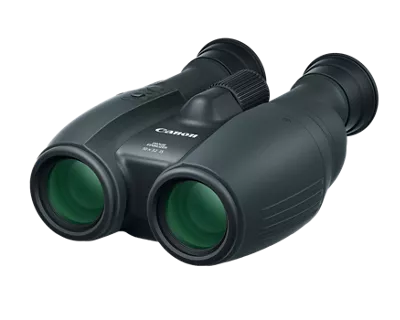
Explore this need in the finder →Canon’s 10 x 32 IS is a discontinued, battery-powered 10x binocular that combines a 6-degree real field with Canon’s lens-shift Image Stabilization and a separate Powered IS mode. Canon’s U.S. refurbished listing identifies the model but also marks it discontinued and no longer available. This is therefore a reference for owners and comparisons, not a current buying recommendation.
The broadest view in this 32 mm stabilized family
At 10x, the 10 x 32 is the easiest of Canon’s documented 10x32, 12x32 and 14x32 group for keeping a moving subject in the scene. Canon lists a 6-degree real field and a 3.2 mm exit pupil. The 12 x 32 narrows the real field to 5 degrees and the 14 x 32 to 4.3 degrees, while the higher powers show a smaller exit pupil. Those are real tradeoffs: lower power makes locating and following birds or players less exact at long range, but leaves more of the scene visible and gives your hands less image movement to control.
The exact U.S. sheet lists a 55.3-degree apparent field under Canon’s stated ISO 14132-1:2002 method; the shared Japanese family table lists 55.5 degrees. I follow the exact-model U.S. sheet and do not average the figures. Both are below the questionnaire’s wide-apparent threshold. Apparent angle is not how wide a landscape appears in real degrees; for that, the 6-degree real field is the useful comparison. The listed 14.5 mm eye relief also does not guarantee a full view through any particular glasses. Eyecup position and eye placement matter, so treat the number as a screening aid rather than a fit promise.
Stabilization is the point, but it is not weightless
Canon identifies lens-shift Image Stabilization and Powered IS on the exact product information. The shared 10x32/12x32/14x32 manual explains two operating styles: a press-and-release activation that runs for roughly five minutes, and a hold-to-operate option. Canon specifies a correction angle of plus or minus one degree; that is a manufacturer figure, not a guarantee that every stance or motion will be fully corrected. Stabilization helps control hand shake when you are watching a distant, relatively stationary subject. It does not freeze a bird’s wingbeat or make panning through a fast-moving event effortless.
The instrument requires two AA cells. Canon’s package list names an alkaline battery but does not say how many, so do not assume the box contains the full operating requirement. The shared manual allows AA alkaline or Ni-MH cells and describes estimated runtimes of about ten hours at 23°C and two hours at minus 10°C under its stated conditions. Actual duration changes with temperature, batteries and use. The manual also says the optical view remains usable without power, but stabilization does not.
At 27.5 ounces before batteries, this is not a light pocket binocular merely because the objectives are 32 mm. Its dimensions are 5.6 by 6.7 by 3 inches, and the listed weight is close to the 12 x 32 sibling. The distinction is the lower magnification and broader real field, not a meaningful carry-weight reduction.
Weather and older-unit condition matter
Canon’s exact U.S. information does not publish a waterproof rating for this model. The shared family manual warns against immersion and strong rain or splashing, so it should not be chosen for a use where waterproofing is essential. Keep the battery compartment dry and plan to inspect an older unit for battery leakage, corrosion, damaged seals and stabilizer function. The manual is useful for the family controls, but Canon’s U.S. support page says its English shared instructions are unavailable; it is not evidence of a current service promise.
How it compares with realistic alternatives
For a current-class 10x stabilizer in a smaller carry package, compare the Nikon STABILIZED 10x25 S. Its 25 mm objectives and lower listed weight change the light and handling tradeoffs; it is not the same 32 mm platform, and it also should not be treated as waterproof. The discontinued Canon 10 x 30 IS II is another historical comparison: it is also 10x and lists a 6-degree real field, but the smaller objective class and lower body weight make it a different carry choice. Neither old Canon reference is a current offer.
The 10 x 32 IS makes the most sense to study if you already own one or are comparing used Canon stabilized models and value the family’s widest real scene more than extra reach. Skip it as a current recommendation, and do not treat the 32 mm objective as a weather rating or a promise of low-light performance. The decision points are magnification, field width, AA upkeep, eye relief and confirmed protection. Canon’s source pages establish the model and specifications; the available family manual adds operating and care context, while the unavailable English file and unreported weather rating remain limitations.
Key specifications
Key details at a glance
| Magnification | 10× |
|---|---|
| Objective diameter | 32 mm |
| Real field of view | 6° |
| Apparent field of view | 55.3° |
| Eye relief | 14.5 mm |
| Exit pupil | 3.2 mm |
More specifications and setup details
| Close focus distance | 6.6 ft |
|---|---|
| Manufacturer-published weight | 27.5 oz |
| Lens and prism coatings | Canon lists Super Spectra coating and a field-flattener lens; the specification sheet does not state a broader coating recipe. |
| Built-in image stabilization confirmed | Yes |
| Image-stabilization method | Lens-shift optical correction |
| Power source | AA alkaline or NiMH cells |
| Batteries required to power stabilization | Yes |
Use the exact model’s instructions for operating limits, supplied equipment and version differences.
Sources for this review
Sources for this assessment
Choose your optical trade-off first.
Choose viewing purpose first, then magnification, objective size, scene width and any fit, weather or mounting constraint. A direct-Sun requirement is separate: only exact manufacturer-confirmed solar binoculars can pass it.