
On this page
Your needs, this model
Does it fit your priorities?
Does the Canon 10x30 IS II show a broader real scene than the 12x36 IS III?
Canon lists 6° real field for 10x30 and 5° for 12x36. The 10x30 also weighs 60 g less before batteries and focuses closer; both have a 3 mm exit pupil and AA-powered vari-angle-prism IS.
Explore this need in the finder →Can its exact page prove waterproofing when weather protection is essential?
No. Canon does not provide a waterproof rating for this exact 10x30 page; unknown weather protection must not satisfy an essential waterproof requirement.
Explore this need in the finder →Will the discontinued 10x30 IS II be recommended as a current Canon offer?
No. Canon shows residual stock language but also says discontinued and no longer available, so this is a reference profile outside buying matches.
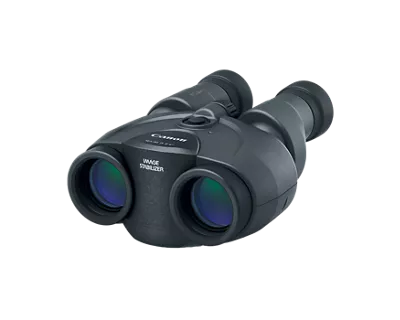
Explore this need in the finder →The Canon 10 x 30 IS II is a compact-format binocular whose 10x view is steadied by built-in optical Image Stabilization. Its 6-degree real field is relatively open for a 10x model, while a 3 mm exit pupil and 30 mm objectives keep it smaller than a full-size 42 mm glass. Canon lists the body at 600 g before batteries. The exact U.S. page now says discontinued and no longer available, so this is an identification and comparison reference, not a current buying recommendation.
Ten power with a genuinely useful field
Canon specifies 10x magnification, 30 mm objectives and a 6-degree real field. The 55.3-degree apparent-field figure uses Canon’s stated ISO calculation method; for following something that moves across a scene, the real field is the more direct comparison. Six degrees is broader than the 5-degree field Canon lists for the 12 x 36 IS III. The 10x30 therefore asks for a little less precise pointing and shows more of the surroundings at once, while the sibling’s 12x view makes a distant subject look larger. This is a difference in framing and reach, not evidence that either resolves more detail.
The 3 mm exit pupil follows from the 30 mm objective divided by 10x power. That number helps set expectations: the 10x30 does not have the relaxed low-light margin of a larger-objective 8x or 10x binocular. Stabilization can calm hand tremor, but it does not increase the light collected by the objective or turn a 30 mm instrument into a dusk specialist. In brighter conditions it is a sensible compromise for wildlife, birding, sports, concerts and travel when steadier handheld detail matters more than a very wide 8x view.
Stabilization is the reason to choose it
Canon identifies optical correction by vari-angle prisms and publishes a correction angle of plus or minus 1.0 degree. That is a manufacturer specification, not a laboratory result or a promise that all motion disappears. Canon presents the model for smooth handheld viewing without needing a tripod. The stabilizer is the main distinction from an ordinary passive 10x30: it can make a high-power view easier to hold on a distant subject, while the moving parts, electronics and batteries add complexity a passive binocular avoids.
The published specification calls for two AA alkaline or NiMH cells. Canon’s in-box list includes an alkaline LR6 battery, but it does not establish a count there, and the shared instruction file is currently unavailable from Canon. Battery life and the exact button or operating modes therefore remain unknown here. The 600 g figure excludes batteries, so the complete powered carry weight is higher. If you need a binocular that is always ready without cells, or a light all-day neck carry, a passive compact deserves serious comparison.
Fit, focus and close subjects
Canon lists 14.5 mm of eye relief, a 55–75 mm interpupillary range and a plus-or-minus 3-diopter correction. Those figures are useful screening information, not a guarantee that every glasses wearer will see the full field; eye placement and the individual’s spectacles matter. The center focus is a manual knob. The listed 4.2 m close-focus distance is more accommodating than the 12 x 36 IS III’s 6 m minimum, but neither is a close-up instrument for insects or flowers just beyond arm’s reach.
The 127 x 150 x 70 mm body uses Canon’s Porro II prism layout. At 600 g before cells it is smaller than many 42 mm binoculars, but it is not a tiny shirt-pocket compact. Its shape and powered system make the most sense when you actually use stabilization; if you mostly scan wide landscapes or track fast birds, an 8x model’s broader framing may be easier. Canon does not state a waterproof rating on the inspected exact page, so do not treat it as suitable for rain or marine use when waterproofing is essential.
How it compares—and what its status changes
Against the Canon 12 x 36 IS III, the 10 x 30 is lighter by 60 g before batteries, offers a 6-degree rather than 5-degree real field, and focuses closer. The 12 x 36 provides 12x magnification and a 36 mm objective, but its exit pupil is still 3 mm; the larger objective is paired with more power rather than a larger exit pupil. Canon lists a plus-or-minus 0.8-degree correction angle for that model versus plus-or-minus 1.0 degree here. Those correction-angle figures do not rank stabilization quality or prove a practical winner. Choose by the view, handling and verified operating needs—not by treating the number as a score.
For a current purchase, the decisive fact is lifecycle: Canon’s page shows residual stock language alongside “Discontinued” and says the product is no longer available. The explicit lifecycle notice wins; this page is not a signal to buy a remaining listing. If built-in stabilization is non-negotiable, compare currently supported stabilized models, checking each exact model’s objective size, field, weather rating and battery needs. If stabilization is optional, a current passive 8x or 10x model may be simpler and can be chosen around a wider field, larger objective or waterproof requirement.
This assessment uses Canon’s exact U.S. product and support pages and its published specifications. It does not claim hands-on testing, owned-product experience, measured image quality or a current price. The matching profile keeps unknown weather protection and unavailable manual details out of essential recommendations. The Canon 10 x 30 IS II is useful to recognize as a 10x stabilized 30 mm design; its discontinued status is the practical reason to keep it in a reference library rather than a buying shortlist.
Key specifications
Key details at a glance
| Magnification | 10× |
|---|---|
| Objective diameter | 30 mm |
| Real field of view | 6° |
| Apparent field of view | 55.3° |
| Eye relief | 14.5 mm |
| Exit pupil | 3 mm |
More specifications and setup details
| Close focus distance | 13.78 ft |
|---|---|
| Manufacturer-published weight | 21.16 oz |
| Lens and prism coatings | The exact inspected Canon pages do not identify objective or prism coatings; none are inferred. |
| Built-in image stabilization confirmed | Yes |
| Image-stabilization method | Optical correction by vari-angle prisms |
| Power source | 2 AA alkaline or NiMH |
| Batteries required to power stabilization | Yes |
Use the exact model’s instructions for operating limits, supplied equipment and version differences.
Sources for this review
Sources for this assessment
Choose your optical trade-off first.
Choose viewing purpose first, then magnification, objective size, scene width and any fit, weather or mounting constraint. A direct-Sun requirement is separate: only exact manufacturer-confirmed solar binoculars can pass it.