
On this page
Your needs, this model
Does it fit your priorities?
Is fixed 10x42 the arrangement you want for added distant-target scale?
The U.S. product ID BU-R5-1042 and shared R5-1042 manual row confirm the exact fixed 10x42 optical configuration.
Explore this need in the finder →Can you accept a separate adapter rather than an included tripod mount?
The R5 guide confirms tripod adaptation but requires a separate compatible 90-degree adapter, so adapter-in-box is not satisfied.
Explore this need in the finder →Will you use the R5 10x42 without imposing an eye-relief minimum?
The exact U.S. page lists 17.5 mm, but the shared R5 guide row lists 15 mm. The conflict leaves eye_relief_mm unknown for hard matching: without a numeric floor the confirmed fixed 10x42 remains eligible; any essential minimum must exclude it until Bushnell clarifies the specification. A number alone also cannot guarantee glasses fit.
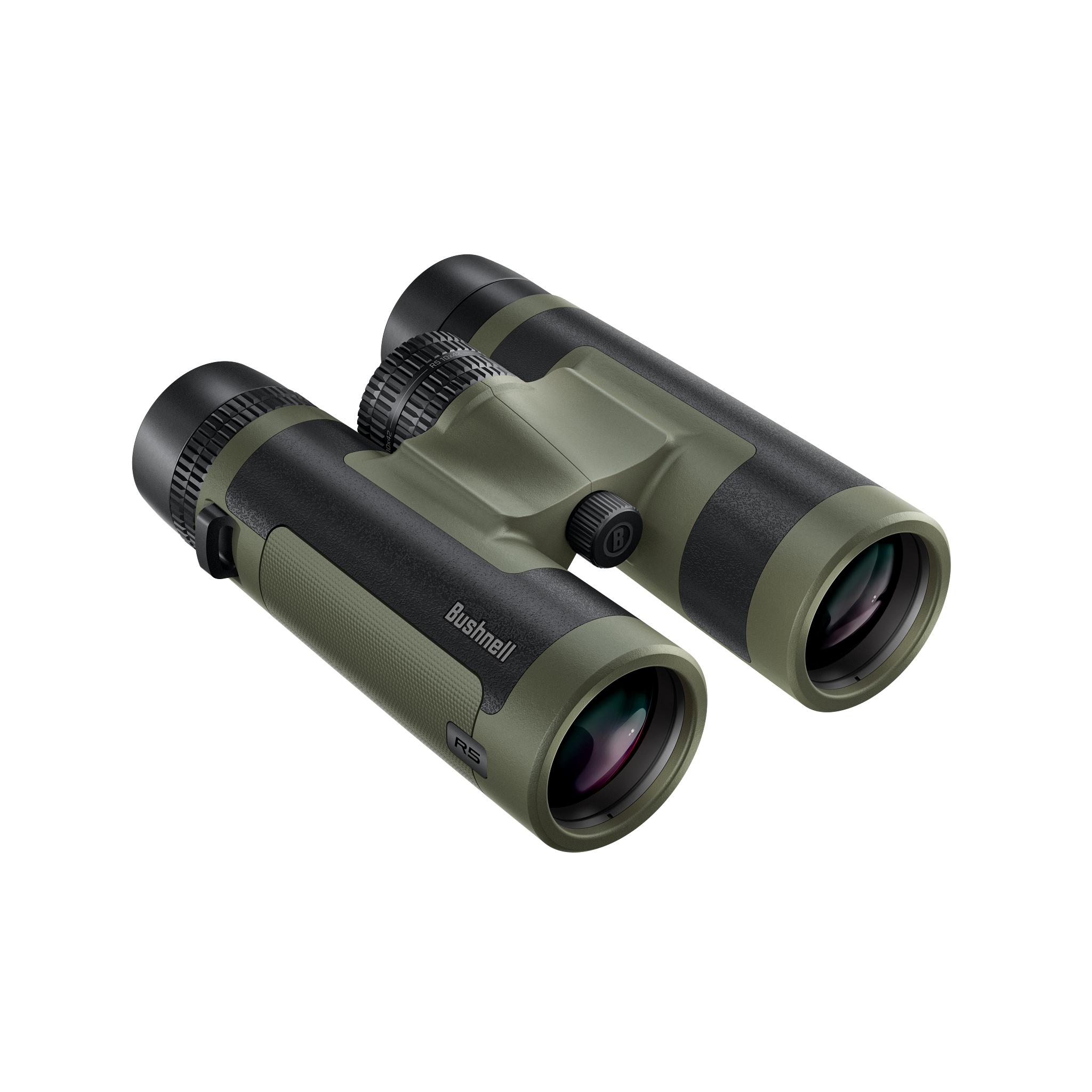
Explore this need in the finder →The Bushnell R5 10x42 is the middle-power configuration in the current R5 binocular family. Its exact U.S. product page identifies model BU-R5-1042, and the shared owner guide uses R5-1042. Ten-power gives a more enlarged view than the 8x42 sibling without moving to the larger 12x50 format, but the manufacturer’s live page conflicts with the manual on several important numbers. This is a source-based assessment, not a hands-on test.
Extra scale, with more demands on a steady hold
At 10x, a distant animal or bird occupies more of the view than it does at 8x when the observer is in the same position. That can help when you are glassing a far ridgeline, field edge or open hillside and need to inspect detail rather than search a close, cluttered scene. The trade is narrower scene coverage and greater sensitivity to hand movement. A tripod or support becomes more useful for long stationary sessions, but it adds a separate adapter and changes the quick-handheld character of binocular viewing.
The owner guide lists a 325-foot field at 1,000 yards for the R5-1042. The current product page instead repeats 390 feet, the same figure it gives the R5 8x42. Because these manufacturer sources disagree so substantially, neither field value is used as a strict threshold. The manual’s comparison still indicates the intended distinction from 8x, but anyone who requires a minimum field width should resolve the discrepancy with Bushnell or test the exact instrument before purchase.
Eye relief and carry mass are also unresolved
The live product page lists 17.5 mm eye relief and 24.7 ounces. The 09-25 guide’s table gives 15 mm and 24.9 ounces. Both figures are preserved; the matcher treats the disputed 10x42 eye-relief and mass values as unknown. That is especially important if glasses are essential: the product page number is not enough to confirm the longer value when the manual lists less. Bushnell’s guide advises wearing glasses with the eyecups down, setting the interpupillary spacing until the circles merge, then checking the view for shadowing. The guide’s stated IPD range is 56–72 mm. Personal fit still matters more than a number alone.
There is another internal mismatch: the current page lists a 5.3 mm exit pupil, while 10x42 geometry points to about 4.2 mm. The owner guide does not list that field separately. I do not use 5.3 mm as a confirmed 10x specification. The page’s detail block also says “390 ft @ 1000 yds” twice, reinforcing why the manual and product-page details should not be merged uncritically.
Construction, weather and care
Bushnell describes a roof-prism binocular with BaK-4 glass, fully multicoated optics, Phase 3 and dielectric prism coatings, EXO Barrier, and IPX7 water resistance. The owner guide explains that the coatings are intended to improve light transmission, contrast and prism reflectivity; that is manufacturer description rather than an independent brightness or resolution measurement. EXO Barrier is described as repelling water, oil, dust and debris at the lens surface, not as scratch protection. The guide warns against immersion deeper than one meter or longer than 30 minutes, even though IPX7 is listed.
Do not rely on the current product page to identify its fill gas. Its feature copy says nitrogen purging while the specification block says argon gas purged. The maker’s own presentation is inconsistent, so gas type remains unknown. The page does describe fogproof construction. Lens care in the guide is practical: blow away grit or use a soft lens brush first, clean with a microfiber cloth or suitable lens tissue, and keep household window cleaner and rough paper away from coated optics.
Setup and mounting are straightforward but not included extras
The shared manual lists a Vault LITE binocular pack with harness, comfort neck strap, lens cloth, and objective and eyepiece covers. Set the eyecups and hinge position, focus the left side with the central wheel, then adjust the right-side diopter independently. The instructions caution against forcing the diopter mechanism. A covered 1/4-20 socket allows tripod adaptation; Bushnell gives its #161002CM 90-degree binocular adapter as an example. Neither that adapter nor the tripod appears in the standard kit. Confirm you are comfortable with this separate-purchase setup if you plan to glass from a fixed position.
Who should consider the R5 10x42?
It is a reasonable format to investigate if you value more target scale than 8x, want a still-compact 42 mm objective class, and can tolerate more visible hand shake. Favor the R5 8x42 for wider-scene searching or if you want the manual’s longer 17.5 mm eye relief confirmed on paper. Consider the 12x50 only if distant open-terrain observation is worth more bulk and a steadier support plan. If exact field width, weight or glasses clearance is a hard requirement, the current source conflict means this particular R5 needs manufacturer clarification rather than an assumed match. Ordinary binoculars must never be aimed at the Sun.
Sources: Bushnell’s R5 10x42 U.S. product page, the R5 binoculars collection, and the R5 owner guide, revision 09-25 (English pages 1–6). The selected exact page-linked image visually appears rendered; manufacturer creation method and republication permission are not stated.
Key specifications
Key details at a glance
| Magnification | 10× |
|---|---|
| Objective diameter | 42 mm |
| Close focus distance | 8 ft |
| ED glass confirmed for this exact model | No |
| Phase coatings confirmed | Yes |
| Locking diopter ring confirmed | No |
More specifications and setup details
| Water and fog protection | The page lists IPX7; the R5 owner guide advises avoiding immersion beyond 1 m or longer than 30 minutes. This is not an underwater-use rating. |
|---|---|
| Tripod use | The R5 guide describes a covered direct 1/4-20 socket and a separate compatible 90-degree adapter (Bushnell #161002CM is an example). Neither the adapter nor tripod is listed in the standard kit. |
| Published weight note | Exact page: 24.7 oz; R5 09-25 manual: 24.9 oz. Hard weight remains null; no independent weighing. |
| Manufacturer-rated waterproof | Yes |
| Built-in image stabilization confirmed | No |
| Integrated laser rangefinder | No |
| Onboard ballistic solution display | No |
| Tripod adapter in package | No |
| Direct 1/4-20 tripod thread confirmed | Yes |
Use the exact model’s instructions for operating limits, supplied equipment and version differences.
Sources for this review
Sources for this assessment
Choose your optical trade-off first.
Choose viewing purpose first, then magnification, objective size, scene width and any fit, weather or mounting constraint. A direct-Sun requirement is separate: only exact manufacturer-confirmed solar binoculars can pass it.