
On this page
Bushnell's exact SHOT-CALL MRAD configuration
The Match Pro ED 15x56 is the exact SHOT-CALL MRAD choice, with the scale in the right barrel, separate reticle focus and a leveling control. Its 52 oz instrument weight, 236 ft per 1,000 yd field and separate tripod-adapter setup matter alongside the specialized pattern; it has no laser distance readout.
Explore the needs this model fits
Your needs, this model
Does it fit your priorities?
Do you need this exact 15x56 configuration for a target that benefits from a manual reticle?
Bushnell identifies the Match Pro ED at fixed 15x with 56 mm objectives and a SHOT-CALL MRAD reticle. The reticle is an optical reference, not an automatic range or trajectory reading.
Explore this need in the finder →Can you support the 52 oz instrument and accept a separate tripod adapter instead of treating the included BridgeSet as a tripod mount?
The exact guide supports a compatible tripod adapter, identifies the BridgeSet as the included IPD stabilizer, and does not confirm a tripod adapter in the package.
Explore this need in the finder →Does the published 18.5 mm eye relief meet your minimum for this 15x56 target view?
The exact page and model-specific owner guide both publish 18.5 mm eye relief; individual eyeglass fit still depends on seeing the full field through your own glasses.
Explore this need in the finder →The Bushnell Match Pro ED 15x56 (U.S. product ID BU-BMP1556G; owner-guide SKU BMP1556G) is a specialist high-power binocular with a right-barrel SHOT-CALL MRAD reticle. That reticle is the reason to consider this configuration: it gives a precision observer a visible angular scale for estimating target size or range when the target's dimensions are known. If you only want an uncluttered view of birds, scenery or stars, a conventional binocular is a simpler fit.
A high-power view built around the reticle
This is fixed 15x magnification with 56 mm objectives, a published 3.8 mm exit pupil and a 236-foot field at 1,000 yards. That field is relatively narrow, so locating a moving subject takes more deliberate aiming than with a wider 8x or 10x pair. Fifteen-power magnifies hand movement too. Bushnell's own guide says a tripod or other suitable support is useful during setup; for extended target observation, plan around a stable mount rather than expecting this nearly 3.25-pound instrument to behave like a walking-around 8x42.
The MRAD scale can help with manual ranging, target sizing and shot correction, but it is not a laser rangefinder. A reticle does not know the real size of the object in view and this model does not publish a digital range readout or ballistic solution. You need the target's actual dimension and the appropriate method for using the angular marks. The reticle sits in the right barrel, so it remains in that half of the image rather than disappearing into a central display. For wildlife or casual sky viewing, decide whether that visible overlay will help or distract before choosing it.
Focus and level are part of setup
The operating guide describes three separate adjustments: the central focus for the scene, an image-calibration diopter for the left barrel, and a reticle-focus diopter for the right barrel. Focus the reticle against a plain background first, calibrate each eye with the prescribed sequence, and then level the reticle against the horizon with its dedicated control. This is not a one-knob setup, but the adjustments let the target image and the MRAD scale be brought into focus independently. The published eye relief is 18.5 mm; it is a specification, not a promise that every eyeglass wearer will see the full field comfortably.
The included BridgeSet stabilizer fixes a chosen interpupillary spacing more securely and can attach at either the front or rear bridge lug. It stabilizes the binocular's setting, not the image. The manual also describes attaching a compatible binocular tripod adapter at a bridge lug; the adapter is a separate mounting component, not the BridgeSet. The exact sources do not identify a standard 1/4-20 thread size or a particular adapter model for this configuration, so verify physical fit with the support you intend to use.
What the specifications do—and do not—settle
Bushnell lists ED Prime objective glass, Abbe-Koenig prisms, BaK-4 prism glass, fully multi-coated optics, Ultra Wide Band coating, PC3 phase treatment and EXO Barrier. The exact specification table separately says dielectric prism coating is absent; do not turn the PC3 phase label into a claim of a dielectric prism coating. These are construction details, not independent evidence of resolution, color accuracy or low-light performance. The 13-foot close-focus distance also makes this a poor choice for nearby subjects.
The manual describes IPX5 water exposure protection and dry-nitrogen fog protection. Treat that as protection for outdoor use in rain, not permission to submerge the binocular. It warns against looking at the Sun through any optical instrument. The guide names the BridgeSet as included and says a neck strap is not included; it does not establish a tripod adapter as part of the package. The listed 52-ounce instrument weight excludes any support hardware you add.
Who should choose it?
Consider the Match Pro ED when you specifically need the SHOT-CALL MRAD reticle alongside a 15x56 view for precision or long-range target observation, and are willing to spend time leveling and focusing that reticle. If you need only magnification and a steady distant view, compare a conventional 15x56 such as the Bushnell R7 15x56; if you need a lighter general-use pair, look at a 10x42 instead. This is not the right pick for electronic distance measurement, automatic trajectory calculation, wide-field tracking or long walks where weight matters. No independent optical, range-estimation or field test is claimed here; the useful decision is whether the manual reticle and mounting workflow match the way you actually observe.
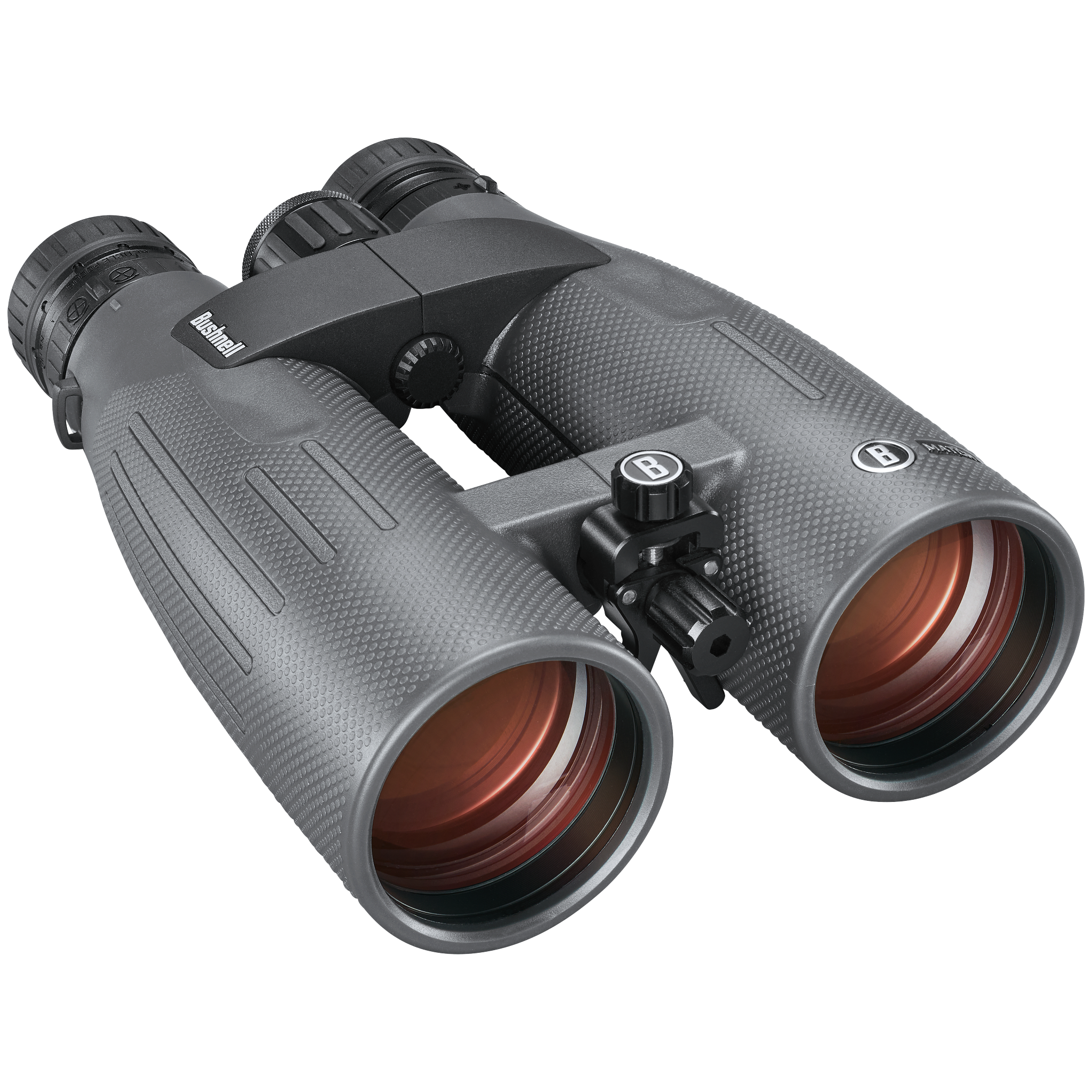
Manufacturer references: the exact Match Pro ED 15x56 product page (U.S. ID BU-BMP1556G) and the Match Pro ED owner’s guide, cover and English pages 3–7. The exact page-linked product image is visually recognizable as the gray Match Pro body and BridgeSet assembly; Bushnell does not state whether it is a photograph or rendering, and republication permission is not established.
Key specifications
Key details at a glance
| Magnification | 15× |
|---|---|
| Objective diameter | 56 mm |
| Field width at 1,000 m | 78.7 m |
| Eye relief | 18.5 mm |
| Exit pupil | 3.8 mm |
| Close focus distance | 13 ft |
More specifications and setup details
| Manufacturer-published weight | 52 oz |
|---|---|
| ED glass confirmed for this exact model | Yes |
| Phase coatings confirmed | Yes |
| Lens and prism coatings | The exact page lists ED Prime, fully multi-coated optics, Ultra Wide Band, PC3 phase treatment and EXO Barrier. Its specification table separately reports dielectric phase coating yes and dielectric prism coating no; those are not treated as interchangeable labels. |
| Water and fog protection | The manufacturer calls the model IPX5 water resistant/waterproof and says the body is tested for IPX5 water exposure. Treat this as weather protection, not permission to submerge it. Dry nitrogen purging is identified for fog resistance. |
| Tripod use | The exact manufacturer page identifies the BridgeSet as the included tool; the owner guide describes use of a compatible tripod adapter at either bridge lug. The sources do not establish an exact adapter model, thread standard, or whether one is included in the package. Do not treat the BridgeSet as the tripod adapter. |
| Published weight note | Bushnell's exact product page and BMP1556G owner-guide table both list 52 oz / 1,474 g. This is manufacturer-listed instrument weight, not an independent measurement or a packed-system weight. |
| Manufacturer-rated waterproof | Yes |
| Built-in image stabilization confirmed | No |
| Integrated laser rangefinder | No |
| Onboard ballistic solution display | No |
| Optical ranging-reticle format | SHOT-CALL MRAD |
Use the exact model’s instructions for operating limits, supplied equipment and version differences.
Sources for this review
Sources for this assessment
Choose your optical trade-off first.
Choose viewing purpose first, then magnification, objective size, scene width and any fit, weather or mounting constraint. A direct-Sun requirement is separate: only exact manufacturer-confirmed solar binoculars can pass it.
Your needs, this model
Binoculars with manual known-size ranging reticles
Choose it when: Choose this exact BMP1556G when the SHOT-CALL MRAD layout itself is essential. The right-barrel reticle can be independently focused and leveled, and the included BridgeSet is an IPD stabilizer—not a laser or a confirmed tripod adapter.
Binoculars with manual known-size ranging reticles →Binoculars with Bushnell's SHOT-CALL MRAD reticle
Choose it when: This is the exact BMP1556G configuration documented with Bushnell's SHOT-CALL MRAD layout. The owner guide covers focusing the reticle separately from the image; Bushnell's page describes a rotating, levelable reticle and the included BridgeSet IPD stabilizer.
Binoculars with Bushnell's SHOT-CALL MRAD reticle →