Binoculars · Choose by your needs
Binoculars with Bushnell's SHOT-CALL MRAD reticle
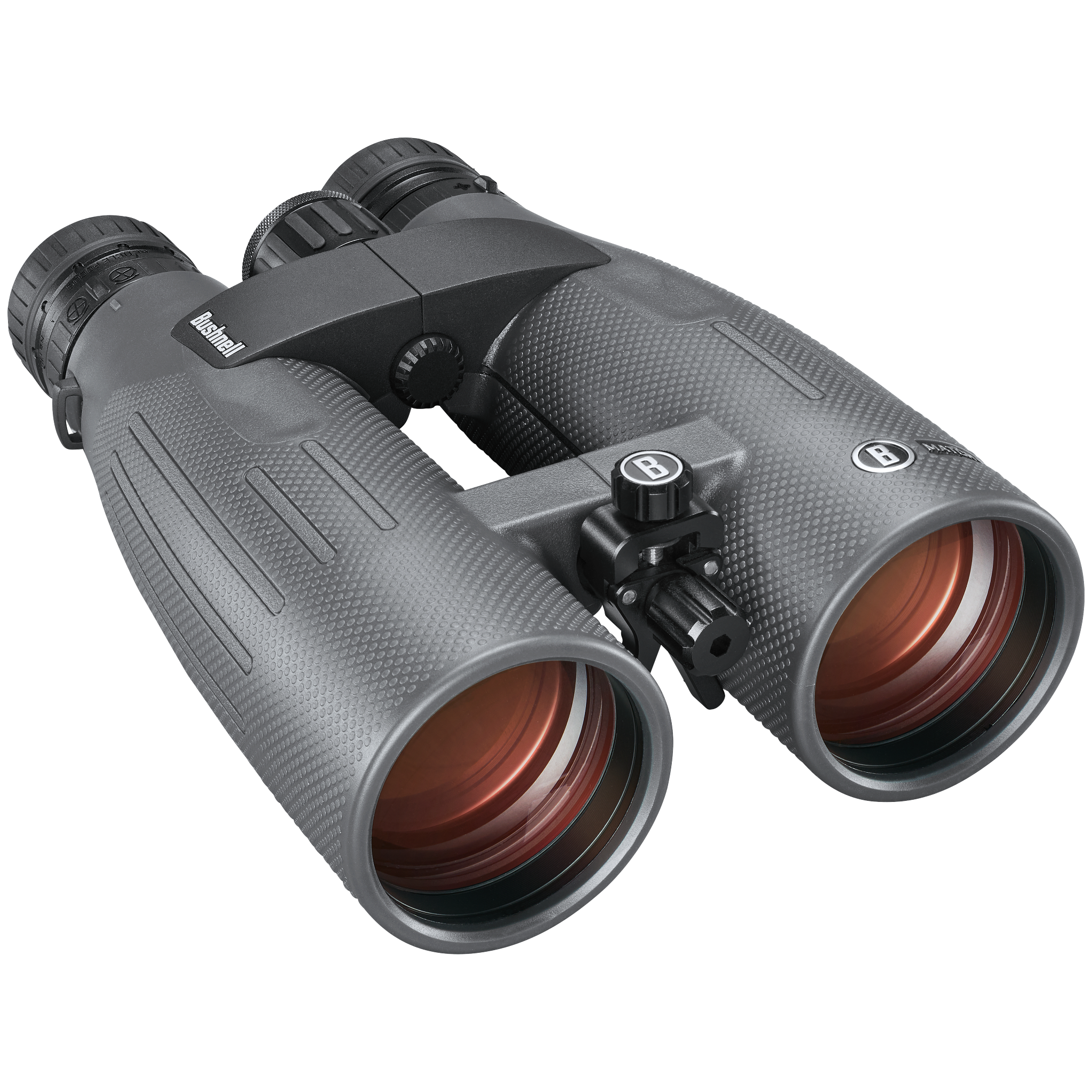
If the Bushnell SHOT-CALL MRAD layout itself is essential, the documented match is the Bushnell Match Pro ED 15x56 (BMP1556G). It is fixed 15x56 with a right-barrel reticle, separate reticle focus and leveling control, and a 236 ft field at 1,000 yd; listed instrument mass is 52 oz. Its included BridgeSet steadies the interpupillary setting, not a tripod, and the model does not provide laser distance or an onboard ballistic solution.
- SHOT-CALL MRAD is an exact reticle layout requirement; another mrad scale is not proof of the same pattern.
- The scale is optical and manual. A known target dimension and a steady view are necessary for useful manual estimates; there is no integrated laser distance readout.
- The exact owner guide describes reticle focus and leveling controls. Allow time to set them, and do not mistake the included BridgeSet IPD stabilizer for a tripod adapter.
- The listed 52 oz is the instrument weight; a compatible tripod adapter, if needed, is a separate setup item whose inclusion is not confirmed.
Comparison updated 29 October 2026.
Why the named layout changes the answer
The exact SHOT-CALL requirement selects the Match Pro ED, not every binocular with an MRAD- or mrad-labelled reticle. The Vortex Ranger HD R/T has its own mrad scale and four silhouette aids, but its layout is not Bushnell's SHOT-CALL pattern. If the existing callouts, diagram or team procedure specify SHOT-CALL, keep that exact condition; do not replace it with a product that merely uses a related angular unit.
Budget for focus, level and support separately
The manual describes separate right-barrel reticle focus and a leveling control. Bushnell lists the included BridgeSet as an IPD stabilizer; the owner guide also describes attaching a compatible tripod adapter, but does not establish that a particular adapter is included. Confirm the mounting hardware for your intended support before relying on a fixed 15x view for sustained use.
Keep manual ranging separate from electronic output
The reticle provides an optical angular scale, not a laser distance reading. It also is not a profile-based wind/drop display. If you need an integrated laser or a ballistic output, use the rangefinder and ballistic answers separately; the model's SHOT-CALL reticle does not establish those electronic features.
When to choose something else
- Vortex Ranger HD R/T 10x50: The exact Vortex R/T model has a manual mrad ranging reticle and silhouette aid, but the required Bushnell SHOT-CALL MRAD layout is not confirmed for it.
Questions that change the choice
Is the included BridgeSet a tripod adapter?
No. Bushnell identifies the BridgeSet as an IPD stabilizer. The owner guide describes a compatible tripod adapter, but the exact package record does not confirm an adapter is included.
Does the SHOT-CALL reticle calculate a range or ballistic hold?
No. It is a manual optical scale. It does not provide a laser measurement or onboard profile-based wind/drop solution.
Sources for the comparison