
On this page
Your needs, this model
Does it fit your priorities?
Does the fixed 10x42 configuration meet a 10x viewing need?
Yes. Athlon identifies the exact product as fixed 10x42; a request for 8x does not match this configuration.
Explore this need in the finder →Does the 21-ounce listed instrument weight meet a 22-ounce maximum?
Yes for the binocular itself. A 20-ounce maximum is below the exact published weight.
Explore this need in the finder →Does its 13.1-foot closest-focus claim meet a 14-foot maximum?
Yes at the manufacturer-published 13.1 ft; a 13-foot maximum is stricter and rejects it.
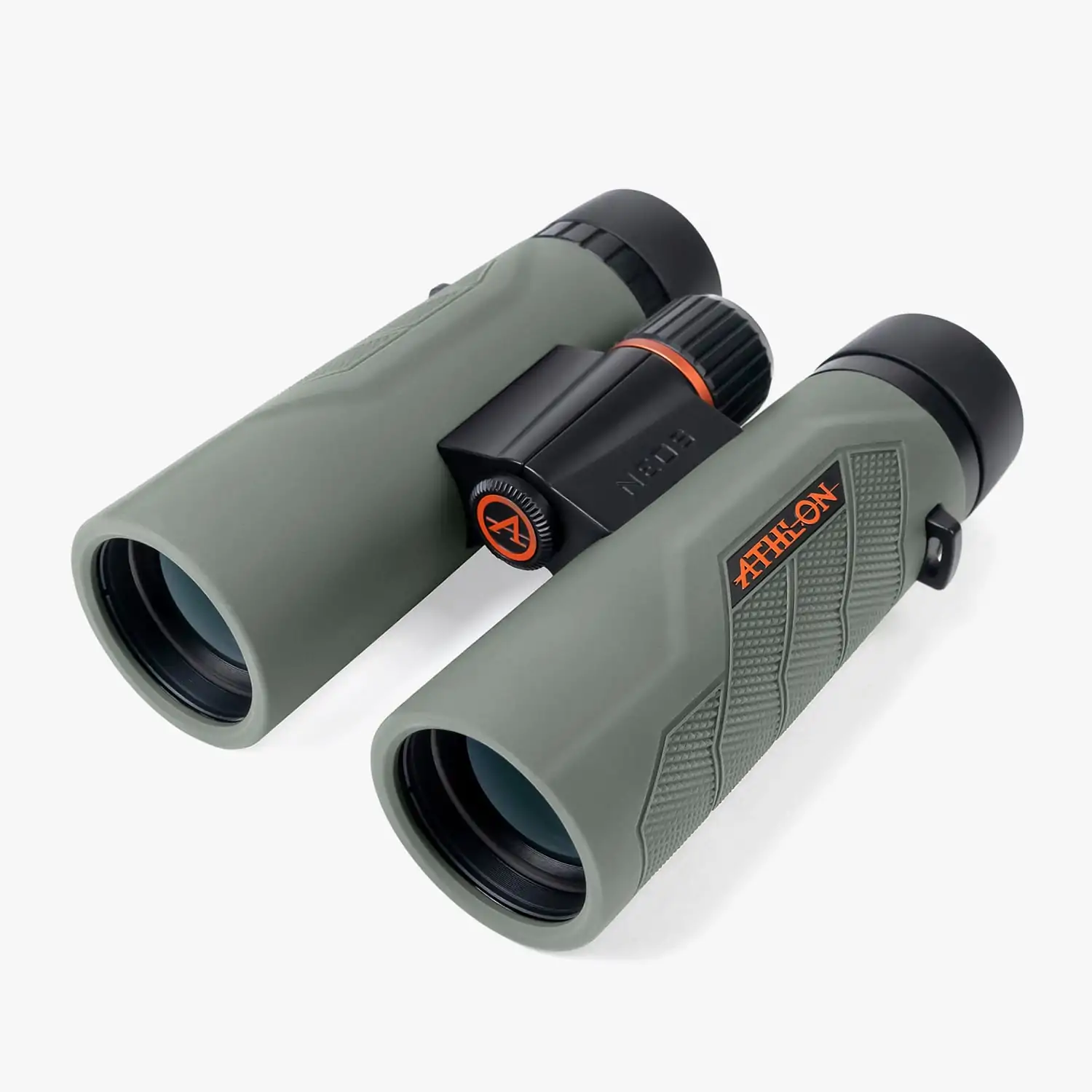
Explore this need in the finder →The Athlon Neos G2 HD 10x42 is the reach-oriented option in the two-model Neos G2 HD 42 mm pair. Athlon lists a fixed 10x power, a 5.9-degree real field (309 feet at 1,000 yards), and a 21-ounce instrument weight. The 8x42 companion shows a wider 367-foot scene at the same stated weight. Choose this model when extra subject enlargement is useful enough to accept less framing room; do not expect the larger number to make locating fast-moving targets easier.
What changes when you move from 8x to 10x
The Neos 10x42 magnifies a distant subject more than the 8x42, which can help when you are watching a perched bird, scanning a ridge or trying to inspect detail without walking closer. The trade is visible in Athlon’s field figures: 309 feet at 1,000 yards and 5.9 degrees for this model, against 367 feet and 7 degrees for the 8x42. The 10x frame contains less of a moving scene, so a bird that leaves the center can take more effort to reacquire. Higher power also makes hand movement more apparent to many observers; it is worth trying both powers from the way you normally hold binoculars rather than assuming 10x will feel better just because it enlarges more.
The two Neos variants otherwise share the same 42 mm objective size, 21-ounce listed instrument mass, 5.9-by-4.9-inch manufacturer dimensions and 13.1-foot closest-focus claim. The 10x is not a bigger or heavier configuration within this pair. If you alternate between nearby feeder birds and distant wildlife, neither is a close-focus specialist; the published 13.1 feet is too far for very near subjects. If your priorities include a wide real field, the 8x42 is the more forgiving choice. If you tend to observe stationary or slow-moving distant subjects, this 10x42 is the more deliberate detail-oriented option.
Do not make an eyeglass decision from the conflicting number
The eye-relief figures for the exact Neos 10x42 do not agree. Athlon’s product page and family category list 14.1 mm; its 10x42 specification sheet says 16.1 mm. Since a few millimeters can matter when an eyeglass wearer is trying to see the full field, we do not use either figure as a confirmed numeric threshold. The manual says the eyecups can be twisted down for glasses and left at intermediate positions if that works better, but that instruction cannot tell you which published eye-relief figure governs or guarantee fit with your own frames. If eyewear compatibility is essential, test this exact model with your glasses before relying on the 10x42 selection.
Athlon lists a 56–72 mm interpupillary-distance range. Set the barrels until the two circles become a single full image without shaded edges; that adjustment is separate from eye relief. The product page gives overall size as 5.9 by 4.9 inches, and the product sheet labels those dimensions height and width without supplying every axis. Treat them as a rough body size, not a complete case or carry-system measurement. The 21-ounce published weight is the binocular itself; the manufacturer does not provide a complete boxed-accessory list in the pages reviewed here.
Weather claims and practical controls
The Neos G2 HD page describes a composite chassis with O-ring seals and nitrogen purging, and identifies rubber armor, fully multi-coated optics and BaK-4 prisms. Athlon calls the line waterproof and fog-proof. No IP rating or immersion depth and duration appear in the consulted page and sheet, so do not convert the brand’s wording into an underwater-use specification. The product is labeled HD, but the exact documentation does not establish a separate ED-glass designation or a measured comparison with other binoculars. Coating and prism terms describe construction; they cannot substitute for a side-by-side performance test.
Focus is conventional: the central wheel handles both sides after you set the diopter. Athlon’s manual recommends starting with the right-side diopter at zero, focusing a detailed distant object with the center wheel while covering the right objective, then tuning the right diopter while looking at the same object. That one-time setup can reduce the need to refocus each eye during ordinary use. Twist-up eyecups help place the eyes at the right distance, and the manual also covers neck-strap routing.
A standard 1/4-20 tripod-adapter socket sits beneath the Athlon logo plate on the center hinge. A compatible adapter is required for tripod mounting; it is not established as a box inclusion. If you use a tripod for long stationary sessions, this is a supported option, but the 10x42 remains usable hand-held when that suits your outing. The manual recommends removing grit before cleaning and warns against wiping lenses with rough or dirty material. It also says not to look directly at the Sun through these ordinary binoculars.
Best fit and alternatives
Choose the Neos G2 HD 10x42 if your common viewing distance is long enough for extra fixed power to help, most subjects move slowly, and a narrower real field is an acceptable trade. It keeps the pair’s 42 mm objectives and 21-ounce published instrument weight rather than adding mass over the 8x. Choose the 8x42 instead if quick scene acquisition, tracking movement and the broader published real field matter more than enlargement. Neither Neos configuration supplies an uncontested eye-relief number, a published waterproof immersion rating, or an established close-focus advantage. Those are not cosmetic footnotes if your fit or environment requires them; they are reasons to compare another exact model before buying.
Manufacturer references: Neos G2 HD 10x42 product page, 10x42 specification sheet, and Neos G2 HD binocular manual.
Key specifications
Key details at a glance
| Magnification | 10× |
|---|---|
| Objective diameter | 42 mm |
| Real field of view | 5.9° |
| Field width at 1,000 m | 103 m |
| Close focus distance | 13.1 ft |
| Manufacturer-published weight | 21 oz |
More specifications and setup details
| Lens and prism coatings | The Neos G2 HD exact materials identify BaK-4 prisms and fully multi-coated optics/lenses. The pages do not establish phase or dielectric coatings, a specific ED-glass type, or comparative measured optical performance. |
|---|---|
| Water and fog protection | Athlon describes the composite chassis as O-ring sealed and nitrogen-purged and calls the model waterproof/fog-proof. No standardized IP code, immersion depth/duration or underwater-use condition was found in the exact page/sheet. |
| Tripod use | The family manual confirms a standard 1/4-20 tripod adapter socket. A compatible adapter is required; product page/manual do not establish package inclusion. |
| Published weight note | Instrument weight reported by the exact manufacturer product page and product-specific specification sheet; the separate 2.5 lb package weight is not binocular mass. |
| Manufacturer-rated waterproof | Yes |
| Integrated laser rangefinder | No |
| Onboard ballistic solution display | No |
| Direct 1/4-20 tripod thread confirmed | Yes |
Use the exact model’s instructions for operating limits, supplied equipment and version differences.
Sources for this review
Sources for this assessment
- Athlon U.S. binocular family index
- Athlon Neos G2 HD U.S. category snapshot
- Athlon Neos G2 HD 10x42 exact U.S. product page
- Athlon Neos G2 HD 10x42 product-specific specification sheet
- Athlon Neos G2 HD binocular user manual and care instructions
- Athlon Neos G2 HD 10x42 manufacturer exact-page-linked image
- CPSC public recall-search landing page (targeted Neos G2 HD name queries)

Choose your optical trade-off first.
Choose viewing purpose first, then magnification, objective size, scene width and any fit, weather or mounting constraint. A direct-Sun requirement is separate: only exact manufacturer-confirmed solar binoculars can pass it.